
Event display ads are visual ad units (static image, animated GIF, or HTML5) shown on websites and apps to promote events; they deliver impressions, clicks, and view-through conversions by linking directly to ticket purchase pages.
Event display ads are digital display creatives served through ad networks or programmatic platforms. They use targeting signals—geography, interests, behavioural data, and contextual placement to reach potential attendees. Common formats include leaderboard (728×90), medium rectangle (300×250), wide skyscraper (160×600), and responsive banners. Ads record metrics such as impressions, clicks, click-through rate (CTR), view-through rate (VTR), and conversions tracked via pixels or server-to-server events. Event organisers use conversion windows (typically 7–30 days) to attribute ticket purchases to ad exposure. Real example: an arena concert ran 300×250 and 728×90 creatives and measured conversions via a ticketing platform pixel.
How do event display ads move people from consideration to purchase?
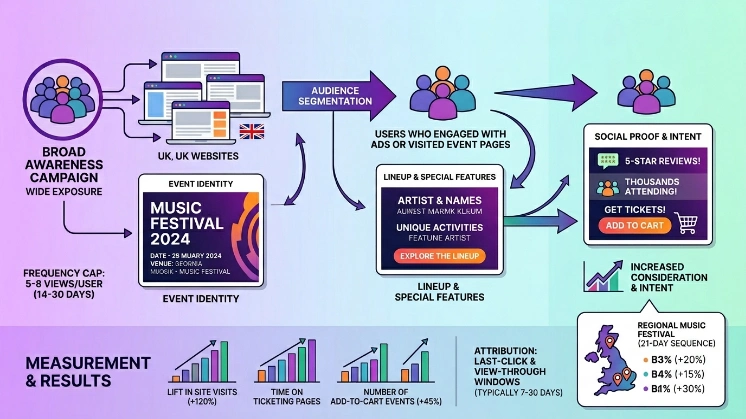
Ads increase purchase likelihood by retargeting engaged users, presenting clear offers, and using conversion-optimised landing pages that reduce friction between interest and checkout.
The conversion path starts when a potential attendee sees an ad, clicks, and lands on an event page. Retargeting captures users who viewed the event page but did not buy and serves ads with reinforcement messaging such as limited-seat alerts or price deadlines. Ads use urgency, exact dates, venue details, and price bands to reduce uncertainty. Measurement ties impressions and clicks to purchase events using first-party or third-party tracking. Example: a theatre used retargeting over seven days with creatives showing seat maps and price tiers; retargeted audiences had a 2.8x higher conversion rate than cold audiences.
What targeting methods improve ticket purchase rates?
Use geographic, behavioral, contextual, and lookalike targeting to focus ads on users most likely to attend and convert.
Geographic targeting restricts delivery to city, postcode, or radius around the venue. Behavioural targeting selects users who recently searched for similar events, attended comparable venues, or engaged with related content. Contextual targeting places ads on pages about music genres, festivals, or local guides. Lookalike targeting uses seed audiences (past buyers) to find users with similar attributes. Combine targeting with frequency caps (3–7 impressions per user per day) to avoid oversaturation. Example: a festival limited delivery to a 50-mile radius and used lookalike audiences from previous years’ ticket buyers.
What creative elements drive conversion on event display ads?
Clear event name, date, venue, ticket price range, CTA button, and high-contrast imagery increase ad clarity and conversion potential.
Creative must communicate the essential facts in one glance: event title, start date, venue, and available ticket types. Use legible fonts, high-resolution images of performers or venue, contrast on the CTA, and a single action per ad (book, reserve, buy). Include pricing cues such as “From £25” or seat category labels. Use seasonal or urgency overlays for time-limited offers, and test static versus animated creatives to measure performance. Example: a comedy show ad that displayed “Sat 12 Sep — Tickets from £18” with a bright “Buy Now” button outperformed a variant without price information by 18% CTR.
How should landing pages be structured to maximise ticket purchases?
Landing pages must present event details, clear ticket options, secure payment flow, and a one-click path from ad to checkout to reduce drop-off.
Landing pages must match ad messaging exactly: same headline, image, and offer. Provide a visible price matrix, seat selection, and explicit delivery options (mobile ticket, print, collection). Minimise steps to checkout; use progressive disclosure for additional information. Display trust signals (secure payment icons, customer support contact, clear refund policy). Implement tracking pixels and server-side conversion events for precise attribution. Example: a venue reduced checkout steps from five to two and saw a 26% increase in completed purchases.
What bidding and attribution strategies improve ROI?
Use CPA or ROAS bidding with event-specific conversion goals and employ a multi-touch attribution model to assign credit across impressions and clicks.
Set conversion goals such as “ticket purchase” with exact revenue values. Use automated bidding strategies—target CPA or target ROAS—when campaign-scale reaches 500+ conversions per week for reliable algorithm learning. For smaller campaigns, use manual CPC with bid adjustments for high-value segments. Choose an attribution window aligned with buying behaviour—7 days for last-click, 30 days for view-through—and implement multi-touch attribution to credit upper-funnel impressions. Example: a promoter applied target ROAS with a 30-day window and increased revenue per ad spend by 35% versus last-click bidding.
How do tracking and privacy changes affect campaign performance?
Implement first-party data collection, server-to-server tracking, and consent-ready pixels to maintain measurement under evolving privacy rules.
Browsers and platforms limit third-party cookies. Use first-party cookies and event-based server-to-server tracking to capture conversions. Collect consent via compliant banners and store consent flags with user identifiers. Use hashed email lists for deterministic match in platforms that support it. Maintain clear data retention policies and document measurement flows for audit. Example: after restricting third-party cookies, an organiser moved the ticketing pixel to server-side implementation and regained 92% of prior conversion attribution accuracy.
What pricing and promotional tactics convert consideration into immediate purchase?
Use limited-time discounts, reserved seating releases, tiered pricing, and explicit scarcity messaging to prompt immediate transactions.
Offer early-bird pricing windows, seat-limited promotions (e.g., “Only 50 balcony seats left”), and bundle offers (two tickets + merchandise). Show remaining seat counts or time-until-offer-expiry on both ad creatives and landing pages. Test discount amounts to find the lowest effective incentive. Example: a theatre offered a 10% discount for purchases within 48 hours of ad exposure; conversion rate rose by 22% for that cohort.
What reporting metrics show whether display ads convert consideration into purchases?
Monitor impressions, unique reach, CTR, cost per click (CPC), view-through conversions, direct conversions, CPA, and revenue per conversion to measure effectiveness.
Impressions and reach show exposure. CTR and CPC measure initial engagement. View-through conversions capture purchases after ad exposure without click. Direct conversions record purchases that followed a click. CPA and revenue per conversion indicate cost efficiency. Use cohort analysis to measure conversion time-lag and segment by creative, placement, and audience. Example: a campaign reported 2.1 million impressions, 0.45% CTR, 4,200 view-through conversions, and overall CPA £12.30.
Explore More Expert Insights:
Gaming Banner Ads That Turn Interest Into Active Player Conversions
Film Trailer Ads That Convert Hype Into Box Office Ticket Sales
Which use cases show high success rates for event display ads?
Recurring events, tiered-ticket productions, and headline concerts show strong conversion when ads combine retargeting, geo-targeting, and promotional urgency.
Recurring events such as weekly comedy nights use continuous display presence to build habitual attendance. Tiered-ticket productions (VIP, standard, early-bird) benefit from segmented creatives that highlight each tier. Headline concerts benefit from intense pre-sale and retargeting bursts. Example: an annual music festival used sequential messaging teaser, lineup reveal, ticket sale—combined with retargeting and sold out 85% of tickets within 10 days of general sale.
Get Detailed Information Here:
How Event Organizers Increase Attendance Using Banner Ads
How do organisers scale campaigns across the United Kingdom?
Segment campaigns by city, event type, and audience affinity; allocate budget based on historical demand and venue capacity to scale efficiently.
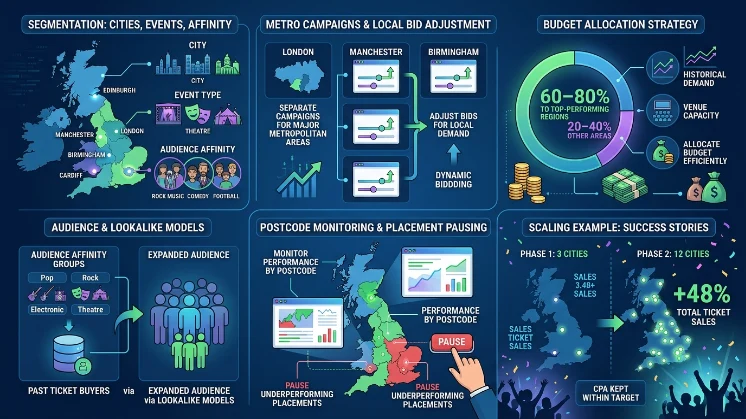
Create separate campaigns for major metropolitan areas (London, Manchester, Birmingham), adjust bids for local demand, and allocate 60–80% of budget to top-performing regions. Use audience affinity groups for genre preferences and expand via lookalike models from past buyers. Monitor performance by postcode and pause placements that underperform. Example: scaling from three cities to 12 increased total ticket sales by 48% while keeping CPA within target.
Event display ads convert ticket consideration into purchases by combining precise targeting, conversion-focused creative, frictionless landing pages, and accurate tracking. Use geographic and behavioral targeting, retargeting sequences, clear pricing and urgency, server-side tracking, and conversion-based bidding to maximise ROI.
For implementation-ready strategies, see the following:
How Event Organizers Increase Ticket Consideration Using Display Ads