
Banner ads are graphical online advertisements placed on websites or apps to promote events; organisers use them to build awareness and drive clicks to event pages. Banner ads are digital images or animations in standard sizes such as 300×250, 728×90, and 320×50 pixels. Event organisers select placements on high-traffic sites and niche publisher pages related to the event theme. They link each banner to an event landing page or ticketing URL for measurement. Common objectives are impressions, clicks, and landing-page visits. Organisers track ad metrics with pixels or UTM parameters to attribute traffic and measure cost per click (CPC) and cost per thousand impressions (CPM).
Banner ads appear in display networks, publisher direct buys, and programmatic exchanges. Display networks provide broad reach across millions of sites. Direct buys secure premium placements on specific publisher pages, for example a music festival buying space on a national entertainment site. Programmatic buys automate bidding across auctions, enabling audience targeting by interest, location, and device. Organisers choose the buying method based on budget, target audience, and performance goals.
How do banner ads fit into the attendee acquisition process?
Banner ads act as top-of-funnel awareness drivers that expose target audiences to an event and generate traffic to conversion-focused pages. Organisers use banner ads at the awareness stage to introduce an event concept and date. Impressions increase recognition; subsequent clicks allow deeper engagement on an event page. Organisers pair banners with retargeting to move users from awareness to consideration. For example, a user who clicks a banner and visits a schedule page can later receive a retargeted ad featuring ticket prices or limited offers. Measurement layers include view-through conversions and click-through conversions to capture both direct and delayed responses.
Campaign timelines often begin 8–12 weeks before the event for national events, and 3–6 weeks for local events. Organisers allocate 40–60% of ad budget to awareness buys, 20–40% to retargeting, and the remainder to last-minute conversion pushes. Tracking is continuous: impressions, CPC, click-through rate (CTR), bounce rate, and landing-page conversion rate provide a performance view. Organisers adjust creative, placements, and bids based on these KPIs.
What audience targeting methods increase banner ad relevance?
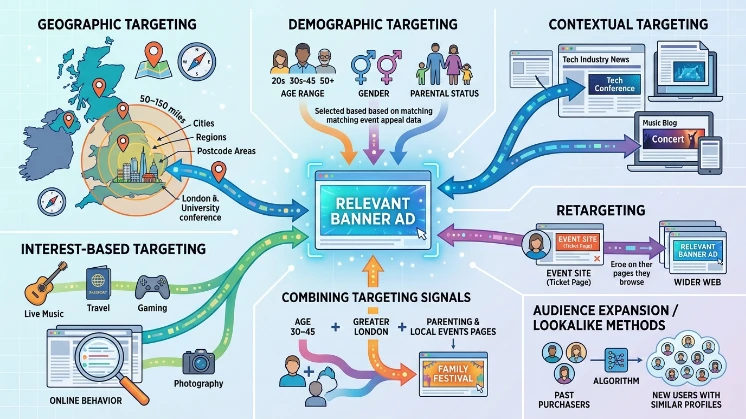
Targeting methods include geographic, demographic, contextual, and interest-based segments to deliver relevant ads to likely attendees. Geographic targeting restricts ads to specific cities, regions, or postcode areas. For a UK university conference, organisers target cities within a 50–150 mile radius depending on travel patterns. Demographic targeting narrows by age range, gender, or parental status when such data matches event appeal. Contextual targeting places ads on pages about similar topics, for example, placing a tech conference banner on industry news pages. Interest-based targeting reaches users whose online behavior indicates a match, such as pages visited about live music for a concert.
Organisers combine targeting signals for precision. Advertise a family festival to users aged 30–45 in Greater London who visit parenting and local events pages. Retargeting focuses on users who visited the event site but did not buy tickets. Lookalike or audience-expansion methods target new users with similar profiles to past purchasers.
Which creative elements improve banner ad performance?
High-performing banner ads use clear headlines, one focused message, strong visuals, and a single clickable area linking to the event page. Clear headlines state the event name, date, and location within the ad. Visuals include professional photography or bold graphics that reflect the event tone. A single focused message avoids clutter; examples: “Saturday 12 Sept — Outdoor Jazz Festival — Tickets from £15.” Legible fonts at digital sizes and contrast between text and background increase readability on mobile devices. Use of a branded color palette and consistent imagery across sizes builds recognition.
Animation can improve CTR when used sparingly and within file-size limits (for instance, under 150 KB). Animated banners should loop no more than three times and end with a static frame that includes the event URL or ticket callout. Include metadata such as image alt text on landing pages to assist accessibility and indexing.
How do organisers measure banner ad effectiveness?
Effectiveness is measured by impressions, CTR, landing-page visits, conversion rate, cost per click, and cost per acquisition tracked via pixels and UTM tagging. Impressions quantify reach. CTR equals clicks divided by impressions and shows immediate engagement. Landing-page visits indicate user interest after clicking. Conversion rate equals ticket purchases divided by landing-page visits. Cost metrics include CPC and cost per acquisition (CPA). Example: a campaign with 200,000 impressions, 1,200 clicks (CTR 0.6%), and 120 ticket purchases yields a conversion rate of 10% and CPC equal to total spend divided by 1,200.
Use of pixels tracks view-through conversions—users who saw a banner and later purchased without clicking. UTM parameters appended to landing-page URLs provide source and medium data in analytics tools. Multi-touch attribution models assign credit across ad exposures, helping organisers understand the banner role in a buyer journey. Regular reporting cadence is weekly during active campaigns and daily during final week before the event.
What campaign setup and bidding strategies work for event banners?
Campaign setup includes multiple creative sizes, targeted inventory, frequency caps, and bidding strategies such as CPM for awareness and CPC for traffic objectives. Create a set of standard sizes (300×250, 728×90, 160×600, 320×50) to cover desktop and mobile environments. Apply frequency caps to limit exposures per user to 3–5 impressions per week to prevent fatigue. For awareness goals, use CPM bidding to optimise impressions. For traffic goals, use CPC bidding to control cost per click. For conversion-focused retargeting, use CPA or target return on ad spend (tROAS) when available.
Set campaign start and end dates aligned with ticket sale phases. Allocate more budget to mobile placements if analytics show higher mobile traffic. Use geo-targeted bid modifiers to increase bids in high-value locations. Test different creatives in A/B splits and pause low-performing variants after a set threshold, for example, after 10,000 impressions.
What are the main benefits of banner ad campaigns for event organisers?
Banner ads deliver scalable reach, precise targeting, measurable engagement, and support multi-touch customer journeys from awareness to purchase. Reach scales across publisher networks and programmatic exchanges, enabling exposure to tens of thousands or millions of potential attendees. Precise targeting reduces wasted impressions and improves relevance. Measurable engagement through CTR and conversions provides clear ROI calculations. Banners integrate with retargeting and email campaigns to support a multi-touch journey that increases the likelihood of ticket purchase.
Banner campaigns also allow rapid iteration. Organisers change creative, messaging, or placement within days. This flexibility supports promotions such as early-bird pricing windows or last-minute lineup announcements. Examples include swapping hero images to feature a headline speaker or artist after announcement and measuring immediate changes in CTR and conversion.
Explore More Expert Insights:
How Gaming Companies Increase Downloads Using Banner Advertising
How Film Studios Drive Movie Buzz Using Banner Ads
What use cases show banner ads increasing event attendance?
Use cases include launching awareness for new events, promoting limited-time ticket offers, retargeting interested visitors, and supporting multi-event series promotions. For a new regional conference, banners create initial awareness among professionals in target cities, generating site visits and email signups. For ticket price promotions, banners advertise early-bird discounts with countdown messaging to push conversions. Retargeting banners show tailored messages to users who viewed schedules or speaker pages without purchasing. For a festival series, banners promote individual dates and cross-sell related shows to attendees of prior events.
Each use case uses different metrics: awareness uses impressions and reach; promotions track CTR and conversions; retargeting tracks return visits and purchase rate. Organisers set specific numeric goals such as achieving 500,000 impressions in month one, 5,000 clicks in month two, and a landing-page conversion rate of 8% during the final two weeks.
How do legal and accessibility rules affect banner ad campaigns?
Campaigns must comply with data-privacy laws and accessibility guidelines to protect users and ensure inclusive reach. In the UK, organisers follow data-privacy regulations for consent when using cookies or tracking pixels for personalised ads. Consent management must operate before non-essential cookies collect personal data. Accessibility recommendations include readable font sizes, sufficient color contrast, and providing equivalent landing-page content for screen readers. Ads should avoid flashing that exceeds three flashes per second to reduce the risk of causing seizures.
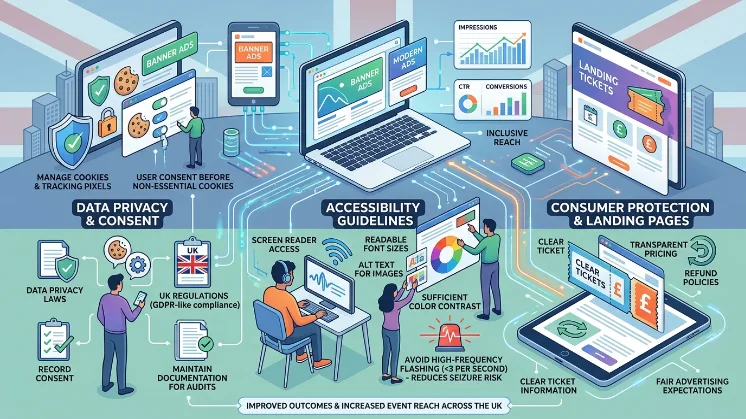
Record consent and maintain documentation for auditing. Ensure landing pages include clear ticket information, pricing, and refund policies to meet consumer protection expectations.
Explore the Complete Guide:
How Event Organizers Increase Ticket Consideration Using Display Ads
Banner ads provide a structured, measurable method to increase event awareness, website traffic, and ticket purchases. Organisers implement geographic and interest targeting, use standard creative sizes, apply frequency caps, and measure campaign performance with impressions, CTR, and conversion metrics. Proper campaign timing, targeted creative updates, and adherence to privacy and accessibility rules improve outcomes for events across the UK.
Discover More Insights:
Event Display Ads That Convert Ticket Consideration Into Purchases