

Trailer ads are short-form video promotions that present a movie’s premise, key scenes, and release information to large audiences on digital, linear, and theatrical channels. Trailer ads run on platforms such as streaming services, social video sites, broadcast television, and cinema pre-shows. Studios classify trailer ads by length (6–30 seconds, 30–120 seconds), by placement (in-stream, pre-roll, mid-roll, out-stream), and by objective (awareness, consideration, conversion). Each trailer ad contains a headline frame, one or more narrative beats, a visual hook, and a clear title card with release date and distribution details.
Studios create multiple trailer variants for the same film. Examples: a 15-second platform-optimized cut for social feeds, a 60-second theatrical cut for cinema pre-shows, and a 30-second TV spot for broadcast. Each variant targets specific audience cohorts and viewing contexts.
How do studios plan trailer ad campaigns?
Studios follow a staged timeline that coordinates creative development, media buying, testing, and ramp-up across windows leading to release. Planning begins 16–40 weeks before release for tentpole films and 8–16 weeks for mid-budget films. Teams set measurable goals: reach percentage of target demographics, view-through rate (VTR), click-through rate (CTR) for ticketing partners, and pre-sale volume. Media planners allocate spend across channels based on expected reach efficiency and CPM benchmarks. Creative teams produce cutdowns and localised versions for regional markets such as the United Kingdom.
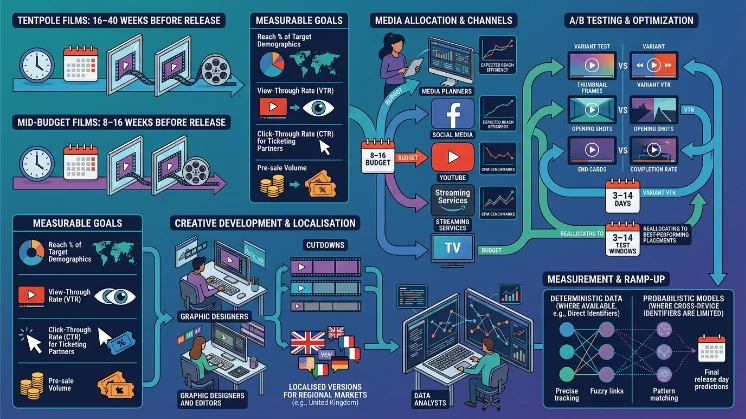
Studios run A/B tests on thumbnail frames, opening shots, and end cards. Tests run for 3–14 days, comparing variant VTR and completion rate. Planners reallocate budget to best-performing placements after test windows close. Measurement uses deterministic data where available and probabilistic models where cross-device identifiers are limited.
How do studios target audiences with trailer ads?
Studios target by demographics, interests, behaviour, and contextual signals to match trailers to audience segments most likely to engage. Demographic targeting includes age brackets (e.g., 16–24, 25–34, 35–49), gender, and region (UK nations and metro areas). Interest and behavioural targeting uses past movie-going data, search queries for similar titles, and streaming genre consumption. Contextual targeting places trailer ads alongside content with aligned themes, such as action trailers adjacent to sports coverage. First-party data from studio ticketing and newsletter lists supplements third-party signals.
Studios create persona segments and map creative variants to each segment. Example: a horror trailer emphasises jump-scare frames for the 18–34 cohort and suspense frames for a 35–49 cohort.
What creative elements drive effective trailer ads?
Effective trailer ads use a strong visual hook within the first 3 seconds, concise narration or title copy, and an explicit release cue. Visual hooks include a striking image, a recognisable actor, or a plot question. Narration and on-screen text provide context in 5–12 words. Release cues show the release date, distribution channel (cinema, streaming), and ticket pre-sale links when applicable. Music and sound design amplify emotional tone but do not replace clear visual information.
Studios test alternative opening frames, trim dialogue-heavy scenes, and produce subtitle variants for sound-off environments. Example: a franchise film uses a title logo reveal at second 2 for immediate brand recognition.
How do studios measure trailer ad performance?
Studios measure trailer ad performance with view-through rate, completion rate, cost per completed view, engagement metrics, and conversion metrics tied to pre-sales. View-through rate (VTR) indicates the share of served impressions that reached a defined duration threshold. Completion rate shows the percentage that played to the end. Cost per completed view (CPCV) and effective CPM (eCPM) show cost efficiency. Engagement metrics include shares, comments, and watch time. Conversion metrics link ad exposure to actions: ticket pre-sales, trailer clicks to film pages, and search lift for title queries.
Attribution uses multi-touch models to assign credit across exposures. Studios use lift measurement to quantify incremental searches and ticket sales versus holdout groups. Reporting cadence runs daily during launch windows and weekly during evergreen campaigns.
What role does platform selection play in campaign success?
Platform selection aligns trailer format and audience behaviour with placement to maximise reach and engagement within the campaign budget. Streaming platforms deliver long-form placements and higher completion rates for longer cuts. Social platforms deliver rapid reach and sharing potential for short cuts and looped creatives. Broadcast television provides mass reach ahead of major live events. Cinema pre-show placements deliver captive audiences and high completion rates for 30–120 second cuts.
Studios allocate 20–50% of digital budgets to social platforms for awareness spikes and 30–60% to streaming platforms for sustained exposure. Cinema and broadcast receive targeted allocations for event windows such as opening weekend and awards season.
How do studios localise trailer ads for the UK market?
Localisation adapts language, cast prominence, cultural references, and release information to match UK audience expectations and regulatory requirements. Localisation includes UK English voiceover, local release date formatting, and region-specific credits or certifications. Studios swap regional shots or captions when a film features UK locations or talent. Compliance checks ensure classification labels and advertising codes comply with the UK Advertising Standards Authority and film classification boards.
Examples: trailers for films with UK premieres highlight London-based events; trailers for films with local stars foreground those performers in the edit.
What are the typical components of a trailer ad tech stack?
A trailer ad tech stack includes an ad server, demand-side platform (DSP), supply-side platform (SSP), measurement SDKs, and tag management for creatives and tracking. The ad server hosts creative variants and serves the correct format based on device and placement. DSPs execute programmatic buys against audience segments. SSPs provide publisher inventory. Measurement SDKs capture viewability, completion, and engagement on apps and streaming devices. Tag management handles versioning and localisation. Data warehouses house campaign logs for post-campaign analysis.
Studios integrate ticketing platforms and CRM systems to link ad exposure to pre-sale events. Studios also use CDPs (customer data platforms) to unify first-party data for audience activation.
Explore More Expert Insights:
How TV Channels Build Program Interest Using Banner Advertising
How Streaming Services Increase Watch Intent Using Display Ads
What benefits do trailer ads deliver for film marketing?
Trailer ads increase awareness, accelerate consideration, and drive ticket pre-sales through targeted reach, creative variation, and measurable outcomes. Awareness metrics show reach across key demographics and regions. Consideration metrics reveal increases in search volume, trailer replays, and page visits. Conversion metrics quantify pre-sale volume and opening weekend attendance lifts. Trailer ads also support earned media by increasing social sharing and press mentions.
Check the Complete Explanation:
How Film Studios Drive Movie Buzz Using Banner Ads
Studios report audience recalls, search lift percentages, and pre-sale upticks to stakeholders during post-campaign reviews.
Explore More Useful Information:
Film Trailer Ads That Convert Hype Into Box Office Ticket Sales
What use cases demonstrate trailer ad effectiveness?
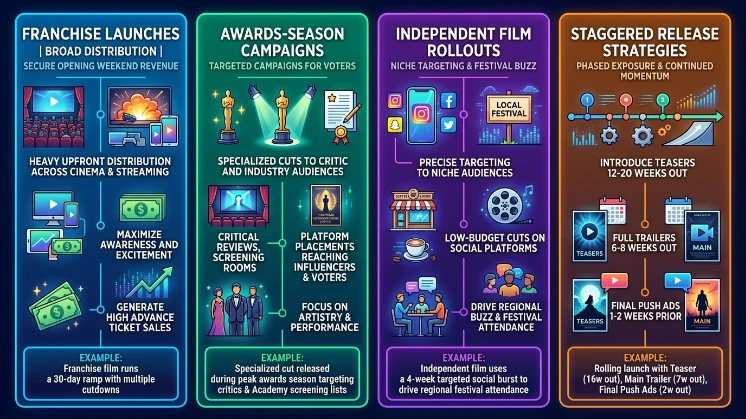
Use cases include franchise launches, awards-season campaigns, independent film rollouts, and staggered release strategies that depend on phased trailer exposures. Franchise launches use heavy upfront distribution across cinema and streaming to secure opening weekend revenue. Awards-season campaigns release targeted cuts to critic and industry audiences with platform placements that reach voters. Independent films use precise targeting to reach niche audiences with low-budget cuts on social platforms. Staggered releases introduce teasers 12–20 weeks out, full trailers 6–8 weeks out, and final push ads 1–2 weeks prior to release.
A franchise film runs a 30-day ramp with multiple cutdowns, an independent film uses a 4-week targeted social burst to drive regional festival attendance.



