
A banner ad is a rectangular digital graphic placed on web pages or apps that delivers a short promotional message and a link. Entertainment platforms use them to highlight shows, pricing tiers, trial offers, or content categories.
A banner ad is a static image, animated graphic, or HTML element sized to fit standard placements such as leaderboard, skyscraper, or medium rectangle. Entertainment platforms select placements on editorial pages, video players, and recommendation feeds. Banner creative contains a headline, visual asset, short copy, and a clickable destination URL. Platforms set campaign objectives around awareness, consideration, or conversion. Measurement tracks impressions, click-through rate (CTR), viewability, and downstream subscription events.
Platforms use banner ads at multiple customer-journey points. On discovery pages they present new releases. On article pages they pitch related series. In-stream overlays appear during free content to nudge sign-up. The creative aligns with campaign goals and audience segments. Targeting uses behavioral, contextual, and first-party engagement signals. Reporting ties ad exposure to site or app events such as registration, trial start, and paid conversion.
How do banner ads fit into the subscriber acquisition funnel?
Banner ads function as awareness and consideration touchpoints that move users from discovery to trial by delivering concise value propositions and gated offers.
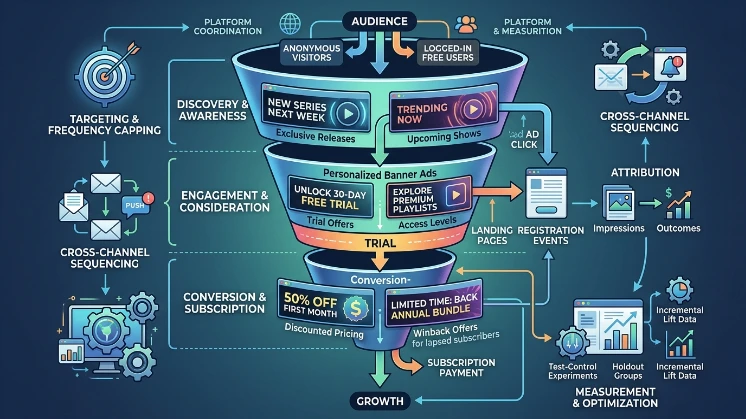
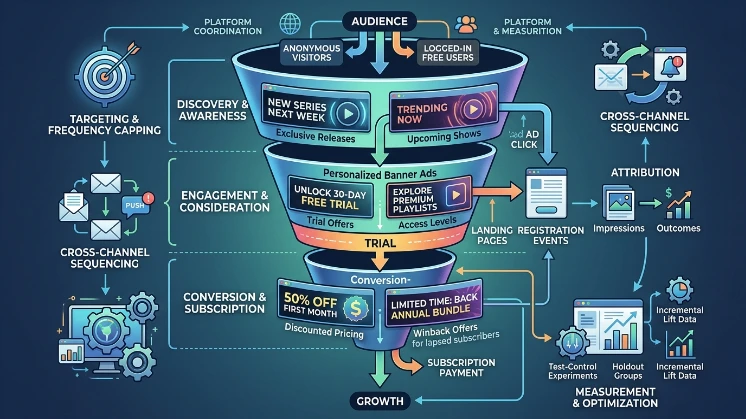
Banner ads serve three funnel roles. In early stages they create awareness by showing upcoming content or exclusive releases. In middle stages they encourage consideration by promoting trial offers, curated playlists, or access levels. In later stages they support conversion by advertising discounted first-month pricing or time-limited bundles. Platforms coordinate creative, landing pages, and tracking to maintain funnel continuity. Attribution links impressions and clicks to registration events and payment outcomes. Cross-channel sequencing aligns banner exposures with email, push notifications, and in-app prompts.
Banner placement strategy varies by user state. Anonymous visitors see broad topical creative. Logged-in free users see personalised recommendations and trial CTAs. Lapsed subscribers see winback offers. Platforms deploy frequency caps and rotation rules to avoid creative fatigue. They measure incremental subscriber lift using test-control experiments and holdout groups.
Which targeting methods increase banner ad relevance for entertainment audiences?
Relevant targeting uses first-party engagement data, contextual signals, and demographic segments to match banner creative to content interest and propensity to subscribe.
First-party data includes viewing history, search queries, watchlists, and play completions. Platforms use these signals to show banners for similar genres, actors, or themes. Contextual targeting matches page or video topic, such as placing a documentary banner on a news category page. Demographic targeting segments by age bracket, region, or device. Behavioral targeting uses recent session behavior, such as multiple short visits without registration, to present trial messaging.
Lookalike audiences derive from known subscribers to find anonymous users with similar attributes. Time-based signals trigger offers after a threshold of engaged minutes or visits. Geo-targeting adjusts language, pricing messages, and available content rights per country or region. Privacy-safe approaches minimise fingerprinting and rely on aggregated or hashed identifiers. Platforms prioritise high-relevance placements to improve CTR and lower cost per acquisition.
What creative elements in banner ads drive subscription interest?
Effective creative uses a clear headline, a single value proposition, concise supporting text, a strong visual cue, and a direct call-to-action linked to an appropriate landing page.
The headline states the main benefit in five to eight words. Supporting text provides one specific fact such as trial length or price. Visual assets feature show stills, key art, or a presentable cast shot sized for the creative format. Contrast and legible typography ensure readability on mobile devices. A direct call-to-action uses imperative verbs tied to the offer, and the banner links to a landing page that continues the promise without distraction.
Creative variants test combinations of headline, imagery, and offer. One variant may emphasise “14-day trial” while another highlights “exclusive series.” Platforms measure CTR, bounce rate on landing, and conversion rate from landing to subscription. Creative sequencing shows a different message after a user clicks and doesn’t convert, adapting intensity and incentive. Ad rotation reduces creative fatigue by refreshing imagery every 7 to 14 days for high-traffic inventory.
How do platforms measure banner ad effectiveness for subscriptions?
Measurement combines immediate engagement metrics with downstream conversion tracking, using incremental lift tests, cohort analysis, and multi-touch attribution windows to quantify subscription impact.
Immediate metrics include impressions, CTR, and viewability percentage. Post-click metrics include landing-page engagement, registration starts, and trial activations. Downstream metrics track trial-to-paid conversion and revenue per acquired user. Platforms run randomised controlled trials that split audiences into exposed and holdout groups to measure incremental subscriber lift. Cohort analysis groups users by first exposure date to observe conversion velocity and lifetime value.
Attribution uses multi-touch windows that credit banner exposure within a defined time period, commonly 7 to 30 days. Platforms use deterministic matching when possible and probabilistic models when attribution signals are incomplete. Revenue-focused KPIs include cost per acquisition (CPA), payback period, and average revenue per user (ARPU). Privacy-first rules anonymise identifiers and aggregate results for reporting.
What process do platforms follow to run a banner ad campaign for subscriptions?
Campaigns follow a data-driven cycle: audience definition, creative development, placement selection, targeting configuration, launch with tests, measurement, and iterative optimisation.
Define objectives such as new subscribers, trial starts, or winbacks. Segment audiences by behavior and lifecycle stage. Develop creative aligned to the objective with multiple variants. Select placements across web and app inventory, specifying sizes and contextual environments. Configure targeting rules, frequency caps, and budget. Launch with A/B or multivariate tests to establish baseline performance.
Monitor live metrics daily for early issues and weekly for optimisation. Optimise by reallocating budget to top-performing placements and creatives. Run incremental lift tests for rigorous measurement. At campaign end, conduct a postmortem covering CPA, conversion funnels, cohort LTV, and creative performance. Use learnings to update audience definitions and creative briefs for the next cycle.
Which components of a landing experience convert banner clicks into subscriptions?
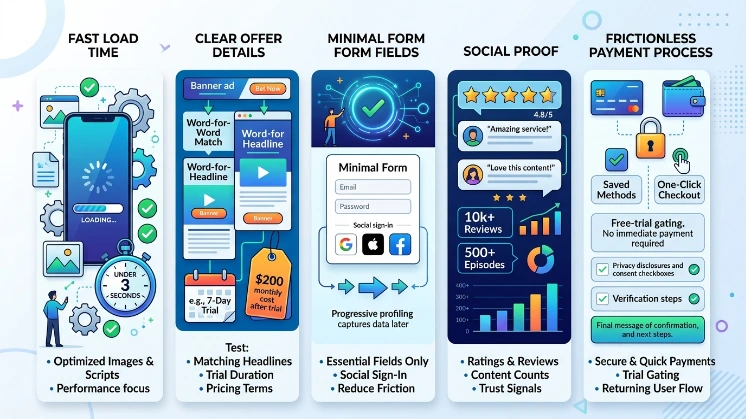
A landing experience that converts offers fast load time, clear offer details, minimal form fields, social proof, and a frictionless payment process.
Load time should be under three seconds on mobile. The headline on the landing page must match the banner headline word-for-word. Offer details include trial length and any price after the trial. Forms request only essential fields such as email and password or single-step social sign-in. Social proof includes ratings, episode counts, or review snippets. Payment flow supports saved methods, free-trial gating without immediate payment, or one-click checkout for returning users.
Progressive profiling captures additional data later in the user lifecycle rather than at signup. Verification steps limit friction to necessary legal or age checks. Consent and privacy disclosures appear clearly and follow regional rules. Post-signup messaging confirms next steps and sets expectations for trial duration and billing.
Explore More Expert Insights:
How Food Businesses Improve Engagement Using Mid-Funnel Advertising
How Restaurants Build Trust Using Review-Based Banner Campaigns
What benefits do banner ads deliver in subscription growth strategies?
Banner ads deliver measurable reach, precise audience targeting, rapid creative testing, and scalable traffic that connects content interest to subscription offers.
They scale impressions across high-traffic editorial and app placements to reach broad and niche audiences. Targeting increases relevance, improving click and conversion rates. Fast creative iteration shortens time-to-insight for messaging and offers. When tied to first-party signals, banners move high-intent users who already engage with specific content toward trial or payment. Measurement capabilities quantify acquisition cost and lifetime value for better budget allocation.
Read the Full Blog Here:
How Entertainment Platforms Increase Subscribers With Banner Ads
Banner ads also enable audience sequencing across channels. A user who sees a banner, then receives a related email, then experiences an in-app prompt demonstrates coordinated messaging that increases probability of conversion. Platforms use these sequences to lift conversion rates and reduce wasted spend.
Where do banner ads work best in entertainment use cases?
Banner ads work best on editorial pages, content hub pages, free ad-supported viewing environments, and within recommendation or search-result feeds.
Editorial pages host feature articles and interviews that support premium placement for new releases. Content hub pages aggregate genres or collections, making them ideal for themed campaigns such as “crime dramas” or “family films.” Free ad-supported viewing environments display high-frequency overlays and leaderboard creative to convert ad viewers into paid subscribers. Recommendation feeds and search results show personalised banners tied to user queries and recent views.
Use cases include promoting limited-time trial offers before seasonal peaks, advertising exclusive premieres to build early signups, and presenting winback incentives to churned users. Platforms pair banner campaigns with measurement tactics like holdout groups to evaluate real subscriber lift for each use case.
Learn Everything About It Here:
Entertainment Ads That Convert Viewing Interest Into Paid Subscriptions
Banner ads are structured, measurable touchpoints that connect content interest to subscription offers. Platforms implement them through targeted creative, optimised landing experiences, and iterative measurement. When integrated with first-party signals and coordinated across channels, banners produce incremental subscribers and provide clear metrics for campaign decision-making.