
A banner campaign is a set of online display ads shown across websites and apps to deliver a consistent visual message about offers or promotions. A banner campaign uses static images, animated GIFs, or HTML5 creatives. Platforms include ad exchanges, programmatic networks, and publisher sites. Creatives link to landing pages that present the promoted offer. Campaigns run on targeting rules, frequency caps, and scheduling. Measurement uses impressions, clicks, view-through conversions, and engagement metrics.
Banner creatives take three clear forms: static images, animated sequences, and interactive HTML5. Static images show one fixed message. Animated GIFs cycle frames to show multiple messages in one asset. HTML5 supports animation, basic interaction, and responsive resizing across screen sizes. Each creative type has explicit file size limits and dimension standards set by common ad exchanges.
How do brands plan the strategy for offer-driven banner campaigns?
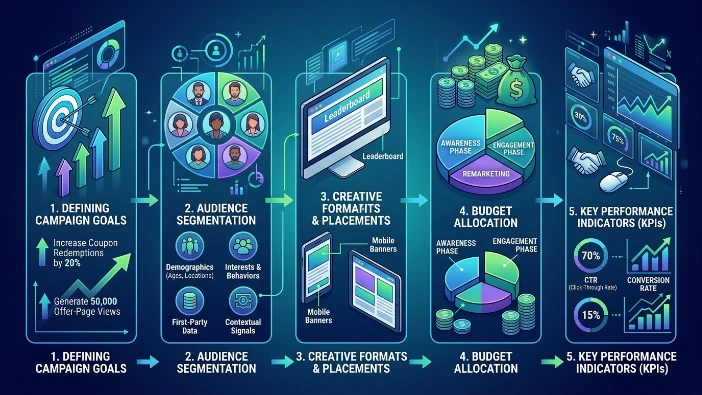
Brands plan campaign goals, audience segments, creative formats, placements, budgets, and key performance indicators before launch. Planning defines the promotional objective, Increase coupon redemptions by 20% or generate 50,000 offer-page views. Audience segmentation uses demographics, interests, first-party data, or contextual signals.
Creative formats map to placements: leaderboard for desktops, mobile banners for smartphones. Budgets split by channel and phase: awareness, engagement, and remarketing. KPIs include CPM, CTR, and conversion rate.
What target metrics guide budget allocation?
Budget allocation uses expected CPM and required reach. Calculate impressions needed: reach × frequency. Example: to reach 500,000 unique users at frequency 3, campaign needs 1,500,000 impressions. Multiply impressions by planned CPM to estimate cost. Track spend daily and reallocate to high-performing placements.
How do brands select audiences and placements for offer banners?
Brands select audiences using demographic filters, contextual categories, behavioural signals, or first-party customer lists, then choose placements that match device and content environment. Demographic filters include age, location, and household composition. Contextual categories include food, recipes, and grocery. Behavioral signals include recent grocery searches or prior site visits. First-party lists contain email-hashed audiences or website visitors. Placement decisions balance viewability and cost: premium publisher sites yield higher viewability and cost; open exchanges deliver broader reach at lower CPMs.
How does device targeting affect creative choice?
Device targeting dictates dimensions and interactivity. Desktop placements support larger creatives and richer HTML5 experiences. Mobile placements require smaller file sizes and vertical-safe layouts. Tablet placements sit between desktop and mobile specs. Creatives must resize without losing key messaging or call-to-action clarity.
What targeting and frequency controls ensure offers reach the right users without overexposure?
Targeting layers combine audience filters and placement controls while frequency caps limit impressions per user to prevent fatigue. Combine inclusion lists and exclusion lists to refine reach. Use lookback windows for recent website visitors to prioritize warmer audiences. Apply frequency caps such as 3 impressions per user per day in awareness phases. Monitor frequency and ad fatigue through CTR and view-through conversion trends. Adjust caps when CTR drops below defined thresholds.
What lookback windows align with offer types?
Short-term offers use 7- to 14-day lookbacks for recent visitors. Longer promotions use 30- to 90-day windows for broader reach. Instant discounts need shorter windows because urgency affects conversion timing.
How do creatives convey offers clearly and legally?
Creatives present essential offer details: discount value, eligible products, redemption method, and expiration, while complying with advertising law and platform policies. Essential elements: headline stating offer, numeric discount or price, a simple redemption instruction (e.g., show code at checkout), and expiration date. Use legible fonts and contrast for accessibility. Include mandatory disclaimers inline when required, such as age restrictions or limited stock statements. Test creatives across devices to ensure legal text remains readable.
What file and size requirements are standard?
Common requirements include max file sizes of 150 KB for static images and 200 KB for animated GIFs; HTML5 bundles often allow larger sizes but need optimisation. Standard dimensions include 300×250, 728×90, 320×50, and 300×600 pixels. Always prepare multiple sizes to support responsive delivery.
How is programmatic buying used to run banner offer campaigns?
Programmatic buying automates inventory purchase using audience signals, real-time bidding, and rules for spend, targeting, and viewability. Demand-side platforms (DSPs) connect bids to supply-side platforms (SSPs) and ad exchanges. Campaign managers set bid strategies, target parameters, and pacing rules. Real-time bidding selects impressions that match audience and contextual criteria. Programmatic supports private marketplaces for premium inventory and open exchanges for scale.
What bidding strategies fit offer-led awareness?
CPM bidding works for pure reach and viewability goals. CPC or oCPM helps when the objective includes clicks or conversions. Dayparting pairs higher bids with peak activity windows. Bid modifiers adjust for premium placements or high-value audience segments.
How do brands measure performance for offer-driven banner campaigns?
Performance measurement tracks impressions, clicks, CTR, viewability, conversions, and cost metrics to evaluate reach and action on offers. Impressions measure exposure; clicks measure direct engagement. CTR equals clicks divided by impressions. Viewability reports percentage of impressions meeting viewable criteria. Conversions capture offer redemptions or landing-page actions. Cost metrics include CPM, CPC, and CPA. Use consistent attribution windows to link impressions to redemptions, for example a 7-day view-through and 1-day click-through window.
How do brands validate redemptions attributable to banners?
Validation combines landing-page tracking parameters, promo codes unique to the campaign, and server-side conversion tracking. Promo codes track offline or in-store redemptions. Landing pages use URL parameters for source identification. Server-side logs reconcile ad impressions with actual conversions.
What creative rotation and testing practices improve offer response?
Rotate multiple creatives and run A/B tests on headlines, images, and offer language to identify top performers quickly. Setup includes minimum two creatives per placement. Test one variable at a time: headline, offer amount, or imagery. Use early performance windows (first 48–72 hours) to identify statistical differences in CTR and conversion rate. Pause low performers and scale creatives that meet predefined uplift thresholds, e.g., 15% higher CTR.
Which test sample sizes yield reliable results?
Require at least several thousand impressions per variant for initial signal. Aim for 10,000 impressions per variant to reach stable CTR estimates, depending on baseline CTR.
What legal and privacy rules apply to banner offer campaigns in the UK?
Campaigns must follow UK data protection law, advertising standards, and cookie consent requirements for personalised targeting. Comply with the UK General Data Protection Regulation and Data Protection Act for personal data use. Obtain consent for cookie-based behavioural targeting. Ensure ad copy does not mislead, following the UK Advertising Standards Authority rules. Keep records of consent and targeting parameters for audits.
Explore More Expert Insights:
How Cafes Increase Foot Traffic Using Display Ads
How Restaurants Attract Customers Using Local Banner Advertising
What benefits do banner campaigns provide for food-offer promotion?
Banner campaigns deliver scalable reach, visual offer presentation, contextual placement near relevant content, and measurable engagement metrics. They reach audiences across sites and apps with visual detail that text search ads cannot convey. Contextual placements place offers alongside recipes and food content to increase relevance. Measurable metrics enable rapid optimisation and clear ROI calculations when paired with unique codes or tracked landing pages.
What use cases suit banner offers best?
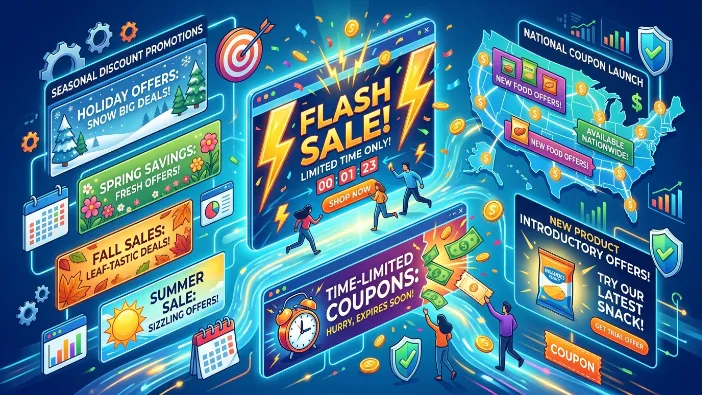
Use cases include national coupon launches, seasonal discount promotions, and new product introductory offers. Banner campaigns suit flash sales that require broad, fast reach and time-limited coupons requiring urgency.
This article defined banner campaigns and explained planning, targeting, creative requirements, buying methods, measurement, testing, and legal rules for food brands promoting offers. It outlined practical parameters such as impression calculations, file-size limits, common dimensions, lookback windows, test sample sizes, and compliance steps.
For deeper reading on educational stages of product awareness and conversion-focused ad types, see related internal resources:
How Food Brands Educate Customers Using Product Awareness Ads
Explore the Advanced Guide:
Food Brand Awareness Ads That Convert Product Interest Into Purchase Intent