Display ads are visual online advertisements images, banners, or short videos served on websites and apps to reach local audiences and drive awareness. Display ads serve static images (JPEG, PNG), animated GIFs, or HTML5 creatives. Ad networks and programmatic platforms place these creatives on webpages that match selected demographics, geolocations, and interests. For cafes, targeting focuses on users within defined radii (for example, 0.5–3 miles / 800–5,000 meters) around a physical store. Ad impressions register when the creative loads; clicks register when a user taps or clicks the ad. View-through conversions record visits or actions after exposure without a click. Measurement uses pixels, SDKs, or store-footfall attribution via anonymised location data.
How do cafes use display ads to increase local awareness?
Cafes use display ads to show offerings, opening hours, and promotions to nearby users to increase visit consideration and recall. Cafes select visual messages that highlight core product signals: menu items, price points, opening times, or seasonal offers. Creative frequency is set to a controlled cap, often 3–7 impressions per week per user, to build recognition without oversaturation.
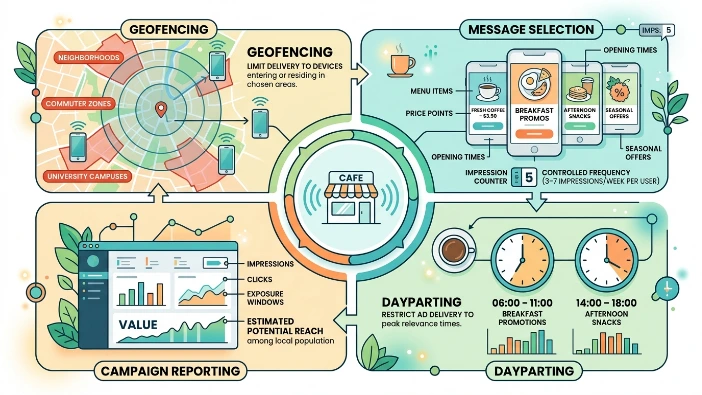
Geofencing limits delivery to devices that enter or reside in chosen areas such as neighbourhoods, commuter zones, or university campuses. Dayparting restricts ad delivery to times of peak relevance, for example, 06:00–11:00 for breakfast promotions and 14:00–18:00 for afternoon snacks. Campaign reporting tracks impressions, clicks, and exposure windows to estimate potential reach among the local population.
What targeting methods increase relevancy for cafe display ads?
Targeting combines geolocation (radius or polygon), contextual site placement, and basic demographic filters to reach likely visitors. Geolocation targets use latitude/longitude plus radius settings or polygons around high-footfall spots such as stations, markets, or office clusters. Contextual targeting places creatives on pages about food, local events, or lifestyle to match user intent. Demographic filters select age bands such as 18–34 or 25–44 when relevant. Interest segments include commuting, coffee, or dining; for example, users who visit recipe or café-review sites. Retargeting serves display ads to users who visited the cafe’s site or engaged with past creatives. Combining these layers increases the chance that impressions reach people with both proximity and relevant intent.
What creative formats perform best for driving visits?
High-contrast static banners and short looped HTML5 animations with clear store information perform best for local visit intent. Static JPEG or PNG banners deliver fast load times on mobile and desktop. HTML5 creatives support simple animations and localised content like daily specials. Include a single strong message line (for example: “All-day espresso — open 07:00–20:00”) and a readable address or nearby landmark. Use legible fonts sized for mobile screens and contrast ratios that meet accessibility thresholds. Reserve video for longer awareness buys in premium placements when budget allows; use 6–10 second cuts to keep messaging concise.
How do cafes measure whether display ads actually increase foot traffic?
Measurement uses exposure metrics plus digital-to-physical attribution methods such as location-based attribution and controlled holdout tests. Basic metrics include impressions, viewable impressions, clicks, and click-through rate (CTR). For physical visits, cafes use anonymised location-based attribution that links ad exposure to device proximity at a store within a defined time window, for example, 24–72 hours. Another method uses coupon codes or mobile order redemptions tied to campaigns to count direct conversions. Holdout tests split similar areas into exposed and unexposed zones; a statistically significant uplift in visits in the exposed zone indicates campaign effect. Reporting should include sample sizes, exposure counts, and confidence intervals when available.
What budget and schedule work for local cafe display campaigns?
Local campaigns typically run for 2–6 weeks with daily budgets aligned to target geography size; common daily budgets range from £5 to £50 per store. Smaller radii (under 1 mile) require lower budgets because the audience size is small. Larger catchments (1–3 miles) need higher daily spend to reach a meaningful portion of the audience. Set frequency caps to 3–7 impressions per week per device. Schedule delivery for peak decision windows: morning commuters, lunchtime, and afternoon. For seasonal promotions such as holiday menus or campus term starts, run concentrated bursts of 7–14 days before key dates to build awareness.
How do privacy rules affect local display-ad campaigns in the UK?
Privacy rules require anonymised processing of location data and clear consent for personalised advertising under UK GDPR and ICO guidance. Advertisers must avoid using identifiable personal data without lawful basis. Use aggregated or pseudonymised location signals for attribution. Ensure consent frameworks cover cookie-based and app-tracking methods. Work with vendors who provide privacy-compliant measurement that supports opt-outs and adheres to UK regulator standards. Document data retention limits and ensure third-party processors follow contractual safeguards.
What campaign components ensure operational readiness?
Operational readiness includes creative assets, geolocation setup, budget controls, measurement tags, and legal compliance checks. Prepare creatives in required sizes and formats for web and mobile. Define geofences, polygons, or radii and list excluded zones such as competitor interiors if desired. Configure frequency caps and dayparting windows. Place tracking pixels or SDKs to collect impressions and viewability. Test creative rendering across devices and browsers. Verify vendor compliance with privacy rules and obtain necessary consent or use non-personalised delivery where consent is unavailable.
Explore More Expert Insights:
How Restaurants Attract Customers Using Local Banner Advertising
How Food Delivery Apps Boost Orders Using Banner Ads
What are evidence-backed benefits for cafes using display ads?
Display ads increase local visibility, support time-sensitive offers, and enable measurable exposure-to-visit attribution when properly configured. Exposure raises spontaneous store recall among nearby residents and passersby. Time-limited creatives drive urgency for new menus or limited editions. Measurement techniques such as holdout tests and location attribution provide quantifiable uplift estimates in visits. Display ads complement offline tactics like window signage and local listings to create consistent local presence across channels.
What use cases show clear results from display-ad campaigns?
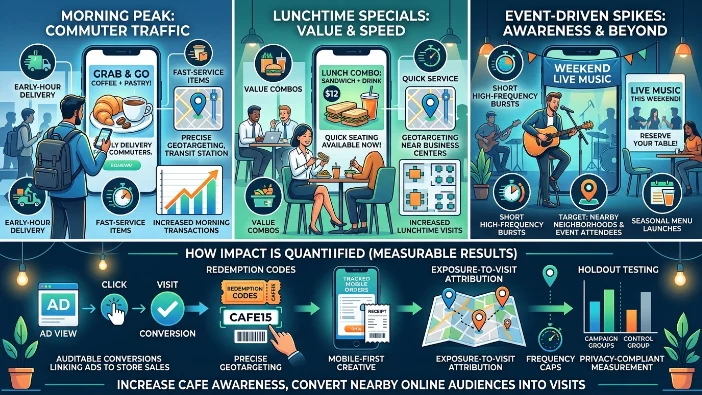
Use cases include traffic growth during morning peaks, lunchtime specials, and event-driven spikes such as weekend live music or seasonal menus. For morning peaks, campaigns target commuters with early-hour delivery focusing on fast-service items. For lunch, ads highlight value combos and quick seat availability. For events, short high-frequency bursts the week before the event concentrate impressions on nearby neighborhoods and event attendees. Campaigns tied to redemption codes or tracked mobile orders yield direct, auditable conversions that link ads to store sales.
Display ads act as a measurable, localised channel for cafes to increase awareness and convert nearby online audiences into visits. Key practices include precise geotargeting, clear mobile-first creative, defined frequency caps, and privacy-compliant measurement. Use exposure-to-visit attribution and holdout testing to quantify impact.
For deeper guidance on building visit intent and converting local interest into visits, see the following:
How Cafes Build Visit Intent Using Local Banner Advertising
For tactics that convert searches into walk-ins, see:
Local Cafe Ads That Turn Nearby Searches Into Walk-In Customers