
Banner ads are static or animated digital images that display promotional content on websites and apps to attract clicks and impressions. Banner ads include size, format, placement, and creative. Sizes follow standard specifications such as 300×250, 728×90, and 320×50. Formats include JPEG, PNG, GIF, and HTML5. Placement refers to above-the-fold, in-article, and sidebar locations. Creative contains headline, image, value proposition, and call-to-action text (for measurement only).
Banner ads function on display networks, programmatic exchanges, and direct site placements. Display networks deliver ads to millions of pages using contextual targeting. Programmatic exchanges use automated auctions where bid, targeting, and frequency settings determine delivery. Direct placements involve manual negotiation for specific publisher inventory.
How do banner ads increase engagement for tourism services?
Banner ads increase engagement by delivering relevant visuals and messages to targeted audiences at scale, provoking clicks, view-throughs, and brand interactions. Engagement metrics include click-through rate (CTR), view-through rate (VTR), hover interactions on rich media, and time-on-site after click. Banner ads use targeting signals such as geography, device, browsing context, and previous site visits to reach users with higher intent.
Creative that features destination imagery and concise messaging produces measurable lifts in CTR and VTR. Testing shows image-led creative increases CTR by 20–60% compared with text-only creative in travel categories. Frequency control prevents ad fatigue by limiting impressions per user per day.
Banner ads use retargeting to re-engage users who visited booking pages but did not convert. Retargeting lists segment visitors by page type, time on site, and booking step abandoned. Segmented retargeting yields higher engagement because ads align with the user’s known interests. Users who viewed hotel listings see room-specific banners; users who viewed destination guides see banners highlighting experiences.
How does targeting work for tourism banner ads?
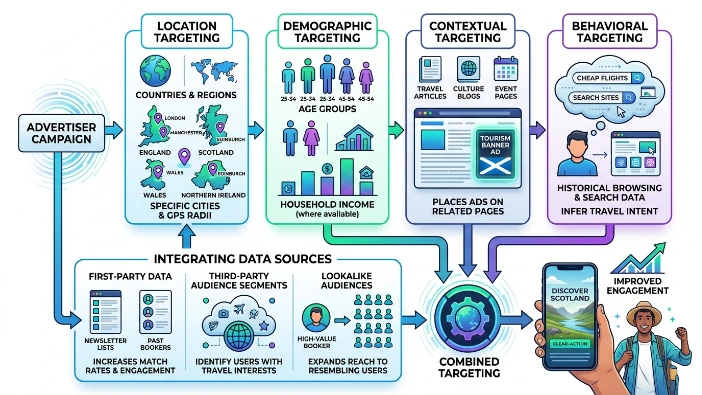
Targeting directs banner ads to defined audiences through location, demographic, contextual, and behavioral signals to increase relevance. Location targeting restricts delivery to specific countries, regions, cities, or GPS radii. For United Kingdom-focused campaigns, targeting uses regions such as England, Scotland, Wales, Northern Ireland, or specific cities like London, Manchester, and Edinburgh. Demographic targeting filters by age groups, gender, and household income where available. Contextual targeting places ads on pages related to travel, culture, and events. Behavioral targeting uses historical browsing and search data to infer travel intent.
First-party data such as newsletter lists and past bookers increases match rates and engagement. Third-party audience segments identify users with travel interest signals across the web. Lookalike audiences expand reach to users who resemble high-value bookers. Combining targeting signals improves engagement by ensuring ads reach users most likely to interact.
What creative components drive engagement in tourism banner ads?
Creative components that drive engagement include a clear visual of the destination, a concise headline, a visible value cue, and a distinct visual hierarchy. Use high-resolution photos of landmarks, beaches, or activities that represent the destination. Images with a single focal point increase clarity and recognition. Headlines: Use short headlines with 3–7 words that state the offer or experience. Include concrete benefits such as “from £99,” “2-night packages,” or “guided tours” to set expectations. Visual hierarchy: Place the image first, headline second, and value cue third to guide attention.
Animated or HTML5 creatives add interactive elements such as slides showing multiple experiences. Rich media units that expand with user interaction show more content without leaving the page, increasing engagement signals. Accessible design ensures legible text at all sizes and alt text for screen readers to maintain reach and compliance.
How are banner ads measured for engagement and performance?
Measurement relies on click-through rate, viewability, conversions, and post-click behavior tracked through analytics and ad-platform reporting. CTR measures immediate engagements. Viewability measures whether an ad was in a visible area for a minimum duration, typically 50% of pixels in view for 1 second for display and 2 seconds for video. Conversions measure downstream actions: newsletter sign-ups, itinerary downloads, or booking starts. Use UTM parameters and ad platform conversion pixels to attribute clicks and view-throughs. Post-click metrics include bounce rate, pages per session, and time on site to evaluate audience relevance.
Attribution models assign credit across touchpoints. First-click models highlight awareness impact. Last-click models show conversion triggers. Multi-touch attribution distributes credit across all exposures to reflect cumulative influence. Implementing server-to-server tracking improves data accuracy and reduces cookie loss.
Click Here to Explore More:
How Tourism Services Build Excitement Using Destination Ads
What processes produce higher engagement with banner ads?
A process that combines audience research, creative testing, targeted delivery, and performance optimisation produces higher engagement. Audience research defines segments by travel intent, seasonality, and trip type. Creative testing uses A/B and multivariate tests to compare imagery, headlines, and value messages. Targeted delivery selects optimal sites and devices, schedules by time of day, and applies frequency caps. Performance optimisation iterates on bids, placements, and creative based on KPI thresholds. Regular reporting every 7–14 days supports rapid adjustments.
What are the legal and privacy considerations for banner advertising?
Compliance requires adherence to data protection rules such as the UK GDPR and transparency about cookie use and data processing. Obtain valid consent for non-essential cookies before collecting or using personal data for targeting. Provide clear privacy notices describing data types used and retention periods. Honor user preferences and do not use sensitive personal data for targeting. Maintain data security controls for first-party lists. Use consent-management platforms to record and pass consent signals to ad platforms.
For interest-based advertising, maintain options for users to opt out. Retargeting windows must be reasonable; common practice uses 7–90 day windows depending on urgency and content. Document audience creation and suppression lists to prevent unintended targeting of excluded groups.
What benefits do tourism services gain from banner ad engagement?
Banner ads increase reach, reinforce destination awareness, drive site visits, and support audience segmentation for follow-up actions. Ads place destination imagery in front of large online audiences across travel and lifestyle sites. Repeated exposures build familiarity with destinations and experiences. Site visits: Engaging creatives with clear messaging drive clicks to destination pages or guides. Segmentation: Engagement data creates lists for retargeting and email campaigns. Cost efficiency: Programmatic buying and contextual targeting achieve scale while controlling CPMs and eCPMs for seasonal campaigns.
Direct benefits translate into measurable lift in pageviews, reportable increases in newsletter subscribes, and higher-quality remarketing lists. Example metrics: a campaign can show a 30% increase in destination page visits and a 15% uplift in newsletter sign-ups when creative and targeting align.
Explore More Expert Insights:
How Travel Companies Inspire Planning Using Mid-Funnel Advertising
How Resorts Nurture Guests Using Visual Experience Banner Ads
What use cases show effective banner ad engagement for tourism?
Use cases include destination awareness campaigns, seasonal offers, event promotion, and retargeting for booking completion. Destination awareness campaigns target broad audiences in key UK regions using scenic imagery and brief messaging. Seasonal offers highlight time-limited prices or packages for holidays and bank holidays. Event promotion targets users interested in festivals, sports, and cultural events with date-specific banners. Retargeting campaigns engage users who started a booking or viewed itineraries to recover abandoned sessions.
A coastal destination runs a spring awareness campaign with region-targeted banners and follows with segmented retargeting for users who viewed accommodation pages. The two-stage approach increases engaged sessions and prepares audiences for conversion-focused messaging later.
How should tourism teams organise banner ad campaigns for long-term engagement?
Organise campaigns by objective, audience, and creative library, with a testing calendar and reporting cadence to sustain engagement. Create separate campaigns for awareness, consideration, and retargeting. Maintain an asset library with approved images, headlines, and value cues mapped to audience segments. Schedule creative refreshes every 14–30 days to reduce fatigue. Define KPIs per campaign: CTR and VTR for awareness; time-on-site and pages per session for consideration. Set reporting cadence weekly for active campaigns and monthly for strategic reviews.
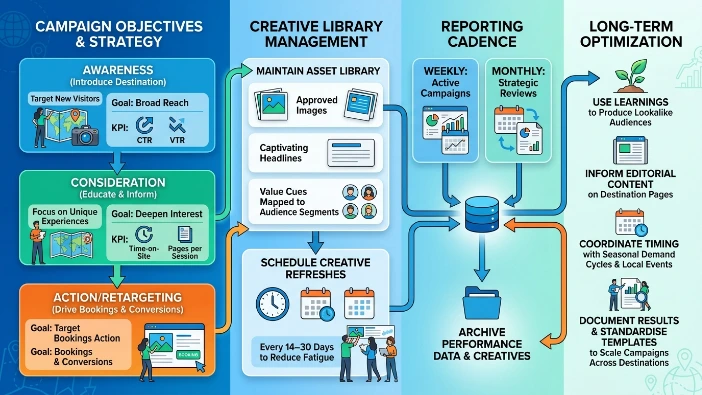
Archive performance data and creatives. Use learnings to produce lookalike audiences and to inform editorial content on destination pages. Coordinate timing with seasonal demand cycles and local events. Document results and standardise templates to scale campaigns across destinations.
Banner ads increase engagement by presenting targeted, image-led creative to defined audiences. Effective campaigns use precise targeting, measurable tracking, creative testing, and data-driven optimisation. Legal compliance and clear consent practices ensure responsible targeting. Organised campaign structures and regular refresh cycles sustain long-term engagement and build high-quality audiences for later conversion efforts.
Learn Everything About It Here:
Tourism Ads That Convert Destination Excitement Into Booking Actions