Hotel experience ads directly showcase room features, on-site amenities, and local experiences to convert browsers into direct bookers within a single campaign. Hotel experience ads are digital ad units designed to present concrete, bookable experiences room types, dining packages, spa treatments, and local tours and link those offers to a direct reservation flow. These ads use images, brief factual copy, pricing, availability windows, and a single direct booking link. Core entities: ad creative (images, short video), offer (price, dates, inclusions), booking endpoint (direct reservation page), and tracking pixel or API for conversion measurement.
How do experience ads fit into a hotel’s direct-booking strategy?
Experience ads function as demand converters that move users from inspiration to a direct reservation page with a single, measurable path. They sit at the bottom of the funnel and replace multi-page discovery with a concise value proposition and booking action. The typical process uses three steps target an audience based on intent signals, present an experience-specific creative with clear price or benefit, and link to a pre-filled booking page showing the same offer.
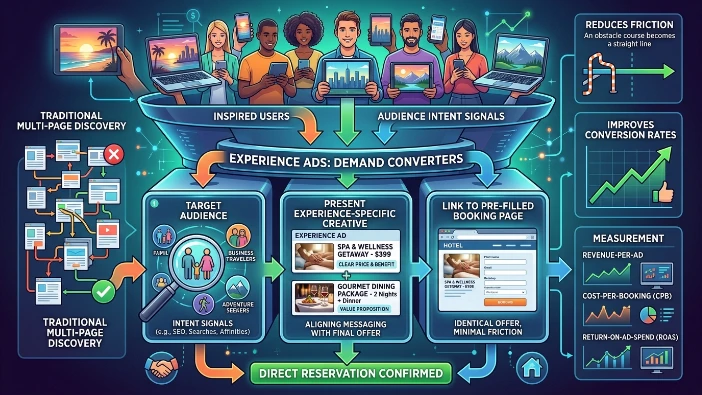
This reduces friction and improves conversion rates by aligning ad messaging with the final booking page. Measurement links ad impressions to completed reservations using revenue-per-ad, cost-per-booking, and return-on-ad-spend (ROAS) metrics.
How do hotels target audiences for these ads?
Hotels target using behavioural intent segments, remarketing lists, geographic filters, and lookalike audiences built from high-value guest data. Targeting uses first-party booking history and consented CRM segments to prioritise repeat guests and high-value bookers. Combine these with intent signals: recent searches for destination keywords, pages visited (room type, packages), and abandoned booking sessions.
Geotargeting narrows to feeder markets within travel distance, for example, drive markets within 200 miles or direct-flight cities. Lookalike audiences expand reach to profiles matching converters on demographic and behavioural features. Campaigns apply frequency caps to avoid ad fatigue and set bid strategies that prioritise conversion value (target ROAS or max conversion value).
How should ad creative be structured to convert interest into direct reservations?
Creative must present a single, tightly scoped experience, show the exact price or saving, and include a clear visual cue of what the guest receives. Headline with the package name, one-line room or experience benefit, price and dates, and a single booking CTA. Include number of nights, price per person, and included extras.
Match creative text to the booking page headline and product ID so the user sees consistent content before and after click. For visual assets, use on-property photos that match the package, not generic stock imagery. Video ads should display the offer text on-screen for at least 4 seconds and close with the booking endpoint displayed as a short URL or QR code.
What landing page features increase direct bookings from experience ads?
Landing pages must mirror the ad, pre-fill booking details, show transparent pricing and fees, and support one-click progression to payment. Identical headline and imagery to the ad, a pre-selected rate plan matching the ad offer, an itemised price breakdown including taxes and fees, visible cancellation policy, and a prominent booking summary box.
Use a trust element (verified reviews count and score) and secure payment badges. Collect only name, email, and card details for guaranteed bookings. Implement server-side validation and show immediate confirmation number upon booking completion. Track bookings with a conversion tag that sends confirmed revenue to the ad platform.
Read the Full Blog Here:
How Hotels Increase Reservations Using Banner Ads
How do hotels measure performance and attribute bookings to experience ads?
Hotels measure by linking ad click ID to booking confirmation via first-party tracking and by calculating cost-per-booking, conversion rate, and revenue-per-click. Set up server-to-server (S2S) callbacks or conversion pixels that pass click identifiers to the booking engine. Match click ID to the booking confirmation at checkout and log revenue, length of stay, and package ID.
What are the primary technical integrations required?
Required integrations include a booking engine with API access, an ad platform pixel or conversion API, a CRM for guest segments, and analytics for reconciliation. The booking engine must accept pre-filled parameters (rate code, room type, check-in/check-out dates) through URL query strings or POST requests. The ad platform requires either a client-side pixel or a conversion API to receive booking events. Connect CRM through hashed identifiers to enable match and lookalike creation.
Use analytics (for example, server logs or cloud data warehouse) to merge ad click data with confirmed bookings for accurate reporting. Ensure GDPR compliance: record consent for marketing cookies and data sharing.
What operational process ensures consistent campaign accuracy?
A documented workflow that ties offer creation, creative approval, URL mapping, and daily reconciliation prevents ad-to-booking mismatches. Define package in the property system with a unique rate code, generate creative assets referencing the rate code and exact price; create a pre-filled booking URL with tracking parameters, test the flow end-to-end before launch. Publish ads and monitor first 48 hours for content mismatches; reconcile daily bookings tagged to the campaign. Assign roles: revenue manager defines rates, marketing creates ad assets, web developer implements tracking, and analytics validates attribution.
Explore More Expert Insights:
Travel Banner Ads That Convert Trip Interest Into Confirmed Bookings
Educational Finance Campaign Ads That Turn Users Into Final Conversions
What benefits do hotels see from experience-focused direct-booking ads?
Hotels increase direct bookings, reduce commission dependency, improve average booking value, and capture first-party guest data for future campaigns. Direct-booking ads reduce reliance on third-party platforms by sending guests to property pages. Experience offers encourage upsells (spa, dining) that raise average booking value by explicit inclusion. Direct bookings provide guest email and consented data for CRM segmentation. Measured results include higher conversion rates compared with generic branding ads and lower cost-per-acquisition when tracking aligns with booking revenue.
How should hotels decide when to use experience ads versus other ad types?
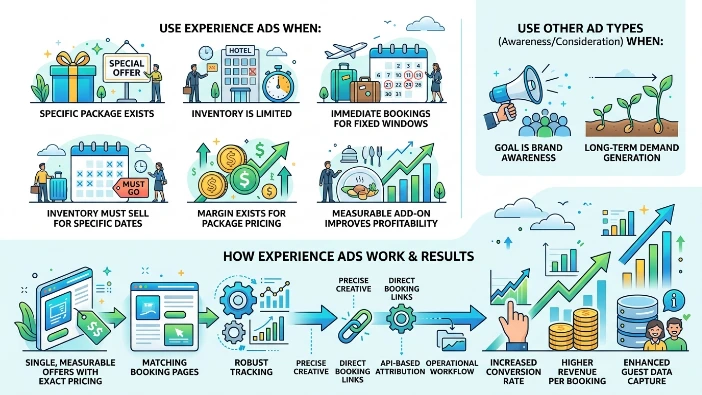
Use experience ads when a specific package exists, inventory is limited, or the hotel targets immediate bookings for fixed travel windows. If the goal is brand awareness or long-term demand generation, use awareness or consideration campaigns instead. Use experience ads when inventory must sell for specific dates, when margin exists for package pricing, or when the hotel can demonstrate a measurable add-on that improves profitability.
Hotel experience ads convert interest into direct reservations by presenting single, measurable offers with exact pricing, matching booking pages, and robust tracking. Implementing precise creative, direct booking links, API-based attribution, and an operational workflow yields measurable improvements in conversion rate, revenue per booking, and guest data capture.
Check Out the Full Article:
How Hotels Build Stay Interest Using Experience-Focused Campaigns