
Retargeting campaigns are digital advertising strategies that reconnect institutes with students who previously visited admission pages, explored course details, or interacted with educational content online. These campaigns strengthen admission intent by repeating relevant academic messaging across digital platforms during the student decision-making process.
Institutes in the United Kingdom use retargeting campaigns after the first stage of student awareness. A student who visits a university course page but leaves without applying often receives additional advertisements later while browsing websites, mobile apps, or video platforms.
These campaigns focus on users who already demonstrated interest in a specific academic category. Examples include students researching MBA programs, undergraduate engineering degrees, healthcare certifications, or online diploma courses.
Retargeting differs from standard awareness advertising because it targets previously engaged users instead of broad audiences. This creates stronger message relevance during the admission journey.
How do institutes use retargeting campaigns to strengthen admission intent?
Institutes strengthen admission intent by showing repeated academic advertisements to interested students across multiple digital channels after initial website visits or content interactions. This repeated exposure reinforces course awareness, enrollment timelines, and institutional familiarity during active student decision-making periods.
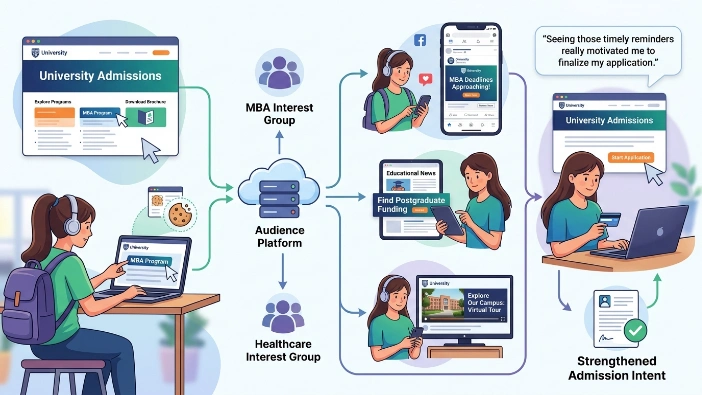
Most retargeting systems begin when a student interacts with an institute’s website. Common interactions include course page visits, brochure downloads, webinar registrations, or admission inquiry submissions.
After this interaction, advertising systems categorize the user into audience groups. These groups receive targeted advertisements related to the specific academic interest already demonstrated online.
A student who explored postgraduate business programs, for example, often receives additional advertisements featuring MBA deadlines, campus information, or postgraduate funding details. A healthcare student may encounter nursing or public health admission campaigns instead.
Institutes commonly distribute retargeting advertisements across search networks, social media platforms, educational websites, and video streaming services. This multi-platform presence increases repeated visibility throughout the admission research cycle.
Campaign timing also plays a central role. Retargeting advertisements usually increase during application deadlines, scholarship announcements, and final enrollment periods when student decision activity intensifies.
Unlike broad awareness campaigns, retargeting communication becomes more personalized and intent-focused. The messaging reflects the user’s earlier browsing behavior rather than general institutional promotion.
Readers interested in final-stage conversion strategies can also explore to understand:
How Institutes Close Admission Leads Using High-Intent Retargeting Campaigns
Why do retargeting campaigns improve student engagement during admissions?
Retargeting campaigns improve student engagement because they reconnect institutes with users who already demonstrated academic interest, increasing message relevance and strengthening ongoing interaction with course-related content during the enrollment research process.
Students rarely complete admission decisions during their first website visit. Most compare multiple institutions, review course structures, analyze tuition information, and evaluate study modes before progressing toward applications.
Retargeting campaigns maintain communication during this extended research phase. Students repeatedly encounter course-specific advertisements while continuing their online activity.
Repeated exposure increases recognition of admission opportunities. A student who sees the same course promotion several times becomes more familiar with the program structure, intake dates, and institutional identity.
Engagement rates also improve because advertisements align with existing academic interests. Users already researching postgraduate psychology programs respond more actively to psychology-related advertisements than to unrelated academic messaging.
Institutes also use engagement-based segmentation to improve campaign accuracy. Students who visited scholarship pages often receive funding-related advertisements, while students exploring accommodation sections receive campus-life messaging.
Retargeting campaigns additionally support cross-device continuity. A student who browses admission pages on a mobile device during the afternoon may later encounter related advertisements on a laptop during evening research sessions.
This continuity keeps institutions visible throughout multiple stages of the student enrollment journey.
What types of student actions trigger retargeting campaigns?
Student actions such as course page visits, brochure downloads, webinar registrations, application form views, and tuition searches commonly trigger retargeting campaigns within educational admission systems. These actions indicate measurable academic interest and active enrollment research behavior.
Institutes track digital interactions through website analytics systems and advertising technologies. These systems record specific user actions connected to admission intent.
Course-page engagement is one of the strongest retargeting triggers. A student spending several minutes reviewing an accounting degree page demonstrates stronger interest than a user briefly visiting a homepage.
Application form interactions also provide important intent signals. Students who begin applications but leave before submission frequently enter retargeting campaigns focused on enrollment completion reminders.
Brochure downloads indicate information-seeking behavior. Many institutes use follow-up advertisements after downloadable prospectus activity because these students already engaged with detailed academic content.
Event registrations also contribute to retargeting audiences. Students attending virtual open days, admissions webinars, or online Q&A sessions often receive continued advertising related to the same course categories afterward.
Tuition and scholarship page visits represent another high-interest signal. These users commonly progress further within the admission funnel because financial planning forms a major part of university decision-making.
Institutes organize these interactions into audience segments based on behavior intensity. Higher-engagement users typically receive more frequent and detailed retargeting advertisements.
How do institutes personalize retargeting advertisements for students?
Institutes personalize retargeting advertisements by matching advertisement content with previous student interactions, academic interests, geographic regions, study preferences, and enrollment timelines. This personalization increases relevance throughout the student admission research process.
Personalized campaigns use behavioral data instead of generic promotional messaging. A student researching online postgraduate programs often receives advertisements focused on flexible learning schedules rather than campus accommodation.
Institutes also customize advertisements based on educational level. Undergraduate applicants receive messaging related to entry requirements and student life, while postgraduate audiences encounter research opportunities and career-focused content.
Geographic personalization improves campaign relevance further. Domestic students in the United Kingdom often receive local campus messaging, while international students encounter visa guidance, international support services, and overseas enrollment deadlines.
Timing-based personalization also influences advertisement delivery. Students browsing during final application periods frequently receive deadline-focused advertisements with direct enrollment reminders.
Course-category personalization remains one of the strongest retargeting strategies. Engineering students receive laboratory-focused campaign visuals, while creative arts applicants encounter portfolio-related messaging and program showcases.
Institutes also use sequential advertising approaches. The first retargeting advertisement may focus on course awareness, while later advertisements highlight scholarships, application support, or enrollment timelines.
This progressive communication structure strengthens student familiarity gradually rather than repeating identical advertisements continuously.
Explore More Expert Insights:
How Online Learning Platforms Increase Course Consideration Using Banner Ads
How Universities Improve Program Awareness Using Mid-Funnel Advertising
How do retargeting campaigns support admission funnel progression?
Retargeting campaigns support admission funnel progression by guiding students from initial awareness toward deeper academic engagement, stronger enrollment consideration, and eventual application activity through repeated and relevant digital communication.
The student admission funnel contains multiple stages. These stages commonly include awareness, consideration, intent development, and final application activity.
Retargeting primarily operates during the middle and lower funnel stages where students already recognize institutional options but continue evaluating alternatives.
At the consideration stage, institutes use retargeting to reinforce academic credibility and program relevance. Advertisements often highlight course outcomes, campus facilities, or learning flexibility.
As students move toward intent development, campaign messaging becomes more enrollment-focused. Examples include application deadlines, interview schedules, scholarship dates, and admission process information.
Retargeting also reduces disengagement within the funnel. Students who leave admission pages without further interaction often return later after repeated advertisement exposure.
Many institutes use audience exclusions to refine progression efficiency. Students who already submitted applications usually stop receiving awareness advertisements and instead receive enrollment or onboarding communication.
This structured movement between audience groups improves message alignment across the entire admission journey.
Readers seeking broader awareness-stage strategies can revisit to understand:
How Institutes Increase Seasonal Admissions Using Banner Ads
What benefits do institutes gain from retargeting campaigns?
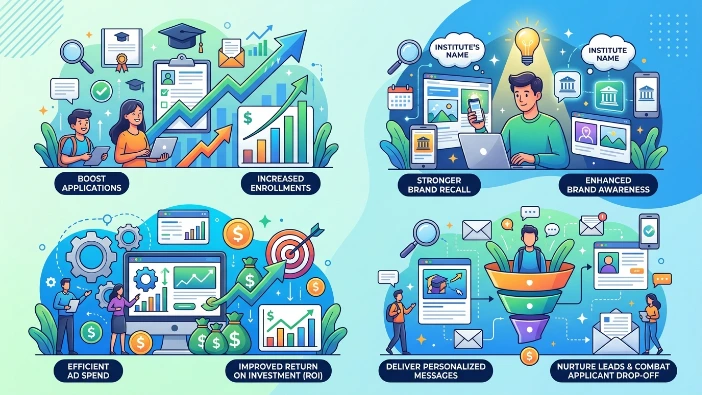
Institutes gain stronger student engagement, higher return visitor activity, improved admission visibility, refined audience targeting, and better enrollment funnel continuity through retargeting campaigns focused on previously engaged users.
Retargeting increases the efficiency of digital admission campaigns because advertising focuses on audiences with existing academic interest rather than entirely new users.
Institutes also gain improved visibility during competitive admission periods. Students comparing several universities continue seeing repeated institutional messaging throughout their online research process.
Campaign analytics provide detailed behavioral insights. Institutes measure return visits, advertisement engagement, application progression, and audience interaction patterns across different academic categories.
Retargeting also improves communication consistency. Students encounter aligned academic messaging across websites, search platforms, and social media environments instead of disconnected advertising experiences.
Audience segmentation creates more efficient campaign management. Undergraduate applicants, postgraduate researchers, international students, and professional learners receive distinct communication paths based on their educational objectives.
Institutes additionally benefit from flexible campaign adjustments. Advertising teams can modify visuals, messaging, or audience settings during active enrollment periods based on engagement data.
As digital student recruitment continues expanding across the United Kingdom, retargeting campaigns remain an important mid-funnel strategy for strengthening admission intent and sustaining student engagement throughout the enrollment decision process.