Retargeting funnels in e-commerce sales conversion are structured advertising sequences that re-engage users who previously interacted with products, guiding warm leads through personalized reminders, trust signals, and conversion-focused messaging until they complete a purchase transaction successfully online.
A warm lead is a user who already demonstrated purchase intent. This includes visitors who viewed products, added items to carts, interacted with checkout pages, or clicked promotional advertisements.
Retargeting funnels reconnect these users with products they previously explored. The funnel structure uses multiple stages to move users from consideration toward purchase completion.
The first stage focuses on visibility restoration. Users see product reminders through display banners, social advertisements, or email retargeting campaigns. The second stage introduces reassurance signals such as customer reviews, stock confirmation, or delivery details. The final stage emphasizes conversion-focused messaging including checkout reminders and time-sensitive offers.
E-commerce businesses in the United Kingdom frequently use retargeting funnels to recover abandoned sales opportunities and increase customer acquisition efficiency.
Read:
How E-commerce Businesses Build Trust Using Social Proof Banner Ads
How do warm leads move through a retargeting funnel?
Warm leads move through a retargeting funnel by progressing from product awareness to repeated engagement, trust validation, purchase consideration, and final checkout completion through sequential advertising messages designed to reinforce interest and reduce abandonment across digital shopping environments effectively.
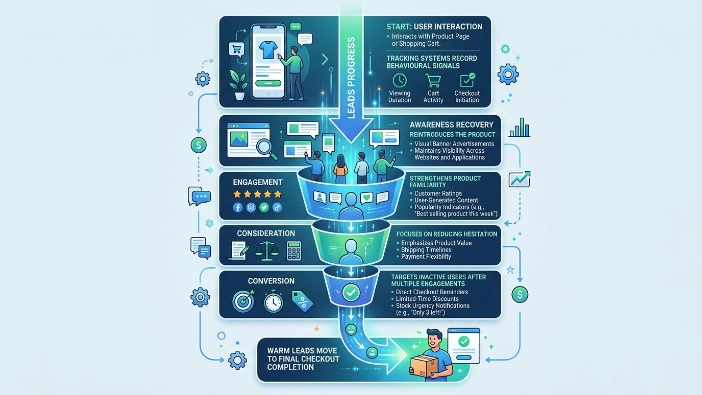
The funnel begins when a user interacts with a product page or shopping cart. Tracking systems record behavioural signals including viewing duration, cart activity, and checkout initiation.
The awareness recovery stage reintroduces the product through visual banner advertisements. These banners maintain product visibility across websites and applications.
The engagement stage strengthens product familiarity. Ads at this stage often include customer ratings, user-generated content, or popularity indicators such as “Best-selling product this week.”
The consideration stage focuses on reducing hesitation. Messaging emphasizes product value, shipping timelines, or payment flexibility.
The final conversion stage targets users who remain inactive after multiple engagements. These advertisements include direct checkout reminders, limited-time discounts, or stock urgency notifications.
Retargeting funnels operate effectively because each stage matches user intent progression rather than repeating identical advertisements continuously.
Why do retargeting funnels improve e-commerce sales performance?
Retargeting funnels improve e-commerce sales performance by increasing repeat exposure, reinforcing buyer confidence, reducing decision delays, recovering abandoned transactions, and delivering personalized conversion messaging that aligns with customer intent during advanced purchasing stages across online retail environments consistently.
Most users do not purchase during the first website visit. Retargeting funnels address this behaviour by maintaining continued product engagement after users leave the store.
Repeated exposure improves familiarity. Familiarity strengthens recognition and increases the probability of return visits.
Behaviour-based personalization also improves advertising relevance. Users see products connected directly to their browsing history instead of unrelated promotional content.
Abandoned cart recovery campaigns contribute significantly to sales performance. Users who already added products to checkout represent high-intent audiences. Retargeting systems prioritize these audiences because conversion probability remains high.
Trust-focused messaging increases funnel efficiency further. Product ratings, customer reviews, and delivery guarantees reduce uncertainty during the final purchase stage.
Sales performance improves because retargeting funnels focus on qualified audiences instead of broad untargeted traffic acquisition.
What types of retargeting ads are used for warm leads?
The main retargeting ads used for warm leads include dynamic product ads, abandoned cart banners, social proof advertisements, discount reminder campaigns, email retargeting sequences, and checkout recovery messages, each designed to increase conversion probability through personalized customer re-engagement strategies online.
Dynamic product ads automatically display products users previously viewed. These ads update in real time based on browsing behaviour and product availability.
Abandoned cart banners focus specifically on incomplete checkout sessions. They remind users about items left in carts and encourage transaction continuation.
Social proof advertisements use customer ratings, purchase statistics, and testimonials to strengthen trust. These ads perform effectively during mid-funnel evaluation stages.
Discount reminder campaigns introduce price-based motivation. Examples include “10% off ends tonight” or “Free delivery available until midnight.”
Email retargeting sequences provide structured follow-up communication. Businesses often send checkout reminders within 24 hours after abandonment to maintain purchase urgency.
Checkout recovery messages target users who entered payment stages but exited before completion. These messages emphasize transaction simplicity and product availability.
Many e-commerce businesses combine multiple ad formats within a single retargeting funnel to improve conversion consistency across different audience segments.
Explore:
How E-commerce Brands Boost Checkout Conversions Using Banner Retargeting
How does audience segmentation strengthen retargeting funnels?
Audience segmentation strengthens retargeting funnels by grouping users according to behaviour, purchase intent, engagement level, and transaction stage, allowing businesses to deliver personalized advertising sequences that match specific customer needs and improve overall sales conversion performance accurately.
Segmentation prevents irrelevant advertising exposure. Users at different purchase stages require different messaging structures.
Product viewers receive awareness-focused advertisements introducing product features and customer engagement data. Cart abandoners receive checkout-oriented reminders and urgency messaging.
High-intent users who reached payment pages often receive stronger conversion incentives such as delivery discounts or stock alerts. Low-intent users receive educational or trust-building content instead.
Purchase history segmentation also improves campaign efficiency. Returning customers receive personalized recommendations connected to previous buying patterns.
Geographic segmentation supports regional optimization. E-commerce businesses targeting United Kingdom audiences often adjust delivery messaging, currency formatting, and shipping expectations based on local purchasing behaviour.
Behavioural segmentation increases advertising efficiency because users receive contextually relevant messages aligned with their actual interaction history.
What role does personalisation play in retargeting funnel success?
Personalization improves retargeting funnel success by aligning advertisements with individual customer interests, browsing behaviour, previous interactions, and purchase intent, creating more relevant experiences that increase engagement quality and accelerate sales conversion outcomes across digital commerce systems efficiently.
Personalized retargeting uses behavioural data to create user-specific advertising experiences. This improves relevance compared to generalized advertising campaigns.
A user browsing winter jackets receives advertisements displaying similar outerwear products instead of unrelated product categories. This maintains contextual consistency throughout the funnel.
Product-specific personalization also increases engagement rates. Ads featuring previously viewed products generate stronger click-through performance than generic promotional banners.
Timing personalization improves funnel responsiveness further. High-intent users often receive advertisements within hours after abandonment to maintain active purchase consideration.
Message personalization strengthens trust. Returning customers may receive loyalty-focused messaging, while first-time visitors receive reassurance-focused advertisements emphasizing reviews or delivery guarantees.
Advanced personalization systems integrate behavioural analytics, browsing frequency, and transaction history to optimize ad delivery timing and content structure.
Businesses evaluating retargeting platforms often prioritize personalization capabilities because relevance strongly affects conversion efficiency.
Explore More Expert Insights:
How Retailers Increase Final Purchase Rates Using Time-Sensitive Banner Campaigns
How E-commerce Brands Turn Wishlist Users Into Buyers Using Personalized Display Ads
How do businesses measure retargeting funnel effectiveness?
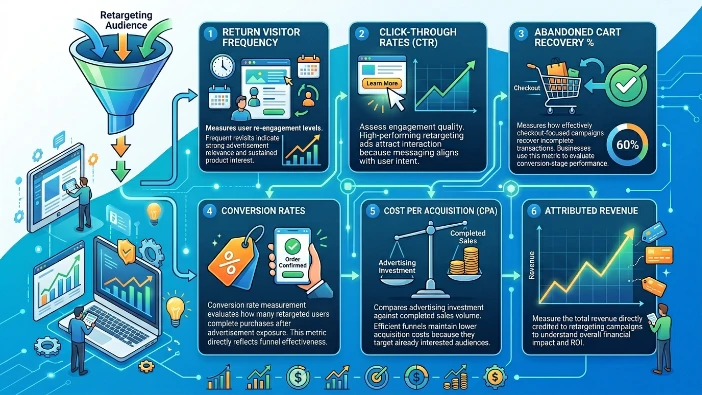
Businesses measure retargeting funnel effectiveness using conversion rates, return visitor frequency, click-through rates, abandoned cart recovery percentages, cost per acquisition, and attributed revenue metrics to evaluate how successfully campaigns convert warm leads into completed online transactions consistently.
Conversion rate measurement evaluates how many retargeted users complete purchases after advertisement exposure. This metric directly reflects funnel effectiveness.
Return visitor frequency measures user re-engagement levels. Frequent revisits indicate strong advertisement relevance and sustained product interest.
Click-through rates assess engagement quality. High-performing retargeting ads attract interaction because the messaging aligns with user intent.
Abandoned cart recovery percentage measures how effectively checkout-focused campaigns recover incomplete transactions. Businesses use this metric to evaluate conversion-stage performance.
Cost per acquisition compares advertising investment against completed sales volume. Efficient funnels maintain lower acquisition costs because they target already interested audiences.
Attributed revenue analysis connects ad exposure directly to transaction outcomes. Businesses use attribution systems to identify which funnel stages generate the highest conversion impact.
Performance measurement also supports optimization decisions. Businesses refine audience segmentation, ad timing, and personalization strategies using campaign data insights.
Why are retargeting funnels important for e-commerce strategies?
Retargeting funnels are important for BOFU e-commerce strategies because they focus on high-intent audiences, accelerate purchase completion, strengthen conversion efficiency, reduce revenue loss from abandonment, and support scalable sales growth through structured behavioural targeting systems designed for transaction-focused marketing objectives.
BOFU marketing focuses on users closest to purchase completion. These users require conversion reinforcement rather than general awareness messaging.
Retargeting funnels support this objective by reconnecting businesses with users already familiar with products and services. This reduces the need for extensive educational advertising.
Warm leads represent valuable conversion opportunities because they already demonstrated measurable interest. Retargeting systems increase the probability of recovering these opportunities through structured engagement.
BOFU-focused campaigns also improve advertising efficiency. Businesses allocate budget toward audiences with established purchase intent instead of broad untargeted traffic pools.
Modern e-commerce competition increases the importance of conversion optimization. Businesses using advanced retargeting funnels maintain stronger checkout recovery performance and higher transaction consistency.
Retargeting funnels combine behavioural tracking, personalization, social proof integration, and conversion-focused messaging into a structured framework that supports sustainable e-commerce sales growth across competitive digital marketplaces.