
Time-sensitive banner campaigns in retail conversion systems are structured advertising formats that display limited-duration offers, countdown indicators, and expiry-based messaging designed to trigger immediate purchase decisions by creating urgency at the final stage of the customer buying journey.
Time-sensitive banner campaigns operate at the bottom of the funnel where customer intent is already high. These banners use visible time constraints such as 15-minute, 1-hour, or 24-hour validity windows to influence final purchase behaviour.
These systems are built on conversion psychology linked to urgency recognition. Customers who are already evaluating checkout options receive final prompts that reduce delay patterns. The banner structure removes extended consideration cycles by introducing measurable time boundaries.
In UK digital retail environments, these banners appear on product pages, cart pages, and checkout transition screens. Their placement ensures exposure when purchase intent reaches maximum probability.
The system defines three operational layers: time framing, visual urgency indicators, and transaction reinforcement. Time framing sets expiry duration. Visual indicators highlight countdown logic. Transaction reinforcement confirms immediate benefit before purchase completion.
How do time-sensitive banners increase final purchase rates?
Time-sensitive banners increase final purchase rates by applying structured urgency signals, reducing decision delays, and reinforcing immediate transaction value through visible countdown systems that encourage users to complete checkout actions before offer expiration thresholds are reached.
Time-sensitive banners influence behaviour at the decision threshold. Customers already prepared to purchase receive final prompts that remove hesitation. The presence of countdown timers creates measurable urgency.
Decision delay reduction occurs because time constraints limit extended evaluation. Users shift from comparison mode to action mode when expiration indicators appear. This accelerates checkout initiation.
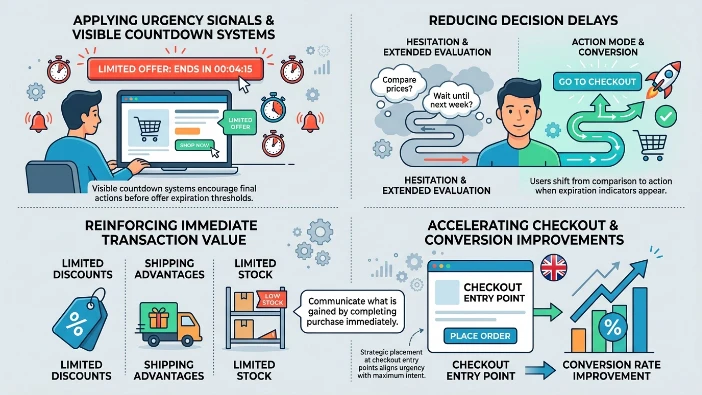
Reinforced value communication ensures that users understand what is gained by completing the purchase immediately. This includes fixed discounts, shipping advantages, or limited stock availability indicators.
In retail systems across the United Kingdom, conversion rate improvements are observed when banners are placed at checkout entry points. These placements align urgency with maximum intent stages.
The final purchase increase mechanism depends on three behavioural triggers: time limitation awareness, loss avoidance recognition, and immediate reward visibility.
What components make time-sensitive banner campaigns effective?
Effective time-sensitive banner campaigns use countdown timers, structured offer framing, visible expiration indicators, and consistent placement within high-intent purchase zones to ensure urgency is clearly communicated and decision acceleration occurs at critical conversion points in retail systems.
Countdown timers display remaining time in structured formats such as minutes or hours. This creates continuous awareness of limited availability and reinforces immediate action requirements.
Offer framing defines what benefit expires. This includes discount percentage limits, shipping upgrades, or bundle availability restrictions. Clear framing ensures users understand what is at risk.
Expiration indicators highlight finality. These indicators remove ambiguity about offer duration and create clear end points for decision-making.
Placement within high-intent zones ensures maximum exposure. These zones include cart pages, checkout overlays, and product confirmation screens where purchase intent is already established.
Each component functions as part of a unified conversion structure. The system ensures urgency is not abstract but measurable and visually reinforced across all interaction points.
How is urgency structured in banner advertising systems?
Urgency in banner advertising systems is structured through time segmentation, visual countdown representation, and behavioral triggers that align limited availability messaging with final-stage purchase intent to create immediate action responses within digital retail environments.
Time segmentation divides offers into defined durations such as 15 minutes, 60 minutes, or 24 hours. Each segment is assigned specific behavioural expectations based on urgency intensity.
Visual countdown representation converts time data into continuously updating displays. These displays ensure users perceive ongoing reduction in availability window, reinforcing action requirements.
Behavioural triggers include loss avoidance signals and limited stock indicators. These triggers activate when users are closest to completing transactions, ensuring maximum conversion impact.
Urgency structure is applied consistently across all banner placements. This ensures users experience uniform conversion pressure at all decision points.
In UK retail systems, structured urgency is commonly applied during seasonal sales events, high-demand product launches, and checkout recovery scenarios.
Where do retailers use time-sensitive banners in the purchase journey?
Retailers use time-sensitive banners at checkout pages, cart interfaces, product confirmation screens, and exit-intent overlays where purchase intent is highest and final decision reinforcement is required to convert consideration into completed transactions efficiently.
Checkout pages represent the most critical placement. Users already committed to purchase receive final urgency signals that reduce abandonment rates.
Cart interfaces display remaining time-based offers that influence whether users proceed or delay. These placements directly affect cart abandonment reduction metrics.
Product confirmation screens reinforce urgency immediately after selection. This ensures that decision momentum is maintained without interruption.
Exit-intent overlays activate when users attempt to leave checkout flows. These overlays reintroduce time-limited incentives to recover potential lost transactions.
Read & explore:
How Retailers Educate Customers Using Comparison Banner Advertising
In UK digital retail environments, these placements are optimised for conversion efficiency. Each location corresponds to a specific stage of decision friction removal within the purchase journey.
Explore More Expert Insights:
How E-commerce Brands Turn Wishlist Users Into Buyers Using Personalized Display Ads
How Online Stores Maximise Checkout Completion Using Conversion-Focused Banner Retargeting Ads
What measurable outcomes come from time-sensitive banner campaigns?
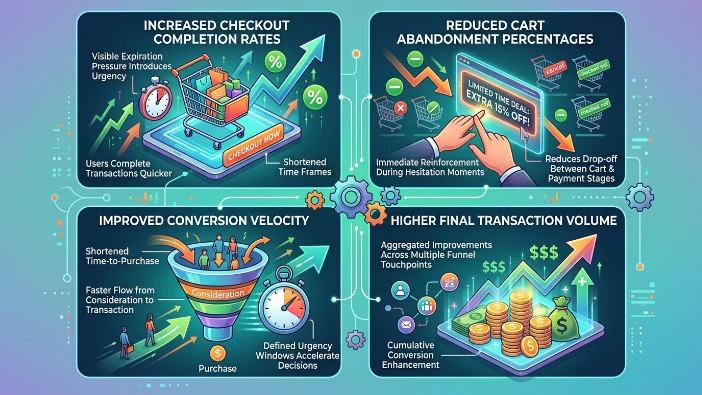
Time-sensitive banner campaigns produce measurable outcomes such as increased checkout completion rates, reduced cart abandonment percentages, improved conversion velocity, and higher final transaction volume due to structured urgency-driven decision acceleration at critical retail interaction points.
Checkout completion rates increase when urgency is introduced at final decision stages. Users complete transactions within shorter time frames due to visible expiration pressure.
Cart abandonment percentages decrease because users receive immediate reinforcement signals during hesitation moments. This reduces drop-off between cart and payment stages.
Conversion velocity improves as time-to-purchase shortens. Customers move from consideration to transaction within defined urgency windows rather than extended browsing cycles.
Final transaction volume increases due to aggregated improvements across multiple funnel touchpoints. Each banner interaction contributes to cumulative conversion enhancement.
Retail systems in the United Kingdom apply these campaigns during high-traffic periods to stabilize purchase flow and maintain consistent revenue performance.
Read & explore:
How E-commerce Stores Increase Repeat Purchases Through Banner Advertising
How do retailers implement optimisation using these campaigns?
Retailers implement optimisation using time-sensitive banner campaigns by aligning urgency triggers with checkout behaviour, integrating structured expiration logic into final decision points, and reinforcing immediate purchase incentives at moments of highest conversion probability.
Optimisation focuses on users already ready to purchase. Time-sensitive banners function as final reinforcement tools that remove hesitation barriers.
Urgency triggers are aligned with checkout behaviour patterns. When users pause at payment stages, banners activate to reintroduce time-limited value propositions.
Expiration logic is integrated into backend campaign systems. This ensures that offers remain valid only within defined conversion windows, maintaining structural consistency across retail platforms.
Final decision reinforcement occurs through visible countdown indicators placed directly within checkout environments. This ensures users remain aware of time constraints until transaction completion.
Retailers in the UK apply optimisation to maximise revenue efficiency per visitor. This approach ensures that high-intent users complete purchases without extended decision delays.