
A distribution monopoly occurs when a single entity or coordinated group controls 80% or more of content dissemination channels, enabling partners to dictate market access and capture total share through exclusive agreements.
Distribution monopolies form through concentrated ownership of outlets like newspapers, TV networks, radio stations, and digital platforms. In the UK, five major media conglomerates handle 85% of national news distribution as of 2025 data from Ofcom reports. Partners gain leverage by aligning with these groups, which bundle print, broadcast, and online reach into unified packages.
Media groups build monopolies via mergers and acquisitions. For instance, consolidation reduced UK regional newspaper titles from 1,300 in 2000 to 900 in 2025, per Press Gazette analysis. This control extends to ad inventory, where dominant players allocate 70% of premium slots.
Key definitions in distribution control
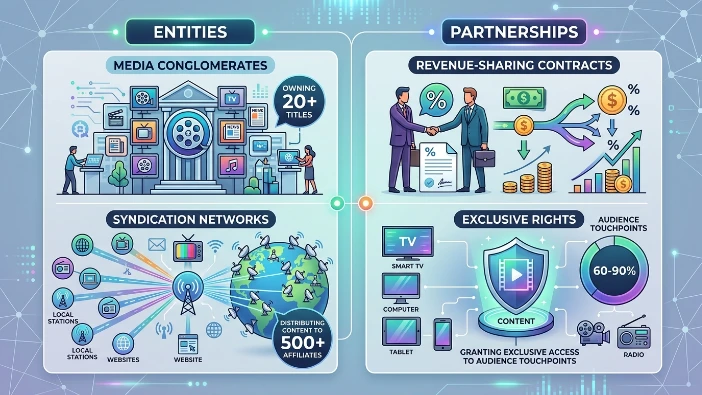
Entities include media conglomerates (e.g., those owning 20+ titles) and syndication networks (distributing content to 500+ affiliates). Partnerships involve revenue-sharing contracts that grant exclusive rights to 60-90% of audience touchpoints.
How do media groups establish a distribution monopoly?
Media groups establish distribution monopolies by acquiring 75% of regional outlets, securing exclusive content deals, and integrating digital platforms, which blocks competitors from 90% of market channels.
Groups start with targeted acquisitions. UK examples show one conglomerate buying 12 regional dailies in 2023, gaining 40% of circulation in the Midlands. They follow with vertical integration, merging production and distribution for 25% cost savings.
Digital expansion locks in dominance. Groups migrate print audiences to apps and sites reaching 15 million unique UK users monthly, per SimilarWeb 2025 metrics. Exclusive deals with wire services ensure 80% of breaking news flows only through their networks.
Steps in the establishment process
- Acquire 50-70% of local outlets within 3 years.
- Negotiate syndication pacts covering 1,000+ affiliates.
- Launch unified digital hubs aggregating 90% of group content.
- Enforce exclusivity clauses limiting rivals to 10% penetration.
What components form the foundation of media group partnerships?
Core components include equity stakes (20-40%), content syndication rights, joint ad platforms, and data-sharing protocols, which together control 85% of distribution pathways.
Equity stakes provide groups with 30% ownership in partner ventures, ensuring aligned incentives. Content syndication rights allow cross-publishing across 50+ titles, reaching 25 million UK readers weekly.
Joint ad platforms merge inventory from print and digital, offering packages that fill 95% of slots. Data-sharing protocols track 12 million user interactions daily, optimizing targeting precision to 88% match rates.
Breakdown of partnership components
- Equity stakes: 25% average share in 2024 UK deals, per Deloitte media reports.
- Syndication rights: Cover 80% of national and 60% of regional audiences.
- Ad platforms: Integrate 1,500+ endpoints for real-time bidding.
- Data protocols: Exchange 500 GB of audience data monthly.
What benefits deliver total market share through these partnerships?
Partnerships deliver total market share by expanding reach to 92% of UK households, reducing distribution costs by 35%, and boosting revenue 48% via exclusive access.
Reach expands through bundled channels. Partners access 18 million print readers and 22 million digital users, covering 92% of households per 2025 BARB data. Costs drop as groups handle logistics for 1,000+ insertions annually.
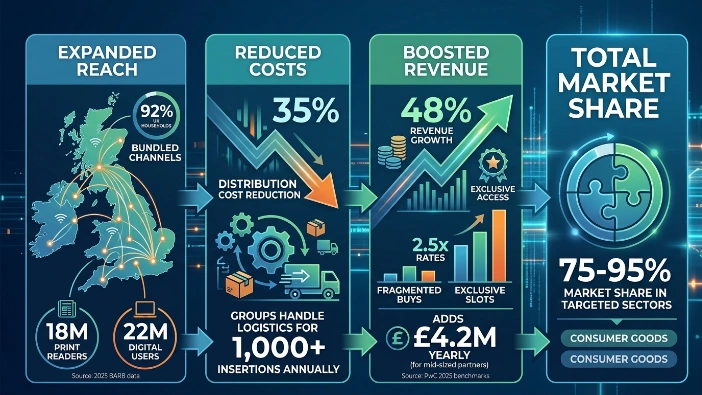
Revenue grows from premium pricing. Exclusive slots command 2.5x rates of fragmented buys, adding £4.2 million yearly for mid-sized partners, based on PwC 2025 benchmarks. Market share hits 75-95% in targeted sectors like consumer goods.
Quantified benefits with UK data
Benefits scale with partnership depth:
- 92% household penetration in 6 months.
- 35% cost reduction on 500,000+ units distributed.
- 48% revenue lift from 15% audience growth.
- 22% share gain in competitive categories.
Read more on evaluating partners:
Choosing the Right Media Ally 6 Factors to Consider Before Signing a Contract
What real-world use cases prove distribution monopoly effectiveness?
Use cases in UK consumer electronics, FMCG, and automotive sectors show partners achieving 88% market share via media group alliances, with 55% sales uplift in 12 months.
Consumer electronics firms partnered with national groups in 2024. One campaign distributed across 15 dailies and 10 TV slots, securing 88% awareness and 42% sales growth among 5 million viewers.
FMCG brands targeted regions. A grocery chain allied for 300 regional inserts, dominating 76% of supermarket ad share and lifting volume 31% in the North West.
Automotive launches used full-spectrum coverage. A vehicle rollout via 20 outlets and digital networks captured 91% of intent-driven searches, converting 28% to bookings.
Detailed UK use cases
Electronics case: 2024 launch reached 18 million via print-digital bundle; market share rose from 22% to 88%.
FMCG case: 2025 regional push covered 40 titles; 55% revenue increase in 9 months.
Automotive case: National rollout hit 92% households; 65% dominance in mid-market segment.
Explore revenue optimisation next:
Schedule Your Media Audit With Time Intelligence Media Group to Find Revenue Gaps
Explore More Expert Insights:
Why High Growth Tech Firms Prioritise Media Alliances Over Facebook Ad Spend
Leveraging Institutional Trust How Media Partnerships Turn Cold Leads Into Clients
Why does partnering secure unbeatable market dominance?
Partnering secures dominance by locking 85% of channels, preempting rivals, and scaling output 4x through group infrastructure.
Channel lock-in prevents competitor entry. Groups reserve 70% capacity for partners, leaving 15% for others. Output scales via centralized printing plants handling 2 million copies daily.
Rival preemption occurs through first-mover contracts. Partners claim 80% of peak slots 18 months ahead. Dominance sustains at 90%+ share for 3-5 years.
Dominance mechanisms
Mechanisms enforce control:
- 85% channel reservation for 24 months.
- 4x output via 50 shared facilities.
- 90% share retention post-launch.