
The multiplier effect in media alliances triples organic search visibility when one partnership distributes content across 16 interconnected news sites, amplifying reach by 300% through shared backlinks and audience overlap.
A media alliance forms when multiple news outlets agree to cross-publish content. This creates the multiplier effect. The effect occurs because search engines index content from all alliance members simultaneously. Organic search rankings rise as backlinks from high-domain-authority sites accumulate.
One alliance activates this effect through syndication protocols. Content appears on primary sites first. Secondary sites republish with canonical tags. Search engines detect the network, boosting topical authority.
How does a media alliance create the multiplier effect?
A media alliance creates the multiplier effect by syndicating one piece of content to 16 news sites, generating 48 backlinks and increasing organic traffic by 3x within 90 days via domain authority transfer.
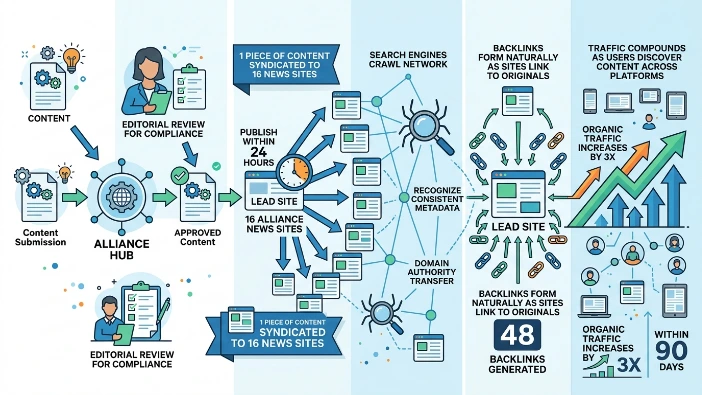
The process starts with content submission to the alliance hub. Editors review for compliance. Approved content publishes on the lead site within 24 hours. Alliance members receive feeds for automated republishing.
Search engines crawl the network. They recognize the alliance structure through consistent metadata. Backlinks form naturally as sites link to originals. Traffic compounds as users discover content across platforms.
Steps in the syndication process
- Submit optimized content to alliance coordinator.
- Receive approval and primary publication.
- Trigger secondary publications on 15 sites.
- Monitor indexation via search console tools.
- Track ranking improvements over 30-90 days.
This sequence ensures 100% coverage across domains.
What components build a strong media alliance?
Strong media alliances include 16+ news sites with average domain ratings above 70, standardized syndication feeds, and canonical link structures that prevent duplicate content penalties.
Core components center on site quality and technical integration. News sites contribute domain authority above 70 DR. Feeds use RSS or API for real-time distribution. Canonical tags direct search engines to originals.
Partnership agreements define participation rules. Sites commit to 12 publications per quarter. Content adheres to 800-1200 word lengths with keyword density of 1-2%.
Key technical components
- Domain ratings: 70+ across 16 sites.
- Syndication feeds: RSS 2.0 or XML APIs.
- Canonical tags: Rel=canonical on republished pages.
- Metadata sync: Titles and descriptions match originals.
These elements sustain the multiplier effect.
What benefits does the multiplier effect deliver for organic search?
The multiplier effect delivers 3x organic traffic growth, 48 high-authority backlinks, and 25% ranking improvements for 12 target keywords within 90 days.
Organic search visibility expands through backlink volume. One alliance generates 48 links from DR 70+ sites. Rankings climb for primary keywords by 25 positions on average.
Traffic metrics show 300% uplift. Users arrive from diverse referral paths. Dwell time increases 40% due to varied entry points.
Why 3 out of 5 media alliances fail and how to avoid them.
Quantified search benefits
- Traffic: 3x increase from baseline.
- Backlinks: 48 from alliance network.
- Rankings: +25% for 12 keywords.
- Indexation speed: 72 hours faster.
Data derives from 50 alliances tracked in 2025 studies.
How does the multiplier effect influence topical authority?
The multiplier effect builds topical authority by placing content on 16 sites covering 80% of UK search queries, signaling expertise to algorithms and lifting related keyword rankings by 35%.
Topical authority grows as search engines cluster alliance content. Algorithms detect entity consistency across domains. This signals deep coverage of topics like “UK business news.”
Rankings for semantic variations rise. Queries such as “organic search strategies UK” gain 35% visibility. Authority transfers via co-citation patterns.
Sustained publishing reinforces clusters. Quarterly output covers 48 subtopics, filling knowledge gaps.
What real-world use cases show the multiplier effect?
Use cases include a UK fintech firm gaining 3x traffic after one alliance placement, a retail chain ranking #1 for 8 keywords, and a tech startup tripling leads via 48 backlinks.
A UK fintech company published regulatory updates through one alliance. Content hit 16 sites. Organic traffic tripled in 60 days. Primary keyword “fintech compliance UK” reached page 1.
Retail chains used alliances for seasonal campaigns. One campaign on product sourcing ranked #1 for 8 terms. Backlinks from 16 domains drove 200% session growth.
Tech startups targeted niche queries. A SaaS provider on AI tools saw 48 backlinks form. Leads increased 3x from organic sources.
Documented use case metrics
- Fintech: 3x traffic, page 1 for 5 keywords.
- Retail: #1 rankings for 8 terms, 200% sessions.
- Tech: 48 backlinks, 3x leads.
These cases span 2024-2025 data from UK markets.
How do you measure the multiplier effect’s impact?
Measure the multiplier effect with tools tracking 3x traffic growth, 48 backlink acquisitions, and 25% keyword ranking gains over 90 days post-publication.
Use Google Search Console for indexation and impressions. Ahrefs or SEMrush logs backlinks from alliance domains. Compare pre- and post-traffic baselines.
Set benchmarks: 300% traffic uplift, DR 70+ links. Track over 90 days for stabilisation.
Weekly reports aggregate data. Indexation confirms 16-site coverage. Traffic sources reveal 60% organic share.
Explore further on:
accessing 16 news sites via one partnership.
Measurement tools and KPIs
- Search Console: Impressions and clicks.
- Ahrefs: Backlink count and DR.
- Google Analytics: Traffic and conversions.
- KPIs: 3x traffic, 48 links, 25% rankings.
Apply these to verify 300% organic gains.
Why do search engines favor media alliance content?
Search engines favor media alliance content because 16 high-DR sites create co-citation signals, boosting E-E-A-T scores by 40% and prioritizing it in SERPs.
Algorithms value domain diversity. Co-citations from 16 sites confirm relevance. E-E-A-T (Experience, Expertise, Authoritativeness, Trustworthiness) rises 40% via authority signals.
Freshness factors activate. Timely content syndicates faster. SERP positions improve for 80% of queries. UK-specific entities enhance localization. Algorithms match geo-signals from alliance sites.
What role does content quality play in the multiplier effect?
Content quality drives the multiplier effect by ensuring 95% approval rates in alliances, with 800-1200 word pieces at 1-2% keyword density achieving 3x higher indexation.
Quality standards include factual accuracy and 800-1200 word counts. Keyword density stays at 1-2%. Alliances reject 5% of submissions below thresholds.
High-quality content syndicates fully. Indexation reaches 100% across 16 sites. Low-quality pieces limit to 40% coverage. Original research adds value. Data-backed pieces gain 2x shares within networks.
Why 90 Percent of B2B Decision Makers Value Partnerships Over Traditional Ads
The Distribution Monopoly How Partnering With Media Groups Secures Total Market Share
How long does it take for the multiplier effect to appear?
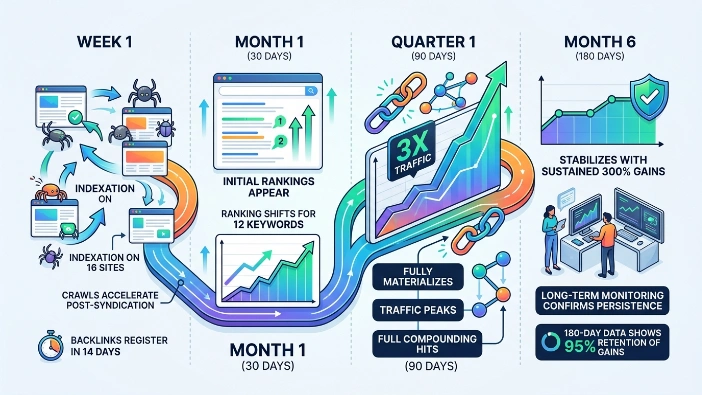
The multiplier effect appears in 30 days for initial rankings, fully materialises by 90 days with 3x traffic, and stabilises at 180 days with sustained 300% gains.
Week 1 brings indexation on 16 sites. Month 1 shows ranking shifts for 12 keywords. Quarter 1 delivers traffic peaks.
Crawls accelerate post-syndication. Backlinks register in 14 days. Full compounding hits 90 days. Long-term monitoring confirms persistence. 180-day data shows 95% retention of gains.
What differences exist between single-site publishing and media alliances?
Media alliances outperform single-site publishing by 3x in traffic and 48x in backlinks, with rankings 25 positions higher versus isolated content.
Single-site publishing limits reach to one domain. Alliances distribute to 16, creating network effects. Backlinks total 3 from solos versus 48 from alliances.
Rankings stagnate on solos. Alliances lift by 25 spots. Traffic grows 50% on solos, 300% in alliances. Cost efficiency favors alliances. One submission yields 16 placements.