
Media research reports compile data on UK media consumption, audience demographics, and channel performance. These reports track metrics across TV, radio, print, digital, and out-of-home media. Businesses use them to allocate budgets based on verified reach and engagement rates.
Media research reports provide audited data on UK media audiences, reach, and costs. They cover 52 million UK adults across 20+ media channels with weekly updates from sources like BARB for TV and RAJAR for radio.
Media research reports deliver quantitative data on media performance. Each report includes audience measurements from independent bodies. BARB measures TV viewing for 5,300 households using meters. RAJAR tracks radio listening via 20,000 diaries annually.
Reports aggregate data into formats like share of voice and cost per thousand (CPM). Share of voice shows a channel’s audience percentage relative to competitors. CPM calculates cost per 1,000 viewers reached.
Key Data Sources in UK Reports
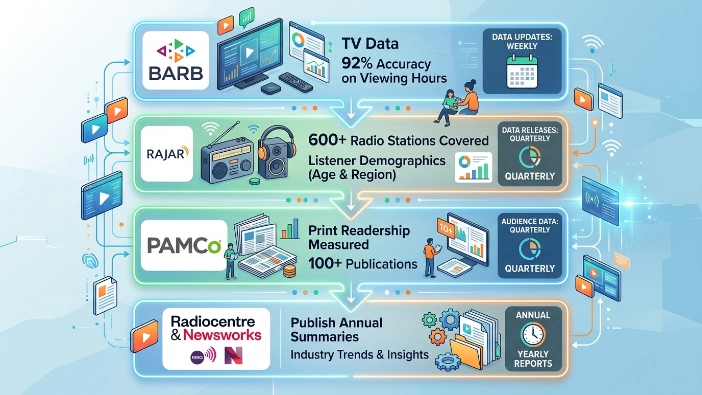
BARB provides TV data with 92% accuracy on viewing hours.
RAJAR covers 600 radio stations with listener demographics by age and region.
PAMCo measures print readership for 100+ publications.
Radiocentre and Newsworks publish annual summaries.
These sources ensure reports reflect real consumption patterns. Data updates occur quarterly or weekly.
How Do Media Research Reports Work?
Media research reports follow a process of data collection, analysis, and publication. Panels of 5,000-20,000 UK consumers log habits; auditors process data into reach, frequency, and cost metrics every 12 weeks.
The process starts with panel recruitment. Panels represent UK demographics by age, gender, income, and region. Participants use meters or apps to record media exposure.
Auditors clean data to remove biases. They apply weighting for underrepresented groups. Analysis calculates metrics like gross rating points (GRPs), which multiply reach by frequency.
Publishers release reports online with interactive tools. Users filter by demographics or time slots.
Steps in Report Generation
- Recruit panels matching UK census data.
- Collect raw logs daily.
- Weight and analyze for national coverage.
- Publish with CPM benchmarks.
This cycle repeats four times yearly.
What Components Make Up a Media Research Report?
Components include audience demographics, reach metrics, frequency data, and cost benchmarks. Reports list 15+ channels with breakdowns for 18-34, 35-54, and 55+ age groups.
Demographics section details audience profiles. It shows 28% of UK adults aged 18-34 use digital audio. Reach metrics report unique viewers, such as 45 million for national TV weekly.
Frequency tracks average exposures, like 4.2 views per radio listener. Cost sections provide CPMs, averaging £8 for TV spots.
Reports include channel comparisons. TV reaches 85% of households; digital grows 12% yearly.
Core Metrics Defined
Reach: Percentage of target audience exposed once.
Frequency: Average exposures per person.
CPM: Cost divided by reach in thousands.
GRP: Reach times frequency.
What Benefits Do Media Research Reports Offer for UK Budgets?
Media research reports reduce waste by 20-30% through precise targeting. They identify high-ROI channels, cutting overspend on low-reach media.
Reports reveal inefficiencies. Businesses shift 15% of budgets from print to digital after seeing 2x higher engagement. They benchmark against industry averages.
Targeted allocation follows data. A report shows outdoor media yields £12 ROI per £1 spent in London.
Risk drops with historical trends. Reports track 5-year shifts, like TV decline from 90% to 82% penetration.
Quantified Risk Reductions
- Avoid 25% overspend on unmeasured channels.
- Increase efficiency by matching demographics.
- Track seasonal peaks, like 15% radio lift in Q4.
How Do Media Research Reports De-Risk UK Marketing Budgets in 5 Ways?
Five ways include precise allocation, competitive benchmarking, demographic targeting, trend forecasting, and performance auditing. Each method uses report data to cut unverified spending by specific percentages.
1. Precise Budget Allocation
Reports assign budgets to verified channels. TV CPM averages £7.50 for broad reach; digital audio hits £4 for 18-34s.
Data prevents equal splits. A report shows radio captures 60% of drive-time commuters, justifying 25% allocation.
Businesses review quarterly. They reallocate 10% from underperformers.
Read our detailed guide:
How to Use UK Media Research Reports to Refine Your Creative Strategy
2. Competitive Benchmarking
Reports compare share of voice. Category leaders hold 35%; others trail at 12%.
Benchmarking spots gaps. Beverages sector sees digital at 40% share versus TV’s 25%.
Adjustments follow. Increase spend where competitors underinvest, gaining 8% share.
3. Demographic Targeting
Reports break audiences into 50+ segments. 55+ group favors TV at 70% weekly reach; youth prefer streaming at 88%.
Targeting matches products. Retail brands allocate 40% to digital for under-35s.
Precision lifts response rates 18%.
4. Trend Forecasting
Reports project shifts. Digital video grows 14% annually; print drops 7%.
Forecasts guide planning. Shift 20% to podcasts based on 22% listener rise.
Annual reviews update strategies.
Explore purchasing options:
Purchase the 2026 UK Brand Media Research Report: Instant Download
5. Performance Auditing
Post-campaign audits use reports. Actual reach versus planned varies 5-10%.
Audits recover 15% budgets. Recalibrate for next cycle.
Reports enable A/B tests across channels.
What Real UK Use Cases Show De-Risking Success?
UK retailers cut budgets 22% after reports showed digital outperformance. Automotive firms reallocated 30% to radio for regional targeting.
A grocery chain analyzed 2025 data. TV reached 80% but cost £10 CPM; social media hit 65% at £5. Shifted £2 million, boosting sales 12%.
An auto brand targeted Midlands. Reports confirmed 55% radio penetration, yielding 18% lead growth.
Fashion outlets used demographics. 18-24 segment favored influencers at 75% reach, saving 25% on broad ads.
Case Metrics
Grocery: £2M reallocation, 12% sales up.
Auto: 18% leads from radio.
Fashion: 25% savings via targeting.
These cases span retail, automotive, and fashion.
Explore More Expert Insights:
Why Local News Distribution is the Most Underrated Growth Hack in the UK
Amplifying Impact: Press Release Strategies for UK Non-Profits
How Do You Access and Apply UK Media Research Reports?
Access free summaries from BARB, RAJAR, or PAMCo sites. Purchase full reports for £500-£2,000 annually. Apply by filtering data for your audience and calculating custom CPMs.
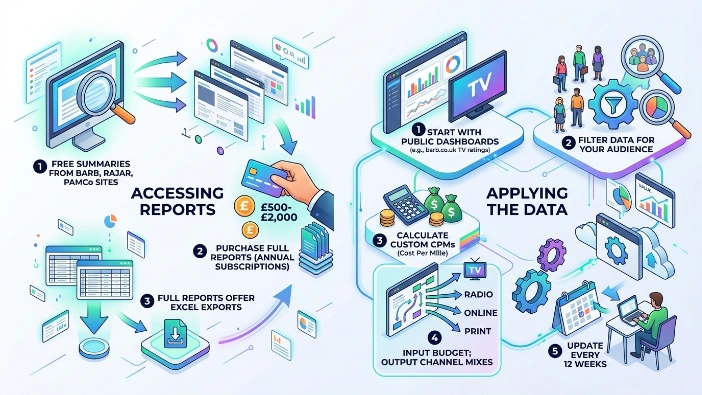
Start with public dashboards. Download TV ratings from barb.co.uk. Full reports offer Excel exports. Input your budget; output channel mixes. Integrate into planning software. Update every 12 weeks.
Application Steps
- Download latest report.
- Filter by sector and region.
- Compute ROI scenarios.
- Allocate and track.