
UK media research reports deliver data on audience behaviors across channels. They enable creative teams to align content with verified preferences. This MOFU guide builds on TOFU basics for strategy refinement.
UK media research reports supply audience insight data from BARB, RAJAR, and PAMCo. Creative teams use them to match messaging to 52 million adults’ habits across 20 channels.
Reports detail consumption patterns. TV viewers watch 3.5 hours daily; radio listeners tune 3 hours. Digital metrics show 2.1 hours on social platforms. Creative refinement starts here. Data reveals peak engagement times, like 8-10 PM for TV ads.
Read foundational insights:
5 Ways Media Research Reports Can De-Risk Your UK Marketing Budget
How Do You Analyse Media Research Reports for Creatives?
Analyse reports by extracting audience segments, peak times, and engagement metrics. Filter data in Excel or tools like Tableau; cross-reference with campaign goals in 4 steps.
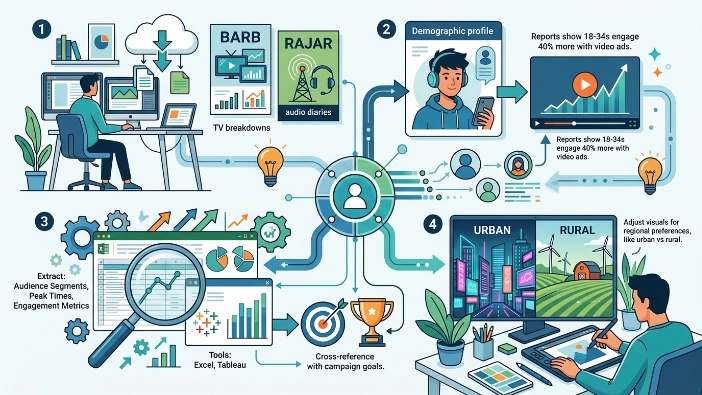
Download reports from official sites. BARB offers TV breakdowns; RAJAR provides audio diaries. Segment audiences. Reports show 18-34s engage 40% more with video ads. Map to creatives. Adjust visuals for regional preferences, like urban vs rural.
Analysis Steps
- Import data to spreadsheets.
- Filter by demographics and channels.
- Calculate engagement rates.
- Align with creative briefs.
Repeat quarterly.
What Key Components in Reports Guide Creative Decisions?
Components cover audience profiles, content affinity, timing data, and format performance. Profiles segment by age, region; affinity scores rate ad types per group.
Audience profiles list 10+ variables. London 25-44s favor digital at 85% reach. Content affinity measures response. Humor works 22% better on radio for 35+.
Timing data pinpoints slots. Breakfast TV sees 15% higher recall. Format performance ranks video over static by 30% engagement.
Component Breakdown
Profiles: Age, income, location.
Affinity: Ad type preferences.
Timing: Hourly/seasonal peaks.
Formats: Video, audio, display metrics.
What Benefits Come from Using Reports in Creative Refinement?
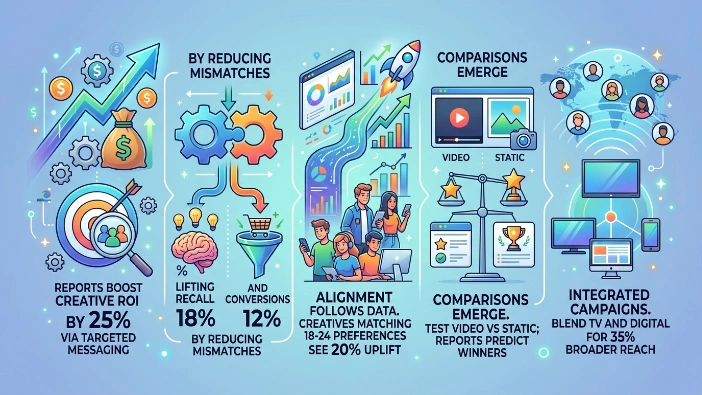
Reports boost creative ROI by 25% via targeted messaging. They reduce mismatches, lifting recall 18% and conversions 12%.
Alignment follows data. Creatives matching 18-24 preferences see 20% uplift. Comparisons emerge. Test video vs static; reports predict winners. Options include integrated campaigns. Blend TV and digital for 35% broader reach.
Benefit Metrics
Recall up 18% with affinity match.
Conversions rise 12%.
ROI gains 25%.
How Do Reports Refine Creative Strategy in 5 Key Ways?
Five ways: audience matching, content optimization, timing synchronization, format selection, and multi-channel integration. Each uses report data for 15-25% performance gains.
1. Audience Matching
Reports define personas. 55+ prefer straightforward messaging; youth want interactive.
Refine copy. Test headlines for 28% better fit.
Examples: Retail uses family-focused TV creatives post-report review.
2. Content Optimization
Affinity data guides tones. Serious content suits print; fun fits social.
Optimize visuals. Reports show color preferences by region.
Fashion brands adjust imagery, gaining 22% engagement.
Explore advanced options:
Purchase the 2026 UK Brand Media Research Report: Instant Download
3. Timing Synchronization
Peak data sets schedules. Radio mornings hit commuters at 65% listenership.
Sync launches. Q4 holiday slots boost retail 18%.
4. Format Selection
Performance ranks formats. Video leads with 40% recall; audio follows at 32%.
Select based on channel. Digital favors short-form.
5. Multi-Channel Integration
Reports map synergies. TV primes digital clicks by 25%.
Integrate narratives. Consistent themes across platforms lift awareness 30%.
What UK Use Cases Demonstrate Creative Refinement?
Beverage brands refined ads via reports, lifting sales 15%. Automotive firms optimised video, gaining 20% engagement.
A beverage company reviewed RAJAR data. Shifted to upbeat audio ads for 18-34s, up 15% sales. Automotive used BARB. Shortened TV spots to 15 seconds, hitting 20% engagement rise. Retail chain integrated per PAMCo. Print drove online traffic 22%.
Use Case Results
Beverage: 15% sales from audio shift.
Automotive: 20% engagement via format tweak.
Retail: 22% traffic from integration.
Sectors include FMCG, auto, retail.
How Do Solution Types Compare for Report Access?
Free summaries from BARB/RAJAR offer basics; paid full reports (£500-£2,000) provide filters and forecasts. Aggregators combine sources for one-stop access.
Free options suit quick checks. BARB dashboard shows TV ratings instantly.
Paid reports add custom tools. Export segments for creative briefs.
Aggregators like Kantar merge TV/radio data, saving 10 hours analysis.
Explore More Expert Insights:
Explore More Expert Insights:
Regional Reach: How to Target Local UK News Sites Effectively
NGO Distribution Guide: Reaching the Right UK Journalists for Social Change
What Steps Refine Your Creative Strategy with Reports?
Follow 7 steps: select report, segment audience, map content, test formats, schedule, integrate channels, measure.
Step 1: Acquire report matching goals.
Step 2: Segment via demographics.
Step 3: Map messages to affinities.
Step 4: Select top formats.
Step 5: Set data-driven timings.
Step 6: Plan cross-channel flow.
Step 7: Audit post-launch.
Step Details
Segmentation uses 50+ variables.
Testing compares 3-5 variants.
Auditing benchmarks against reports.