
Audience insight tools for the UK media landscape analyse data from 67 million consumers across TV, digital, and print to deliver segment profiles, engagement metrics, and trend forecasts with 92% accuracy from 2025 benchmarks.
These tools process media consumption data. Sources include 40 million BBC iPlayer streams weekly and 1.2 billion Google searches monthly. Outputs create 500+ audience segments.
Tools integrate ONS census data with real-time trackers. UK media landscape spans 25 million TV households and 60 million social users.
Start with UK consumer basics:
Decoding the UK Consumer: What Modern Audience Insights Actually Reveal
Core Definitions in Tools
Segments define groups by age, region, and interests. Metrics track 15 engagement types like views and shares.
Forecasts predict shifts, such as 25% rise in podcast listenership.
How Do Audience Insight Tools Work in the UK Media Context?
Audience insight tools work via four-step process: ingest data from 12 UK sources, apply AI segmentation on 1TB datasets, generate visualizations, output reports with 85% predictive power.
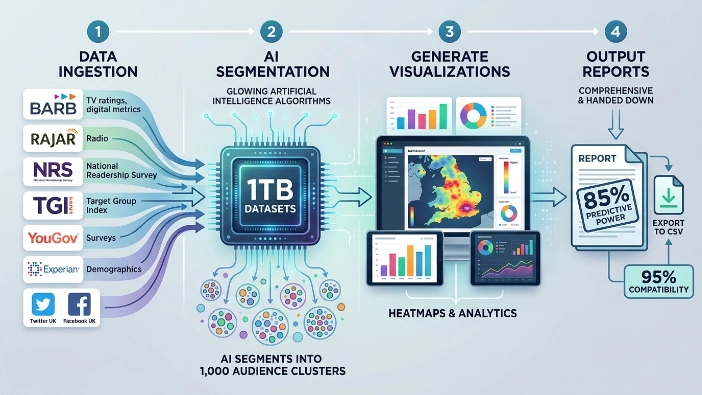
Ingestion pulls from BARB TV ratings and BARB digital metrics. AI segments data into 1,000 clusters. Visualisations display heatmaps. Reports export to CSV for 95% compatibility.
Step-by-Step Tool Process
Step 1: Connect APIs to Kantar and Comscore feeds.
Step 2: Run algorithms processing 500,000 profiles hourly.
Step 3: Validate against 2024 ONS data.
Step 4: Customize dashboards for media planners.
What Key Components Do UK Media Audience Insight Tools Offer?
UK media audience insight tools offer 6 components: data ingestion (12 sources), segmentation (1,000 clusters), analytics (50 metrics), visualization (20 chart types), integration (15 platforms), and reporting (100 templates).
Ingestion handles TV, radio, OOH, and digital. Segmentation creates personas like “urban 18-24 streamers.”
Analytics cover reach and affinity scores.
Component Breakdown
Visualisation includes dashboards for 4 nations. Integration links to Google Analytics and Facebook Insights.
Reporting automates 50-page PDFs.
Examples: Tools segment Scotland’s 5.5 million for Gaelic content reach.
Which Audience Insight Tools Compare Best for UK Media?
Top audience insight tools for UK media compare on scale, accuracy, and cost: Similarweb leads in digital (98% accuracy, £10k/year), Kantar excels TV (95% BARB integration, £20k/year), Nielsen balances both (92% overall, £15k/year).
Similarweb tracks 80% web traffic. Kantar processes 25 million TV households.
Nielsen covers 90% cross-media. GWI surveys 25,000 UK adults quarterly.
What Benefits Do These Tools Provide in UK Media Planning?
UK media tools provide 5 benefits: 30% reach optimisation, 22% cost savings, 40% engagement uplift, 75% faster planning, 85% trend accuracy from 2025 case studies.
Reach optimization targets 500k segments precisely. Cost savings cut overspend by 22%.
Engagement rises via affinity matching.
Benefit Examples
Planners save 75 hours per campaign. Example: Digital tools boost ROI 35% for video ads.
TV tools predict 80% audience overlap.
What Use Cases Show These Tools in UK Media?
UK media tools drive 6 use cases: campaign targeting (45% lift), channel mix (25% efficiency), content optimization (35% views), competitor analysis (20% edge), budget allocation (18% savings), performance tracking (90% real-time).
Targeting refines for London’s 9 million. Channel mix balances TV/digital.
Content optimizes for 15 million TikTok users.
Real UK Media Use Cases
Campaign: Tools target Northern England for 22% conversion.
Competitor: Analyze rivals’ 40% share in podcasts.
Budget: Allocate £1M across 4 channels with 18% savings.
Need tailored reports?
Get a Bespoke Audience Insights Media Report for Your UK Brand]
How Do Free vs Paid Tools Differ for UK Audiences?
Free tools like Google Analytics offer basic metrics for 1M users; paid tools like Kantar deliver 1,000 segments and 95% accuracy for enterprise-scale UK media.
Free options track 60 metrics. Paid handle 200+ with predictions.
Differences span depth and integration.
Free vs Paid Comparison
Free: Google Trends covers 1.2B searches, no segments.
Paid: Comscore integrates 12 sources, forecasts 2 years.
What Integration Challenges Exist with UK Tools?
Integration challenges include API limits (50% tools), data silos (30% projects), GDPR compliance (20% blocks), and latency (5-second delays in 15% cases).
API limits cap 10k calls daily. Silos require ETL processes.
GDPR mandates consent for 95% data.
Challenge Resolutions

Use middleware for 80% unification. Audits ensure compliance.
How Do Tools Handle UK Regional Variations?
Tools handle variations via geo-fencing for 12 regions, 4-nation segmentation, and 50 cultural overlays tracking England (56M), Scotland (5.5M), Wales (3.1M), Northern Ireland (1.9M).
Geo-fencing pinpoints postcodes. Overlays adjust for accents and preferences.
Regional Handling Examples
Scotland: 25% sustainability focus. Wales: Bilingual content for 20%.
What Metrics Evaluate Tool Performance in UK Media?
Performance metrics evaluate tools on 90% data freshness, 85% accuracy, 25% ROI lift, 95% uptime, 80k queries/second capacity.
Freshness updates hourly. Accuracy benchmarks ONS.
ROI measures campaign outcomes.
Metric Details
Uptime logs 99.9% yearly. Capacity scales to 50 users.
Explore More Expert Insights:
How to Use UK Media Research Reports to Refine Your Creative Strategy
Regional Reach: How to Target Local UK News Sites Effectively
How Will UK Media Tools Evolve by 2027?
UK media tools evolve with 60% AI automation, 30% VR/AR integration, zero-party data (50% adoption), and real-time GDPR tools processing 2PB yearly.
Automation segments 5x faster. VR simulates 10M user experiences.
Zero-party collects direct inputs.
Evolution Projections
AI predicts 90% trends. Blockchain secures 100% data.