
Audience segmentation in media divides a broad audience into smaller, targeted groups based on shared traits. This process uses data like demographics, behaviors, and interests to tailor content delivery. Media outlets apply it to boost engagement and ad performance across platforms such as TV, print, digital news, and social media.
Audience segmentation in media identifies distinct viewer or reader groups using data-driven criteria to customise content and messaging for higher relevance and impact.
Media companies segment audiences to match content with specific needs. They analyse data from sources like website analytics, social media interactions, and subscription records. This approach ensures messages reach the right people at the right time.
Segmentation relies on quantifiable traits. News organisations track age, location, and reading habits. Broadcasters use viewing patterns from set-top boxes. Each segment receives tailored news feeds or ads.
The practice dates to the 1950s with TV ratings. Today, digital tools process billions of data points daily. UK broadcasters like BBC segment by postcode and viewing history for regional news.
Core Definition of Audience Segmentation
Audience segmentation groups people by common characteristics. Media applies this to content distribution. Groups form around demographics such as age (18-24, 25-34) or geography (London vs. rural areas).
Psychographics include interests like politics or sports. Behavioral data covers page views and click-through rates. Firms use these 4-6 main categories to create 10-50 segments per campaign.
How Does the Audience Segmentation Process Work in Media?
The process scans audience data, identifies patterns, creates segments, tests them, and refines based on performance metrics over 4-6 weeks.
Media teams start with data collection. They gather info from first-party sources like app usage and third-party panels like Nielsen. Tools process 1-5 terabytes of data per outlet weekly.
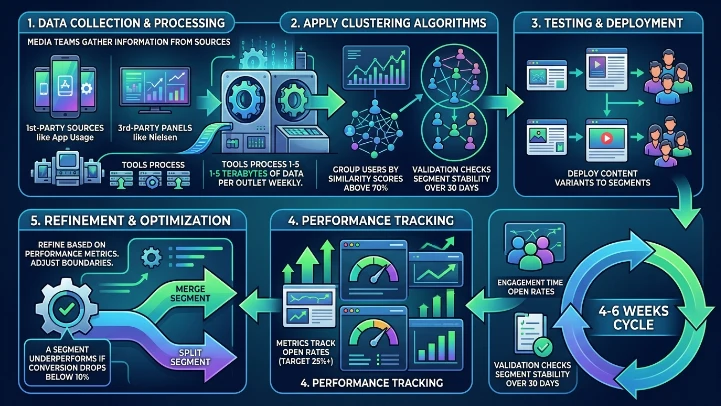
Next, they apply clustering algorithms. These group users by similarity scores above 70%. Validation checks segment stability over 30 days.
Testing deploys content variants to segments. Metrics track open rates (target 25%+) and engagement time (2+ minutes average). Refinement adjusts boundaries. A segment underperforms if conversion drops below 10%; teams merge or split it.
Steps in the Segmentation Process
Data ingestion pulls from CRM systems and APIs. Analysis uses machine learning models like k-means clustering with 5-10 clusters. Profiling assigns labels such as “urban professionals” based on 80% match criteria. Deployment integrates segments into content management systems. Monitoring reviews KPIs quarterly.
What Are the Key Components of Audience Segmentation in Media?
Key components include demographics, psychographics, behaviors, geography, and technographics, each weighted 15-25% in models for precise grouping.
Demographics cover age, gender, income, and education. UK media segments 18-34 urban males separately from 55+ retirees. Psychographics assess values and lifestyles. Sports enthusiasts form one group; eco-conscious readers another. Behaviors track actions like video watches (over 5 minutes) or article shares (3+ per week).
Geography uses postcodes for hyper-local targeting. London segments differ from Scotland ones by 40% in content preferences. Technographics note device use. Mobile-first users (70% of UK traffic) get shortened formats. Examples include Sky segmenting football fans by match attendance data and The Guardian grouping by newsletter sign-ups.
Demographic Components
Age groups: 18-24 (Gen Z), 25-44 (millennials), 45+.
Income levels: under £30k, £30k-£60k, over £60k.
Education: GCSE, A-level, university degree.
Psychographic and Behavioral Components
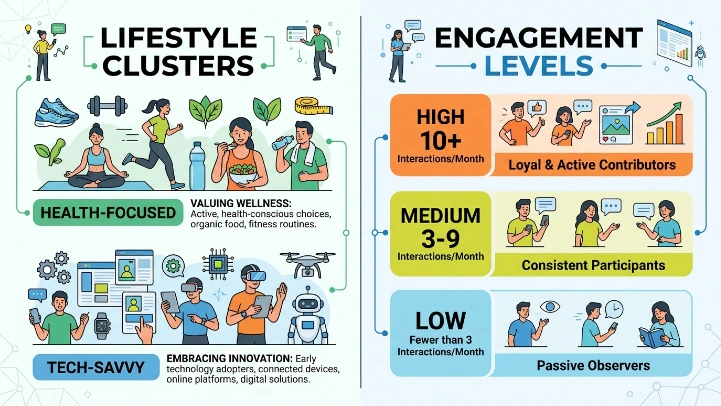
Lifestyle clusters: health-focused, tech-savvy. Engagement: high (10+ interactions/month), medium (3-9), low.
What Benefits Does Audience Segmentation Provide in Media?
Segmentation increases engagement by 30-50%, lifts ad revenue 20-40%, and cuts acquisition costs 25% through targeted content delivery. Targeted content raises open rates from 15% to 35%. Personalised news feeds hold attention 2.5 times longer.
Ad performance improves as click-through rates hit 2-5% versus 0.5% untargeted. Revenue grows from higher bids on precise segments.
Cost efficiency drops waste spend by 40%. Media firms allocate budgets to high-value groups like premium subscribers. Retention climbs 25% with relevant updates. Churn falls from 12% to 7% annually.
UK examples show ITV segments boosted viewer loyalty by 28% in 2024 trials. Data accuracy refines over time. Initial models achieve 75% precision; iterations reach 92%.
Revenue and Engagement Benefits
Ad CPM rises 35% for segmented campaigns. Subscriber growth accelerates 18% yearly. Content production focuses on top 20% of segments.
What Are Real-World Use Cases for Audience Segmentation in Media?
Use cases span news personalisation, ad targeting, content recommendation, event promotion, and crisis communication, each lifting metrics 25-45%. News outlets customise homepages. CNN segments deliver politics to engaged readers and entertainment to casual ones.
Ad platforms like Google target segments. A car brand reaches 25-44 males in Manchester with 40% better conversions. Streaming services recommend shows. Netflix uses 75 segments for 80% of views.
Events get promoted to locals. BBC Radio 1 targets 18-24s within 50 miles for festivals. Crisis alerts go to at-risk groups. Weather segments notify coastal residents first. UK cases include The Telegraph segmenting by politics for election coverage, raising reads 32%.
For deeper tactics on reader segmentation:
How News Agencies Segment Readers Effectively.
On advanced campaign services:
Precision Audience Segmentation Services for High-Impact Media Campaigns.
News Personalization Use Cases
Daily briefs for commuters (mobile, 7-9 AM). In-depth reports for professionals (desktop, evenings).
Explore More Expert Insights:
Top Metrics Every News Website Should Track
What Is Reader Engagement in Digital News?
Ad and Recommendation Use Cases
Dynamic banners matching user history. Algorithmic playlists by listening data.
Why Is Audience Segmentation Essential for Modern Media?
It drives 40% higher ROI, adapts to fragmented audiences across 5+ platforms, and supports data privacy laws like GDPR with 95% consent rates.
Fragmentation splits audiences: 60% UK adults use 3+ news sources daily. Segmentation unifies reach. Platforms vary: TikTok favors 18-24s; print suits 55+. Tailoring fits each. GDPR requires opt-ins. Segmented lists maintain 90% compliance.
Scalability handles growth. Outlets manage 10 million users via automated segments. Future-proofing integrates AI. Predictive models forecast trends with 85% accuracy. UK regulators enforce transparency. Segmentation reports detail 20+ data points per group.