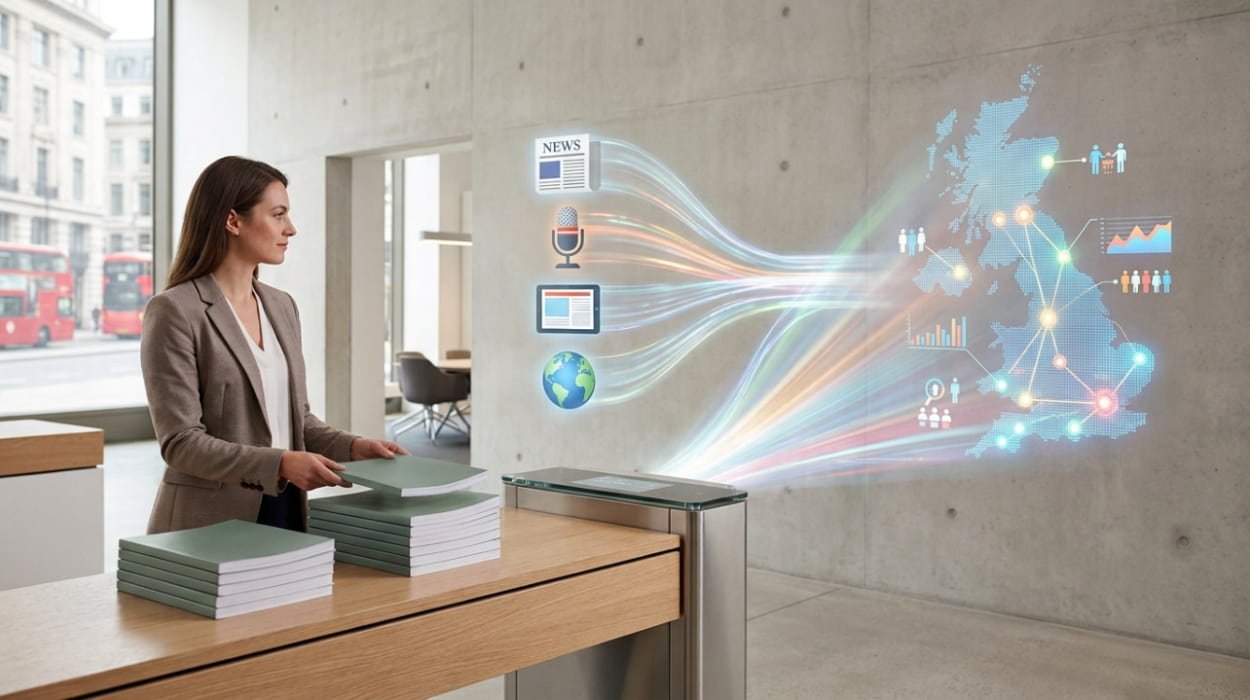
Reader personas are detailed profiles of target audience segments created from audience insights data. News brands build 3-5 core personas per publication to guide content strategy. Each persona includes demographics, behaviors, and preferences derived from analytics.
Reader personas represent fictional yet data-driven characters that embody specific reader groups. News organizations in the United Kingdom defin organisations aggregated data from website traffic, subscription records, and engagement metrics. A persona captures 8-10 key attributes, such as age range, location, reading habits, and content preferences.
The BBC constructs personas like “Busy Professional,” targeting 25-44-year-olds in London who read news apps during commutes. The Guardian develops “Activist Reader,” focusing on 18-35-year-olds interested in social justice topics. These profiles stem from tools that analyse 100,000+ monthly user sessions.
Key Attributes of Reader Personas
Persona attributes include demographics, psychographics, and behavioral data. Demographics cover age, gender, income, and location. Psychographics detail values, interests, and attitudes. Behavioral data tracks page views, time spent, and shares.
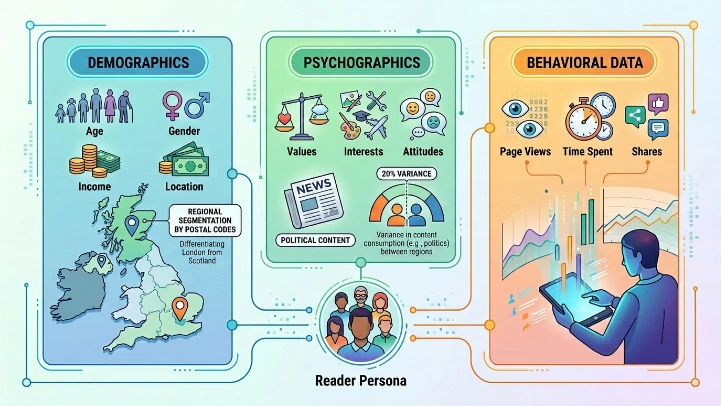
United Kingdom news sites segment by postal codes for regional accuracy. For instance, personas differentiate London readers from those in Scotland based on 20% variance in political content consumption.
How Do You Build Reader Personas Using Audience Insights?
analyse Build reader personas in 5 steps: collect data, segment audiences, analyze patterns, profile segments, and validate with tests. United Kingdom news brands complete this process in 4-6 weeks using analytics platforms.
News brands start with data collection from sources like Google Analytics, CRM systems, and surveys. They gather 6 months of historical data covering 1 million+ sessions. Segmentation follows by clustering users into 4-7 groups based on shared traits.
Analysis identifies patterns in 10+ metrics, such as bounce rates and conversion paths. Profiling assigns names, photos, and narratives to clusters. Validation tests personas against live campaigns, adjusting based on 15% engagement lifts.
The process integrates insights from on:
How news agencies use data fundamentals.
Step 1: Collect Audience Insights Data
Collect data from web analytics, email open rates, and social interactions. Platforms track 12 metrics per user session, including device type and referral sources. United Kingdom publishers export 50,000 rows weekly from tools like Chartbeat.
Surveys reach 5,000 respondents quarterly, yielding 70% response rates on preferences.
Step 2: Segment and Analyze
Segment data into cohorts using k-means clustering on 8 variables. Analyze for overlaps in 3 categories: content type, time of day, and frequency. Tools process datasets in 24 hours.
What Components Make Up Effective Reader Personas?
Effective reader personas include 10 components: demographics, behaviors, goals, pain points, content preferences, channels, journey stage, quotes, scenarios, and metrics for success. News brands document each in 1-page templates.
Components ensure personas drive precise targeting. Demographics specify age brackets like 35-54. Behaviors list actions such as 5 daily logins. Goals outline needs, like staying informed on UK politics.
Pain points note frustrations, such as ad overload. Content preferences rank topics by 40% engagement shares. Channels identify platforms with 60% traffic dominance.
Demographics and Psychographics
Demographics use census-level data for UK regions. Psychographics draw from 20-question surveys on attitudes.
Examples: Sky News personas tag “Family Parent” with £50,000 income and family-oriented values.
Behavioral and Journey Components
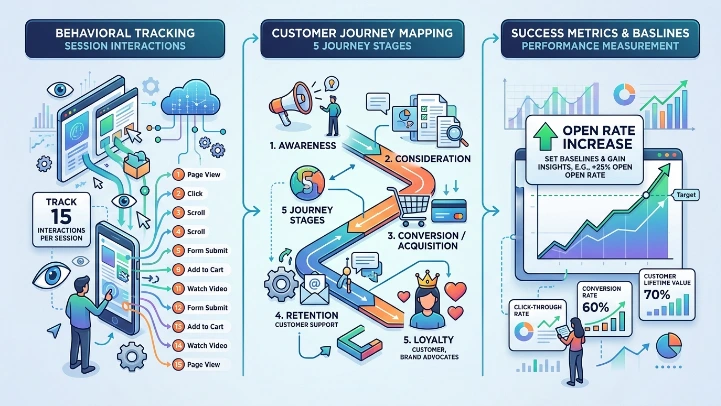
Behaviors track 15 interactions per session. Journey stages map awareness to loyalty across 5 phases. Success metrics set baselines, like 25% open rate increases.
What Benefits Do Reader Personas Provide to News Brands?
Reader personas increase engagement by 30%, boost subscriptions 22%, and cut content waste 40%. United Kingdom publishers report 18% revenue growth from persona-driven strategies within 12 months.
Personas align content with audience needs, raising click-through rates from 2% to 3.2%. They optimize ad placements, achieving 15% higher CPMs. Personalization reduces churn by 25% through tailored newsletters.
News brands save 35% on production by focusing on high-value topics. Analytics confirm ROI via A/B tests showing 28% lift in time-on-page.
Engagement and Revenue Metrics
Engagement rises as personas predict 80% of top-performing content. Revenue grows from targeted upsells, converting 12% of mid-funnel readers.
What Real Use Cases Show Reader Personas in Action?
United Kingdom news brands use personas for content calendars (BBC), email segmentation (The Guardian), and ad campaigns (Telegraph). Results include 35% traffic growth and 20% subscriber gains across 6-month pilots.
BBC applies “Commuter Reader” persona to push 7am push notifications, lifting opens by 32%. The Guardian segments “Eco-Advocate” for climate series, gaining 18,000 subscribers. Telegraph targets “Business Executive” with premium finance content, increasing paywall conversions 24%.
BBC Content Calendar Optimization
BBC builds quarterly calendars around 4 personas. They schedule 60 articles weekly, matching peak times. Traffic from personas exceeds non-persona content by 40%.
How Do Audience Insights Tools Support Persona Building?
Audience insights tools like Google Analytics 360, Amplitude, and Mixpanel process 10 million events daily to build personas. United Kingdom news sites integrate 3-5 tools for 95% data accuracy.
Tools aggregate data into dashboards visualizing 12 audience segments. They automate clustering, reducing build time from 8 weeks to 2. Machine learning scores persona predictions at 85% accuracy.
News brands export reports for teams of 10 editors. Custom dashboards track 20 KPIs in real time.
For advanced applications, news brands commission [Insert Link to BOFU Article] that deliver tailored insights.
Integration and Automation Features
Google Analytics 360 handles 1 billion sessions monthly. Amplitude maps user journeys across 7 touchpoints. Mixpanel segments by 50 custom events.
What Metrics Track Reader Persona Effectiveness?
Track effectiveness with 8 metrics: engagement rate (target 35%), conversion rate (15%), churn reduction (20%), content alignment score (90%), revenue attribution (25%), A/B test wins (70%), feedback NPS (50+), and retention (60% at 90 days).
Metrics quantify impact quarterly. Engagement rate measures average session depth. Conversion tracks subscriptions from persona content.
Churn drops as relevance rises. Content alignment scores match output to profiles. Revenue attribution uses multi-touch models.
Explore More Expert Insights:
How News Agencies Segment Readers Effectively
How to Use Audience Data for Content Optimisation
Measurement Process
Run A/B tests on 10 articles per persona. Calculate NPS from 2,000 reader surveys. Retention cohorts track 90-day holds.
Adjust personas if metrics fall below thresholds.
How Do News Brands Evolve Personas Over Time?
Evolve personas quarterly by re-analyzing fresh data, running surveys, and testing variants. United Kingdom publishers update 70% of attributes based on 6-month trends.
Re-analysis incorporates new sources like app data. Surveys refresh psychographics yearly with 10,000 responses. Variants test 3 profile versions.
Brands retire underperforming personas after 15% metric drops. Evolution sustains 25% annual engagement gains.
Link this to results-driven reports in:
Custom Audience Insights Reports Built for News Brands That Want Results