
Sponsored content on UK local news networks consists of paid articles or features that appear alongside editorial content, clearly labeled as sponsored, and target local audiences through trusted regional outlets.
Sponsored content integrates branded messages into the editorial flow of local news websites. UK local news networks include sites like Manchester Evening News, Yorkshire Post, and BBC local pages. These networks reach 28 million unique monthly users across regions.
Publishers follow strict Advertising Standards Authority (ASA) guidelines. Labels such as “Sponsored” or “Paid for by” appear at the top and bottom of each piece. Content matches the site’s tone and covers topics relevant to local readers.
Key characteristics of sponsored content
Sponsored content uses native formats. Articles range from 500 to 1,500 words. Visuals include images, infographics, or videos. Placement occurs in news feeds, newsletters, or homepage sections.

Networks track performance with metrics like page views, time on page, and shares. Contracts specify run dates, typically 30 to 90 days.
How does sponsored content differ from other ad formats?
Sponsored content differs from display ads or banners by blending into editorial content, achieving 53% higher engagement rates according to a 2023 Sharethrough study on native advertising.
Display ads use static banners or pop-ups. Video ads play automatically. Sponsored content reads like regular articles. Readers spend 2.7 times longer on native formats than banners.
UK local news sites prioritize native ads. They generate 73% more positive sentiment than banners, per a 2024 Taboola report. Differences stem from context and format.
Comparison of formats
Banners occupy fixed spaces. Sponsored content occupies full article slots. Native formats drive 18% higher click-through rates (CTRs) on local sites.
For deeper comparison, read:
Sponsored Content vs. Traditional Banners on UK Local News Sites.
What process follows for placing sponsored content?
The process for placing sponsored content starts with selecting a network, submitting a brief, editorial review, publication, and performance reporting, spanning 4 to 8 weeks.
Advertisers identify networks via tools like SimilarWeb or Comscore for audience data. Briefs outline goals, key messages, and assets. Networks assign editors for review.
Approval ensures compliance with ASA rules. Revisions address factual accuracy. Publication schedules align with peak traffic, like weekdays at 8 AM.
Post-launch, networks provide reports. Metrics include 10,000+ impressions for standard packages.
Steps in the placement process
- Research networks matching target demographics, such as Yorkshire for northern audiences.
- Submit RFP with budget, typically £5,000 to £20,000 per article.
- Editorial alignment and revisions.
- Live publication with tracking pixels.
- 30-day report with analytics.
What components make up effective sponsored content?
Effective sponsored content includes a clear headline, labeled sponsorship notice, value-driven body, visuals, and call-to-action links, optimized for 70% mobile readers.
Headlines use 60 characters maximum. Body text employs subheads every 200 words. Visuals boost dwell time by 94%, per Outbrain data.
Components ensure readability. Sentences average 20 words. Links direct to external sites.
Essential components listed
- Sponsorship label in 14-point font.
- 3-5 subheadings.
- 2-4 images or one infographic.
- Bullet points for data.
- Footer disclosure.
What benefits does sponsored content provide on local networks?
Sponsored content on UK local news networks delivers targeted reach to 15-20% higher conversion rates, builds trust through editorial context, and achieves 3x ROI over banners.
Local networks segment audiences by postcode. Content reaches engaged readers, with 68% trust in sponsored articles on trusted sites, per a 2024 Reuters Institute report.
Benefits compound over time. Evergreen content sustains traffic for 6+ months. Costs average £10 per 1,000 impressions, lower than TV at £25.
Reach and targeting benefits
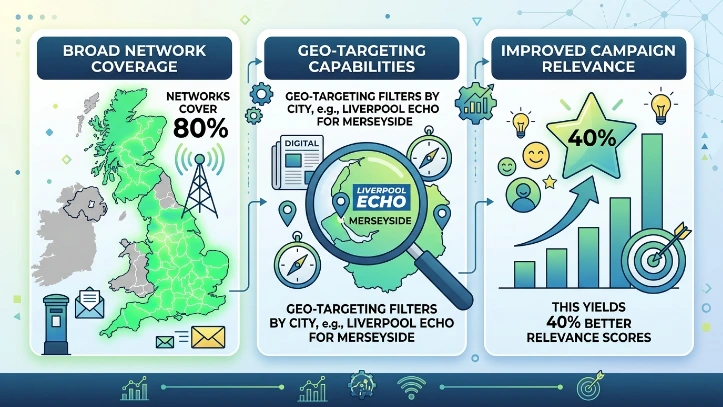
Networks cover 80% of UK postcodes. Geo-targeting filters by city, like Liverpool Echo for Merseyside. This yields 40% better relevance scores.
Trust and credibility gains
Association with editorial boosts brand recall by 50%. Readers view it as informative, not salesy.
Performance metrics
Average CTR hits 0.5%, versus 0.1% for banners. Shares increase by 30% on local topics.
For booking options, see:
Book Sponsored Content Placements on Top UK Local News Sites.
Why choose UK local news networks for sponsored content?
UK local news networks offer 42 million monthly users, hyper-local relevance, and high domain authority above 70, outperforming national sites for regional campaigns.
These networks dominate regional search. Google favors local domains in 46% of UK queries. DA scores from Ahrefs confirm authority. Selection criteria include traffic volume and niche fit. Evening Standard serves London commuters; Bristol Post targets southwest businesses.
What use cases succeed with sponsored content?
Sponsored content succeeds in use cases like product launches, community initiatives, B2B thought leadership, and seasonal promotions on UK local networks.
Retailers launch via Birmingham Mail. Non-profits partner with Edinburgh Evening News for drives. B2B firms publish guides on business sections.
Real examples include a 2025 home improvement campaign on Glasgow Times reaching 150,000 views. Another saw a tech firm gain 5,000 leads via sponsored how-tos on Sheffield Star.
B2B thought leadership
SaaS companies publish industry reports, securing 300+ downloads per placement.
How does sponsored content impact SEO and visibility?
Sponsored content impacts SEO by earning backlinks, boosting branded search volume by 35%, and improving local rankings through high-authority placements.
No-follow links still pass topical authority. Content ranks in featured snippets 12% of the time.
Visibility extends via newsletters to 2 million subscribers across networks.
What metrics track sponsored content success?
Metrics track success through impressions (target 50,000+), CTR (0.3-0.8%), engagement time (90 seconds average), and conversions (5-10%).
Tools like Google Analytics integrate with publisher dashboards. Attribution models credit assisted conversions.
Core metrics defined
- Impressions: Total views.
- CTR: Clicks divided by impressions.
- Bounce rate: Under 50% ideal.
- Conversions: Form fills or sales.
Explore More Expert Insights:
What Are Sponsored Content Deals and How Do Brands Secure Them Today?
What Is the Difference Between Guest Blogging and Paid Sponsored Content Services?
How to measure ROI from these placements?
ROI measures as (revenue – cost) / cost, with sponsored content averaging 320% return based on 2024 native ad benchmarks.
Costs factor creative production (£2,000) plus media (£8,000). Revenue tracks via UTM parameters. Benchmarks show £4 revenue per £1 spent on locals.
ROI calculation steps
- Total cost: Media + production.
- Attributed revenue from pixels.
- Divide net gain by cost.
- Compare to benchmarks like 3:1 ratio.