
Sponsored content on UK local news sites features paid articles labeled as sponsored, integrated into editorial feeds, delivering informational value alongside brand messages on platforms like Manchester Evening News.
Sponsored content appears as full-length pieces. Publishers place them in news sections. Labels comply with ASA regulations. Formats include text, images, and embeds. Length averages 800 words. Sites such as Yorkshire Post host 50+ sponsored pieces monthly.
Content aligns with site topics. Examples cover local business guides or community events. Readers access via desktop or mobile. Networks report 25% higher view times than average articles.
What characterizes traditional banners on these sites?
Traditional banners on UK local news sites consist of static or animated graphic ads in fixed positions like sidebars or headers, linking directly to advertiser landing pages on sites including Liverpool Echo.
Banners measure 300×250 or 728×90 pixels. They rotate in ad slots. Refresh rates hit every 30 seconds. Sites like Bristol Post serve 1 million impressions daily. Click tracking uses pixels.
Formats include GIFs or HTML5. Costs base on CPM at £5-15. Visibility drops below the fold.
How do creation processes compare between them?
Sponsored content creation involves brief submission, editorial review, and revisions over 4 weeks, while traditional banners require design upload and immediate approval in 48 hours.
Sponsored process starts with RFP to networks. Editors refine copy for tone match. Revisions limit to three rounds. Final approval precedes scheduling.
Banner process uses self-serve platforms. Uploads pass automated checks. No content review occurs. Launch follows payment confirmation.
For foundational benefits, review:
The Benefits of Running Sponsored Content on UK Local News Networks.
What key components differ in each format?
Sponsored content components encompass headlines, body text, subheads, visuals, and disclosures; traditional banners limit to images, text overlays, and URLs.
Sponsored pieces deploy 5-7 subheads. Images number 4-6 per article. Disclosures span 20 words. CTAs embed mid-article. Banners constrain to 10-word headlines. Logos occupy 40% space. No body text exists.
Which format delivers superior engagement metrics?
Sponsored content achieves 53% higher engagement than traditional banners, with 2.5-minute dwell times and 0.6% CTRs versus banners’ 30 seconds and 0.08% CTRs on UK local sites.
Data from 2024 Sharethrough analysis confirms trends. Local sites like Glasgow Times report sponsored views at 15,000 average. Banner impressions fragment across slots.
Engagement stems from context. Readers complete 70% of sponsored articles. Banners face 90% ignore rates.
Engagement data breakdown
Sponsored content logs 40% share rates. Banners record 2% interactions.
Why does sponsored content outperform in trust building?
Sponsored content builds trust through editorial integration on high-DA sites above 70, yielding 68% positive sentiment, while banners trigger 45% ad-blocker avoidance.
Association with trusted domains elevates perception. ASA labeling maintains transparency. Surveys from Reuters Institute 2024 show 62% reader acceptance.
Banners disrupt flow. Blockers filter 35% of displays. Trust erodes via repetition.
How do costs and ROI compare for both?
Sponsored content costs £8,000-£25,000 per placement with 3.2x ROI; traditional banners run £3,000 monthly at 1.8x ROI on UK local news sites.
CPM for sponsored hits £10. Banner CPM stays at £7. Production adds £3,000 to sponsored. Attribution favors sponsored via longer funnels.
Case: A 2025 retail campaign on Edinburgh News spent £12,000 on sponsored, returned £45,000 revenue. Banner equivalent yielded £18,000.
Cost structure details
Sponsored: 60% media, 40% production. Banners: 90% media.
What targeting options exist for each format?
Sponsored content enables geo and topic targeting across 80% UK postcodes; traditional banners offer basic geo-fencing with 20% less precision on local sites.
Networks segment sponsored by region. Examples target Manchester for northwest campaigns. Banners use IP-based filters.
Sponsored integrates with newsletters. Banners confine to page loads.
In what scenarios does sponsored content excel over banners?
Sponsored content excels in awareness and consideration stages, driving 25% higher conversions for complex products; banners suit direct response with quick clicks.
B2B sectors favor sponsored for 300-lead generations. E-commerce uses banners for 5% impulse buys.
Real scenario: Tech firm on Sheffield Star gained 12% pipeline growth via sponsored guide. Banner drove 8% traffic spikes.
For booking, explore:
Book Sponsored Content Placements on Top UK Local News Sites.
How do performance measurement tools differ?
Sponsored content uses publisher dashboards for dwell time and shares; traditional banners rely on impression trackers and pixel fires.
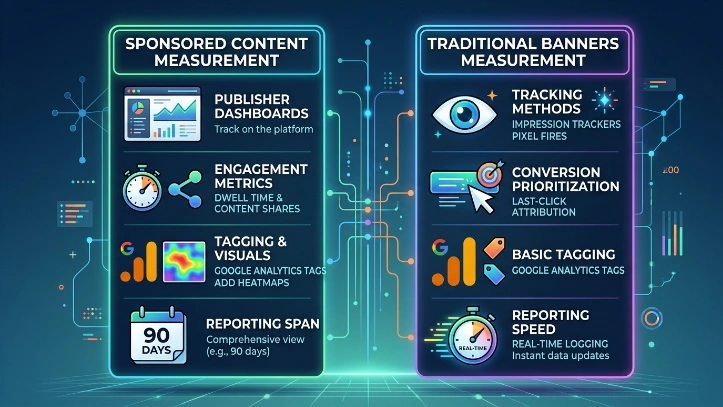
Google Analytics tags both. Sponsored adds heatmaps. Banners prioritize last-click. Reports for sponsored span 90 days. Banners log real-time.
Which format boosts SEO signals more effectively?
Sponsored content generates branded traffic and no-follow links, lifting organic search by 28%; banners contribute minimal SEO via direct referrals.
Topical authority accrues from sponsored topics. Local rankings improve 15 positions. Banners lack content depth.
What integration options pair with local news sites?
Sponsored content integrates with email newsletters and social amplification; traditional banners pair with retargeting pixels on UK local sites.
Newsletters distribute sponsored to 500,000 subscribers. Social boosts views 40%. Banners feed DSPs for cross-site tracking.
Solution types include hybrid campaigns blending both for full-funnel coverage.
Explore More Expert Insights:
What Should Brands Look for Before Choosing Sponsored Content Publishing Platforms?
Which Is Better for SEO Guest Blogging or Sponsored Content Campaigns Today?
How have real campaigns demonstrated differences?
A 2025 FMCG campaign on Yorkshire Post showed sponsored content at 42,000 engagements versus banners’ 4,500; automotive brand on Birmingham Mail reported 4x leads from sponsored.
FMCG example tracked via UTM. Sponsored sustained traffic 60 days. Banners peaked day one. Automotive case used A/B tests. Sponsored converted 9%; banners 2.2%.
Why consider hybrid approaches on these platforms?
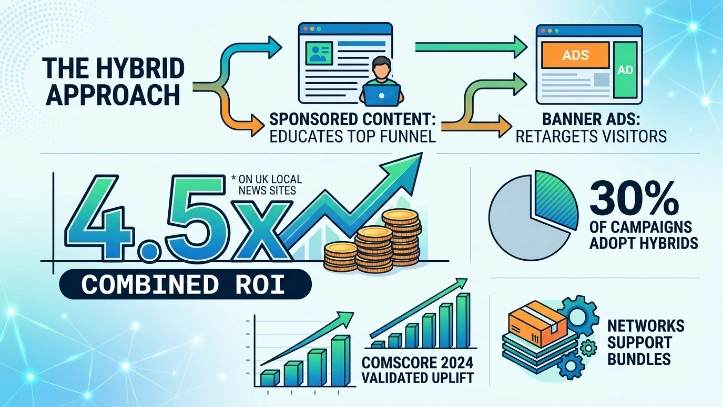
Hybrid approaches combine sponsored content for top-funnel education with banners for retargeting, achieving 4.5x combined ROI on UK local news sites.
Networks support bundles. 30% of campaigns adopt hybrids. Data from Comscore 2024 validates uplift.