
Banner advertising platforms deliver digital ads in rectangular or graphical formats across websites and apps. Brands use these platforms to display visuals, text, and calls-to-action to targeted audiences. They operate through automated systems that match ads to user data for precise reach.
These platforms process billions of ad impressions daily. In 2025, global banner ad spend reached $120 billion, representing 25% of digital advertising revenue. Brands integrate them into strategies for awareness and traffic generation at scale.
What Are Banner Advertising Platforms?
Banner advertising platforms are online software systems that enable brands to create, manage, and distribute graphical display ads across digital publishers. They handle ad inventory, targeting, and performance tracking in real time.
Banner advertising platforms connect advertisers with website owners through centralized networks. Publishers upload ad spaces, while brands upload creative assets like images and HTML5 files. The platform matches ads to available slots based on predefined criteria.
These platforms use server-side technology to serve ads instantly when users load pages. Core functions include ad serving, frequency capping to limit exposures per user, and viewability measurement to ensure ads appear in visible screen areas. Over 70% of platforms now enforce viewability standards set by industry bodies like the Interactive Advertising Bureau (IAB).
Key Definitions in Banner Platforms
A banner ad measures in standard sizes such as 300×250 pixels for medium rectangles or 728×90 pixels for leaderboards. Platforms define these units to ensure compatibility across devices.
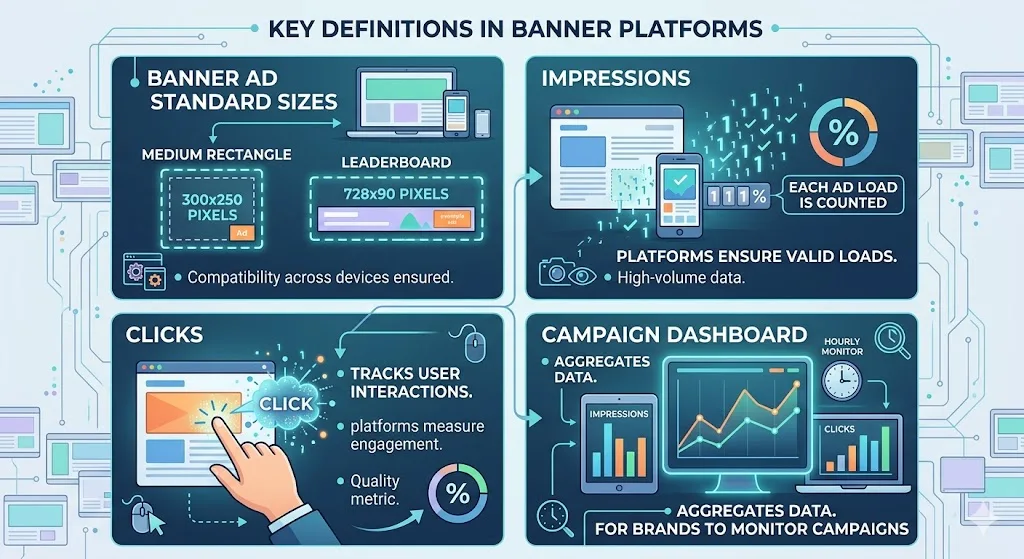
Impressions count each ad load, while clicks track user interactions. Platforms aggregate these metrics into dashboards for brands to monitor campaigns hourly.
Historical Evolution of Banner Platforms
Banner platforms originated in 1994 with the first web banner on HotWired.com, which achieved a 44% click-through rate. Modern iterations incorporate machine learning for optimization.
By 2025, platforms evolved to support responsive designs that adapt to mobile screens, covering 60% of global internet traffic.
How Do Banner Advertising Platforms Work?
Banner advertising platforms work by auctioning ad inventory in real-time, delivering targeted creatives to users via scripts embedded in publisher pages, and reporting metrics through integrated analytics.
The process starts with publishers embedding a JavaScript tag from the platform on their sites. When a user visits, the tag sends a bid request to the platform detailing user data like location, device, and browsing history.
Platforms run real-time bidding (RTB) auctions in milliseconds. Winning bids trigger ad delivery from content delivery networks (CDNs) for speed. This auction model handles 10,000 bids per second on average across major networks.
Step-by-Step Ad Delivery Process
First, the user’s browser requests a page. The platform’s tag pings the ad server with contextual data. Second, the server selects eligible ads from the brand’s campaign pool based on targeting rules.
Third, the ad renders in the designated slot, tracked by pixels for impressions and clicks.
Role of Data in Platform Operations
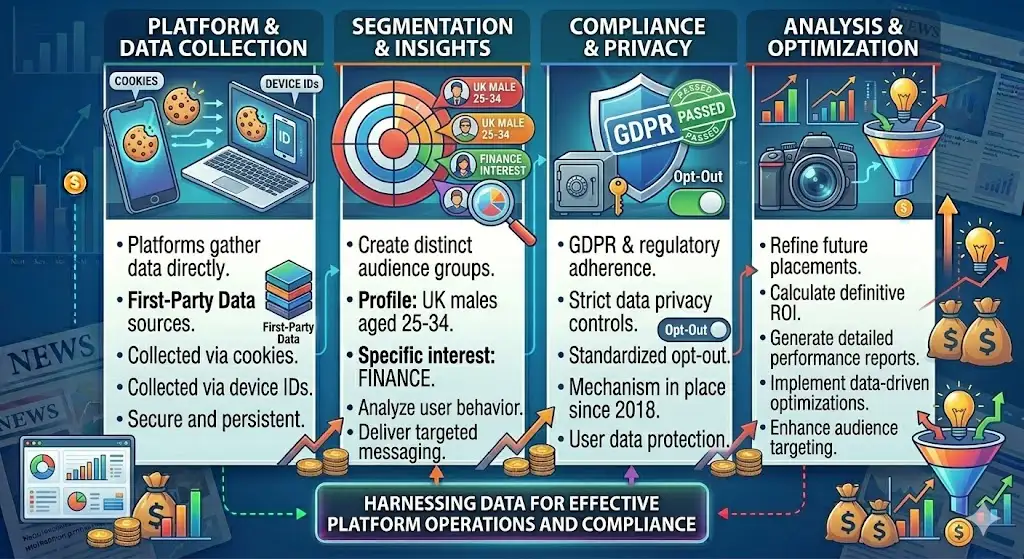
Platforms collect first-party data from cookies and device IDs. They segment audiences into groups like “UK males aged 25-34 interested in finance.” Compliance with regulations like GDPR ensures data privacy, with opt-out mechanisms standard since 2018.
What Are the Main Components of Banner Advertising Platforms?
Main components include ad servers for delivery, demand-side platforms (DSPs) for buying, supply-side platforms (SSPs) for selling inventory, and data management platforms (DMPs) for audience insights.
Ad servers store and distribute creatives, managing rotations and A/B tests. DSPs allow brands to bid on inventory across multiple exchanges programmatically.
SSPs help publishers maximize revenue by connecting to multiple buyers. DMPs clean and segment data for precise targeting, processing trillions of data points daily.
Detailed Functions of DSPs
DSPs integrate with ad exchanges to access inventory from thousands of sites. Brands set budgets, bids, and frequency caps within DSP interfaces. They optimize campaigns by pausing underperforming creatives automatically, increasing efficiency by 30% on average.
Integration of SSPs and DMPs
SSPs auction inventory to the highest bidder while reserving premium placements. DMPs feed anonymized data to DSPs, enabling lookalike audience building from seed lists of 1,000 users.
What Benefits Do Banner Advertising Platforms Offer Brands?
Banner platforms offer brands scalable reach to millions, precise targeting by demographics and behavior, measurable ROI through metrics like CPM at $2-5, and creative flexibility across formats.
Scalability comes from access to global inventory, serving ads to 90% of internet users. Targeting uses 50+ parameters, reducing waste spend by 40%.
ROI measurement tracks cost per acquisition (CPA), with average rates at $1.50 for e-commerce brands. Creatives support animations up to 15 seconds, boosting engagement.
For deeper insights into formats driving top engagement, Which Banner Advertising Formats Generate the Highest Engagement and Click Through Rates?.
Quantifiable Reach and Targeting Advantages
Platforms deliver 5 trillion impressions yearly. Behavioral targeting matches ads to recent searches, lifting conversions by 25%. Geofencing targets UK users within 10 miles of stores, ideal for local campaigns.
Performance Measurement and Optimization
Platforms provide dashboards with 50 metrics, including click-through rates (CTR) averaging 0.1-0.5%. Automated rules adjust bids to maintain target CPA.
What Are Real-World Use Cases for Banner Platforms Today?
Brands use banner platforms for awareness campaigns reaching 80% unaided recall, retargeting past visitors with 2x higher conversion rates, and seasonal promotions spiking traffic by 300%. Awareness campaigns flood top UK sites with consistent messaging. A finance brand might target 5 million impressions over a week.
Retargeting serves dynamic banners showing viewed products, recovering 20% of abandoned carts. Seasonal use spikes during Black Friday, with CPM dropping 15% due to volume.
To optimize placements for maximum ROI, explore Maximise Advertising ROI With High Performing Banner Placements on News Websites.
Awareness and Branding Applications
Brands run video banners on news sites for storytelling. Sequence ads build narrative over three exposures. Sequential messaging increases brand lift by 15%, measured via post-campaign surveys.
Retargeting and Performance Use Cases
E-commerce platforms retarget with personalized pricing. Travel brands serve destination banners to searchers. Performance campaigns test 10 creatives weekly, scaling winners to full budgets.
How Have Banner Advertising Platforms Evolved for Modern Brands?
Banner platforms evolved with programmatic buying handling 85% of transactions, mobile optimization for 55% of traffic, and AI-driven bidding that cuts costs by 20%.
Programmatic automation replaced manual negotiations, enabling 24/7 trading. Mobile support includes interstitials and native formats blending with content.
AI analyzes 100 variables per auction for bid predictions. Header bidding lets publishers receive simultaneous bids, raising fill rates to 95%.
Shift to Programmatic and Mobile
Programmatic grew from 10% market share in 2014 to 85% in 2025. Mobile banners resize dynamically, maintaining 98% load success.
AI and Advanced Tech Integration
AI fraud detection blocks 25% of invalid traffic. Contextual targeting scans page content for relevance, complying with cookie deprecation.
What Role Do Banner Platforms Play in UK Brand Strategies?
In the UK, banner platforms drive 30% of digital ad spend, targeting 67 million internet users with GDPR-compliant data and focusing on high-DPI displays for premium visuals.
UK brands allocate £10 billion annually to display ads. Platforms prioritize desktop and app inventory, with 40% of spend on mobile.
GDPR mandates consent management, integrated into 100% of compliant platforms. High-traffic sites like news portals yield CTRs of 0.3%.
UK-Specific Targeting and Compliance
Platforms segment by postcode-level data for regional campaigns. Consent tools achieve 70% opt-in rates. Premium inventory on FTSE 100 sites ensures quality reach.