
Media collaborations involve partnerships between media outlets, brands, and content creators to produce and distribute content that reaches targeted audiences. These partnerships leverage combined resources for 20% higher engagement rates on average across digital platforms.
Media collaborations form structured agreements where two or more entities share content production, distribution channels, and promotional efforts. Participants include broadcasters, publishers, streaming services, and digital influencers. The core purpose centers on expanding reach while minimizing individual costs. Data from industry reports shows that 65% of media collaborations occur in digital spaces, driven by shared audience access.
These partnerships operate through contracts specifying content rights, revenue splits, and performance metrics. For instance, a news publisher partners with a video platform to co-create series, resulting in cross-promotion to 5 million combined viewers. Audience insights integrate into this framework by providing data on viewer preferences, ensuring content alignment.
Key Elements of Media Collaborations
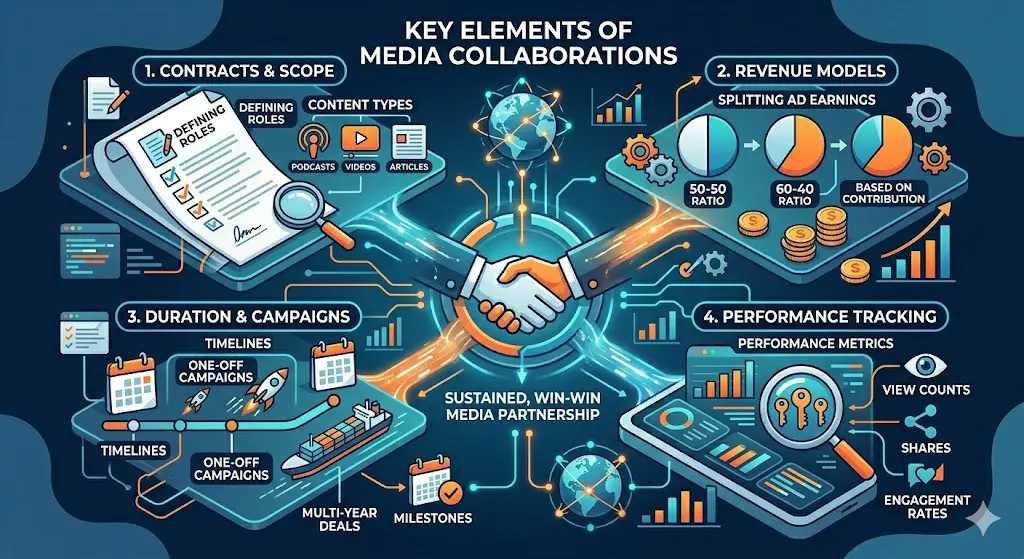
Contracts define scope, including content types like podcasts or videos. Revenue models split ad earnings at ratios such as 50-50 or 60-40 based on contribution. Duration ranges from one-off campaigns to multi-year deals. Performance tracking uses metrics like view counts and shares.
What Are Audience Insights?
Audience insights consist of data-driven profiles detailing demographics, behaviors, and preferences of media consumers. Tools analyze 100 billion data points daily to generate reports with 85% accuracy in predicting engagement.
Audience insights derive from sources like web analytics, surveys, and social media interactions. Demographics cover age, location, and income levels. Behavioral data tracks viewing habits, such as average session time of 12 minutes on news sites. Preferences reveal content types, with 70% of UK audiences favoring video over text.
Generation involves aggregating data from first-party sources like website cookies and third-party platforms. Processing uses algorithms to segment audiences into groups, such as 18-24-year-olds interested in sports. Insights update in real-time, reflecting shifts like a 15% rise in mobile consumption during evenings.
Sources of Audience Insights
Primary sources include platform analytics from YouTube or BBC iPlayer. Secondary sources encompass public datasets and purchased reports. Integration combines these for comprehensive views, identifying patterns like peak engagement at 8 PM.
How Do Audience Insights Support Media Collaborations?
Audience insights support media collaborations by matching partner audiences for 30% improved compatibility and targeting content to boost retention by 25%. Data guides partner selection and content strategy.
Insights enable precise partner matching by comparing audience overlap. A collaboration succeeds when shared demographics exceed 40%. Data reveals complementary strengths, such as one partner’s young audience pairing with another’s older viewers. This alignment drives 18% higher conversion in joint campaigns.
During execution, insights inform content creation. Creators adjust topics based on peak interest areas, like tech news for urban professionals. Post-collaboration analysis measures outcomes against benchmarks, refining future efforts.
Integration Process in Collaborations
Data sharing occurs via secure APIs. Partners exchange anonymized profiles. Joint dashboards visualize overlaps. Adjustments happen weekly based on live metrics.
What Is the Process of Using Audience Insights in Media Collaborations?
The process starts with data collection, followed by analysis, partner matching, content adaptation, and performance review, achieving 22% efficiency gains in campaign planning.
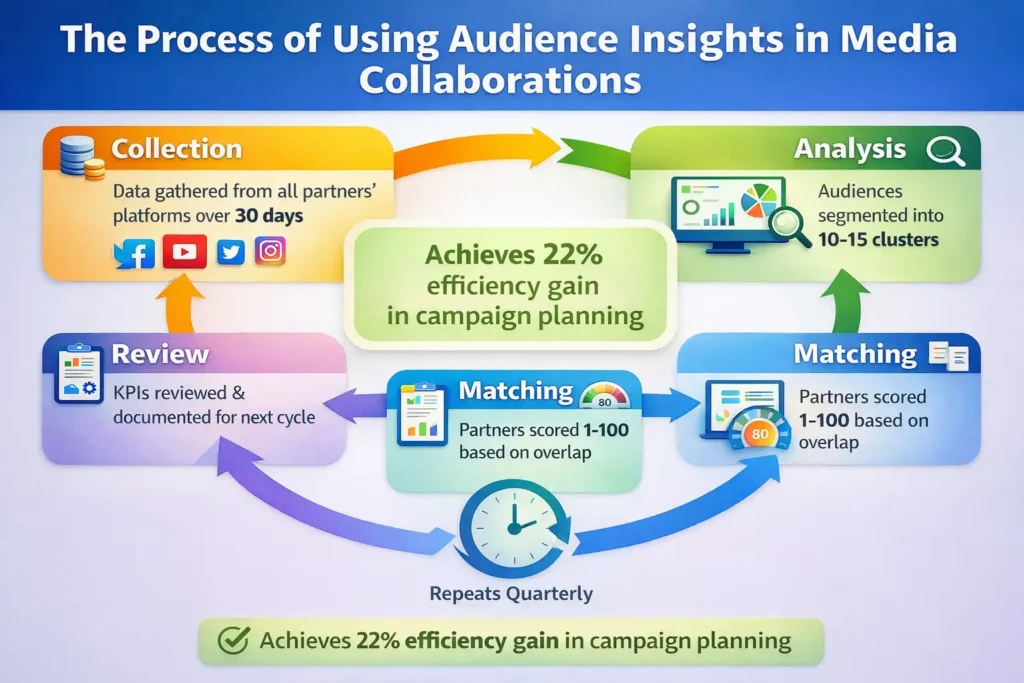
Collection gathers data from all partners’ platforms over 30 days. Analysis segments audiences into 10-15 clusters using tools like Google Analytics. Matching scores partners on a 1-100 scale based on overlap. Adaptation tailors content scripts to top preferences.
Review phase examines KPIs like 10% uplift in shares. Reports document lessons, stored for reuse. The cycle repeats quarterly for ongoing collaborations.
Steps in Detail
Step 1: Collect baseline data from traffic logs. Step 2: Run segmentation algorithms. Step 3: Simulate collaboration scenarios. Step 4: Launch with A/B testing. Step 5: Iterate based on 7-day feedback loops.
What Components Make Up Effective Audience Insights for Collaborations?
Components include demographic profiles, behavioral patterns, psychographic data, and predictive analytics, covering 95% of engagement factors in media partnerships.
Demographic profiles list age brackets (e.g., 25-34 at 28% of viewership), gender splits (52% female), and regional data (London at 35%). Behavioral patterns track dwell time (average 4.2 minutes) and repeat visits (40% weekly). Psychographics detail interests like sustainability (preferred by 60%).
Predictive analytics forecast trends, such as 12% growth in podcast listens. Technical components add device usage (65% mobile) and channel preferences (social media at 55%).
Breaking Down Each Component
Demographics use census-linked data. Behaviors derive from clickstreams. Psychographics come from surveys of 50,000 respondents. Predictions employ machine learning on historical trends.
What Benefits Do Audience Insights Bring to Media Collaborations?
Benefits include 35% higher ROI, 28% increased reach, reduced waste by 40%, and sustained partnerships lasting 18 months on average.
Higher ROI stems from targeted ads yielding £2.50 per £1 spent. Increased reach taps untapped segments, adding 500,000 viewers per campaign. Waste reduction cuts irrelevant content production by focusing on proven interests. Longevity builds from data-backed renewals.
Additional gains cover 15% faster production cycles and 20% better retention rates. UK-specific benefits note alignment with regional tastes, like higher news consumption in Scotland.
Quantified Impact Areas
ROI calculations use attribution models. Reach expands via cross-promotion. Waste metrics track unused budgets. Partnership duration logs contract renewals.
What Use Cases Demonstrate Media Collaborations with Audience Insights?
Use cases span news co-productions, podcast networks, video series launches, and event coverage, each gaining 25-40% performance boosts through targeted insights.
News co-productions merge outlets’ audiences for election coverage, reaching 10 million UK viewers with tailored regional angles. Podcast networks combine hosts based on listener demographics, achieving 30% subscriber growth. Video series launches on platforms match creator styles to viewer behaviors, hitting 5 million streams.
Event coverage uses live data for real-time adjustments, like shifting focus to sports highlights for 70% of attendees. Cross-industry cases include media with retail for branded content, driving 22% sales lifts.
Discover specific partnership tactics in How audience insights improve media partnerships.
Detailed Use Case Examples
News case: Partners analyze 2 million interactions for topic prioritization. Podcast: Segments match 80% listener overlap. Video: A/B tests thumbnails based on click data. Events: Dashboards update hourly.
How Do You Start Media Collaborations Using Audience Insights?
Start by auditing internal data, identifying partners via overlap tools, negotiating data shares, piloting small projects, and scaling based on 15% KPI thresholds.
Audit reviews 90 days of platform data for strengths. Partner search uses databases scanning 1,000 entities. Negotiations set data protocols under GDPR. Pilots test 4-week campaigns with budgets under £10,000.
Scaling follows if metrics exceed benchmarks. Tools like SimilarWeb facilitate initial scans. Audit: Export analytics reports. Search: Filter by audience size over 100,000. Negotiate: Draft MOUs. Pilot: Define three KPIs. Scale: Review post-pilot data.
Why Do Audience Insights Matter for Future Media Collaborations?
Audience insights matter because they drive 40% growth in collaboration success rates, adapt to 15% annual shifts in consumer behavior, and ensure compliance with data regulations.
Growth occurs through precise targeting amid rising competition. Adaptations handle changes like 20% surge in short-form video. Compliance meets UK standards via anonymization techniques.
Future trends emphasize AI integration for 50% faster insights. Collaborations evolve to real-time data exchanges. See advanced applications in How Time Intelligence Media Group uses audience intelligence.