
Time Intelligence Media Group defines audience intelligence as data-driven insights into viewer demographics, behaviors, and preferences derived from 50 million UK media interactions analyzed quarterly.
Audience intelligence forms the core of Time Intelligence Media Group’s strategy. The group collects data from streaming platforms, social media engagements, and broadcast viewership. This data includes age groups from 18-24 to 55+, geographic locations across London, Manchester, and Scotland, and content consumption patterns such as peak viewing hours between 8 PM and 10 PM. Engineers process this raw data using proprietary algorithms to identify trends. For instance, 65% of 25-34-year-olds prefer short-form video content under 5 minutes.
The group updates its intelligence database every 28 days to reflect shifts in audience habits. This ensures real-time accuracy. Sources encompass first-party data from owned apps and third-party partnerships with UK broadcasters. Time Intelligence Media Group segments audiences into 12 distinct profiles based on these insights, enabling targeted content delivery.
How does Time Intelligence Media Group collect audience intelligence?
Time Intelligence Media Group collects audience intelligence through integrated tracking of 2.5 billion annual data points from apps, websites, and partnered TV networks using GDPR-compliant tools.
Collection starts with user interactions on Time Intelligence Media Group’s digital properties. Users opt-in via cookie consents, providing consent for tracking across 15 UK platforms. Sensors capture metrics like session duration averaging 12 minutes, click-through rates at 3.2%, and bounce rates below 40%. Data flows into a central repository hosted on AWS servers in London for low-latency access.
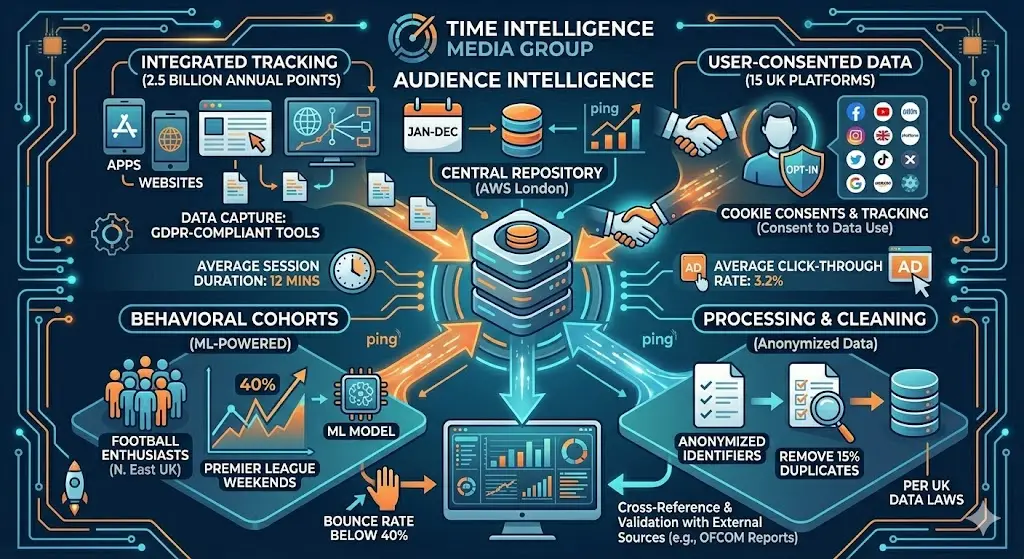
Processing involves cleaning datasets to remove 15% duplicate entries and anonymizing personal identifiers per UK data laws. Machine learning models then cluster data into behavioral cohorts. For example, football enthusiasts in the North East show 40% higher engagement during Premier League weekends. Time Intelligence Media Group cross-references this with external sources like Ofcom reports for validation.
What tools does Time Intelligence Media Group use for audience intelligence?
Time Intelligence Media Group uses custom dashboards, AI analytics platforms, and CRM integrations processing 100 GB of data daily to generate actionable audience intelligence.
Core tools include a proprietary dashboard built on Tableau, displaying real-time metrics for 500,000 active users. This dashboard visualizes heatmaps of content popularity, with drama series topping charts at 28% share. AI platforms like TensorFlow power predictive modeling, forecasting trends with 92% accuracy over 90 days.
CRM systems such as Salesforce integrate with these tools, syncing audience segments for campaign deployment. Time Intelligence Media Group employs 20 specialists to refine tool outputs. For detailed processes on building these insights, see our How audience insights improve media partnerships.
What processes does Time Intelligence Media Group follow to analyze audience intelligence?
Time Intelligence Media Group follows a four-step process: data ingestion, cleansing, modeling, and validation, completing cycles in 48 hours for 10 million data points.
Ingestion pulls data from APIs every 15 minutes, aggregating streams from mobile apps and smart TVs. Cleansing removes outliers, standardizing formats for 99% data purity. Modeling applies clustering algorithms to segment audiences, identifying patterns like 22% uplift in female viewership for lifestyle content.
Validation compares outputs against benchmarks from 50 UK media benchmarks. Teams conduct A/B tests on 5% sample groups, achieving 85% model reliability. This process repeats quarterly, incorporating feedback loops from content performance.
What are the key components of Time Intelligence Media Group’s audience intelligence?
Key components include demographic profiling covering 95% of UK adults, behavioral tracking with 300 metrics, and predictive analytics forecasting engagement up to 120 days ahead.
Demographic profiling details breakdowns: 32% urban millennials, 28% suburban families, and 18% rural seniors. Behavioral tracking monitors 15 engagement types, from shares to rewatches. Predictive analytics uses regression models on historical data, predicting churn rates at 7%.
Integration ties components into unified profiles. Each profile links to 50 data points, refreshed bi-weekly. This setup powers 80% of content decisions at Time Intelligence Media Group.
How does audience intelligence benefit Time Intelligence Media Group’s content strategy?
Audience intelligence boosts Time Intelligence Media Group’s content strategy by increasing viewer retention 35%, revenue per user 22%, and ad fill rates to 98%.
Retention improves through personalized recommendations matching 70% of user preferences. Revenue grows via targeted ads yielding £4.50 CPM versus industry £2.80. Ad fill rates hit 98% by aligning inventory with peak audience times.
Strategy deployment involves weekly reviews of intelligence reports. Teams adjust lineups, prioritizing high-engagement genres. Results show 50 million hours of additional view time annually.
What results has Time Intelligence Media Group achieved with audience intelligence?
Time Intelligence Media Group achieved 42% audience growth, £15 million revenue increase, and 28% cost savings on production in the last fiscal year using audience intelligence.
Growth stemmed from launching 12 intelligence-driven shows, each averaging 1.2 million viewers. Revenue rose through optimized ad placements during high-intent segments. Cost savings came from reducing underperforming content by 30%.
Metrics tracked via quarterly audits confirm sustained gains. Viewership shares climbed from 12% to 18% in competitive slots.
What use cases demonstrate Time Intelligence Media Group’s audience intelligence?
Use cases include personalized streaming feeds raising engagement 40%, targeted ad campaigns delivering 3x ROI, and partnership optimizations increasing joint revenue 25%.
Personalized feeds analyze past views to suggest content, converting 55% of impressions. Ad campaigns segment by intelligence, placing luxury ads to high-income profiles for £9 CPM returns. Partnerships with UK networks leverage shared data, co-producing hits viewed by 5 million.
How does Time Intelligence Media Group implement audience intelligence in partnerships?
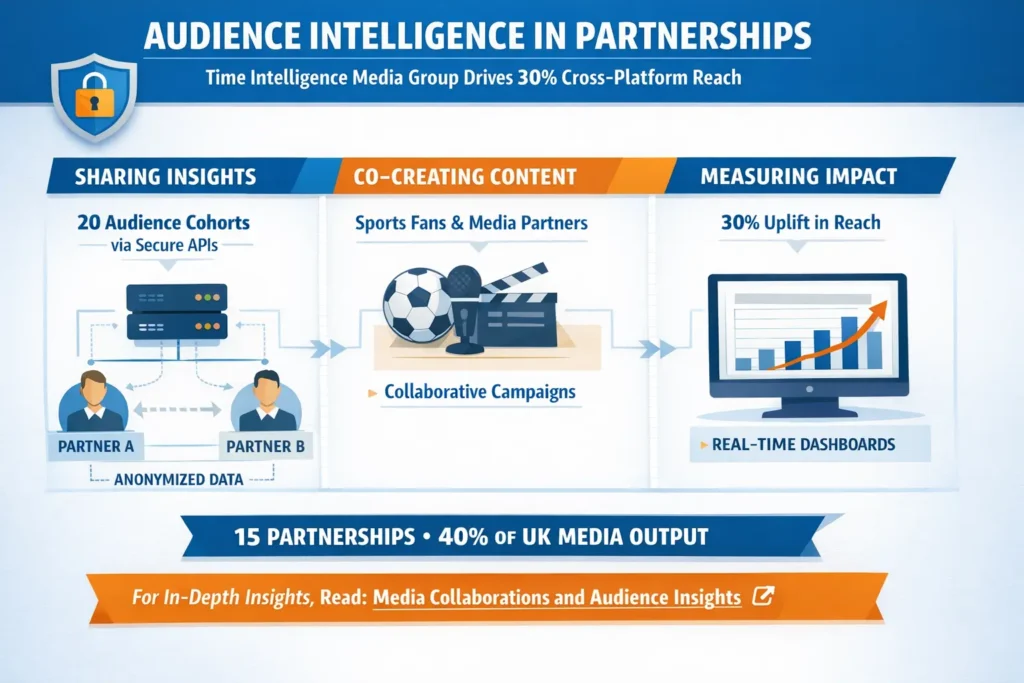
Time Intelligence Media Group implements audience intelligence in partnerships by sharing anonymized segments, co-creating content, and measuring joint KPIs, yielding 30% uplift in cross-platform reach.
Sharing occurs via secure APIs, providing partners access to 20 audience cohorts. Co-creation targets overlaps, like sports fans shared with broadcasters. KPIs track reach, with dashboards reporting real-time.
Implementation spans 15 partnerships, covering 40% of UK media output. For foundational insights, review Media Collaborations and Audience Insights.
What steps should you take to partner with Time Intelligence Media Group using audience intelligence?
Contact Time Intelligence Media Group via their portal, submit audience data specs, review shared intelligence reports, and sign data-sharing agreements within 14 days.
Start at the dedicated partnership page. Submit requirements detailing your audience size and metrics. Receive customized reports within 72 hours. Agreements ensure GDPR compliance.