In today’s media landscape, businesses often grapple with the difference between PR and advertising when building brand visibility. Public relations (PR) focuses on earning credible media coverage through relationships and storytelling, while advertising involves paid placements to control messaging. Understanding these core differences helps marketers allocate budgets effectively and amplify reach without wasting resources.
This distinction matters especially for emerging brands seeking sustainable growth. PR builds long-term trust via third-party endorsements, whereas advertising delivers immediate but temporary exposure. By dissecting these approaches, companies can craft hybrid strategies that leverage both for maximum impact.
Core Definitions: What Sets PR and Advertising Apart
Public relations, or PR, revolves around managing a brand’s reputation through unpaid, earned media channels. Professionals in PR craft narratives that journalists and influencers find newsworthy, resulting in organic coverage on news sites, podcasts, and social platforms. This earned media feels authentic because it’s vetted by independent sources, fostering genuine audience trust over time.
Advertising, in contrast, is a paid promotional tactic where brands purchase space or time in media outlets. Think of banner ads on websites, TV commercials, or sponsored social posts—these allow full creative control but come with a “paid for” label that savvy consumers often recognize. The key difference between PR and advertising here lies in payment: PR earns its spot, while advertising buys it outright.
To illustrate, consider a tech startup launching a new app. PR might secure a feature article in TechCrunch highlighting user testimonials and innovation, positioning the company as an industry leader. Advertising could mean a Google Ads campaign targeting “best productivity apps,” driving clicks but without the endorsement halo. These examples underscore how PR invests in relationships for lasting credibility, unlike advertising’s transactional nature.
Control and Messaging: Who Holds the Reins?
One of the starkest differences between PR and advertising is the level of message control. In advertising, brands dictate every word, image, and call-to-action, ensuring alignment with sales goals. This precision suits time-sensitive promotions, like Black Friday deals, where consistency across channels drives conversions.

PR demands relinquishing some control to journalists who interpret stories through their lens. A PR pitch about a sustainable fashion brand might evolve into a critical piece on industry ethics, potentially highlighting challenges alongside successes. This unpredictability can yield deeper engagement but requires resilient messaging frameworks.
Brands navigating this balance often use PR for thought leadership and advertising for direct response. For instance, a healthcare company might advertise flu vaccine benefits with tailored visuals, while pitching PR stories on community health initiatives to local news. Such strategies highlight how surrendering control in PR builds authenticity, contrasting advertising’s scripted reliability.
Strategic Trade-Offs in Message Ownership
PR’s lack of control encourages adaptable storytelling that resonates with diverse audiences. Media outlets repackage pitches into relatable formats, like turning a corporate sustainability report into a human-interest feature on employee-led recycling programs. This organic evolution enhances shareability and SEO value through backlinks.
Advertising’s control, however, enables A/B testing for optimization—tweaking headlines or visuals based on real-time data. Yet, over-control can make ads feel salesy, leading to ad fatigue. The difference between PR and advertising shines in crises: PR manages narratives via trusted voices, while advertising amplifies positives but can’t counter negative perceptions alone.
Cost Structures: Budgeting for Earned vs. Paid Media
Financially, the difference between PR and advertising boils down to upfront costs versus long-term value. Advertising operates on a pay-per-use model, with expenses tied to impressions (CPM), clicks (CPC), or conversions. A national TV spot might cost $100,000 for 30 seconds, scaling with audience size and frequency.
PR costs center on agency fees, content creation, and distribution tools, but coverage is free once secured. Retainers for PR distribution services typically range from $5,000–$20,000 monthly, yielding multiple placements without per-exposure fees. This model rewards persistence, as one viral story can generate millions in equivalent ad value (AVE).
Real-world scenarios reveal these dynamics. A restaurant chain spends $50,000 on digital ads for a new menu launch, tracking ROI via promo codes. Simultaneously, PR efforts land reviews in food blogs, sparking user-generated buzz at no extra media cost. Time Intelligence Media Group’s PR Distribution Services exemplify efficient PR budgeting, amplifying stories across premium outlets for measurable reach.
Measuring Success: Metrics That Matter
Effectiveness in PR versus advertising hinges on distinct KPIs. Advertising excels in quantifiable metrics like click-through rates (CTR), return on ad spend (ROAS), and sales attribution, thanks to tracking pixels and UTM parameters. A 2% CTR on a $10,000 campaign signals solid performance.
PR success leans qualitative: share of voice, sentiment analysis, and backlink quality gauge reputation impact. Tools like media monitoring software track mentions, estimating AVE while prioritizing high-authority domains. The difference between PR and advertising in measurement is immediacy—ads report daily, PR builds over months.
Consider a beverage brand’s summer campaign. Advertising metrics show 500,000 impressions yielding 10,000 website visits. PR secures features in lifestyle magazines, boosting brand searches by 30% and earning 50 backlinks. For deeper insights, explore our PR Distribution vs Newswire Services comparison to see how targeted distribution elevates PR outcomes.
Long-Term vs. Short-Term ROI Examples
PR’s ROI compounds through sustained visibility; a single Forbes mention can drive traffic for years via evergreen search. Advertising delivers spikes but requires ongoing spend to maintain momentum, often leading to diminishing returns.
In practice, nonprofits blend both: ads fundraise during holidays with trackable donations, while PR builds donor loyalty via impact stories in outlets like CNN. This hybrid approach maximizes the unique strengths of each.
Credibility and Audience Perception
Credibility forms the heart of the difference between PR and advertising. Earned media from PR carries third-party validation, making claims more believable—studies show consumers trust editorial content 4x more than ads. This halo effect influences purchasing decisions subtly.
Advertising’s paid nature triggers skepticism; disclosure labels like #ad signal commercial intent. Yet, when executed creatively, ads like Super Bowl spots become cultural moments blending entertainment with persuasion.
A luxury watchmaker demonstrates this: PR placements in Vogue build aspirational prestige, while Instagram ads drive e-commerce. Over time, PR cements heritage status, outlasting ad-driven hype.
When to Choose PR Over Advertising (or Both)
Select PR for reputation-building phases, like product launches or executive thought leadership, where authenticity trumps volume. Advertising suits performance marketing, such as lead gen or e-commerce scaling.
Hybrid strategies thrive: use PR for awareness, ads for conversion. A SaaS firm might pitch PR on AI innovations for Time Intelligence Media Group distribution, then retarget readers with ads. See our Case Study: Successful PR Campaign Reach for proof of amplified results.
Lists clarify decision frameworks:
- Choose PR when: Seeking trust, backlinks, or crisis management.
- Choose Advertising when: Needing quick traffic, precise targeting, or seasonal pushes.
- Combine for: Full-funnel coverage, from TOFU awareness to BOFU conversions.
Evolving Trends in PR and Advertising Integration
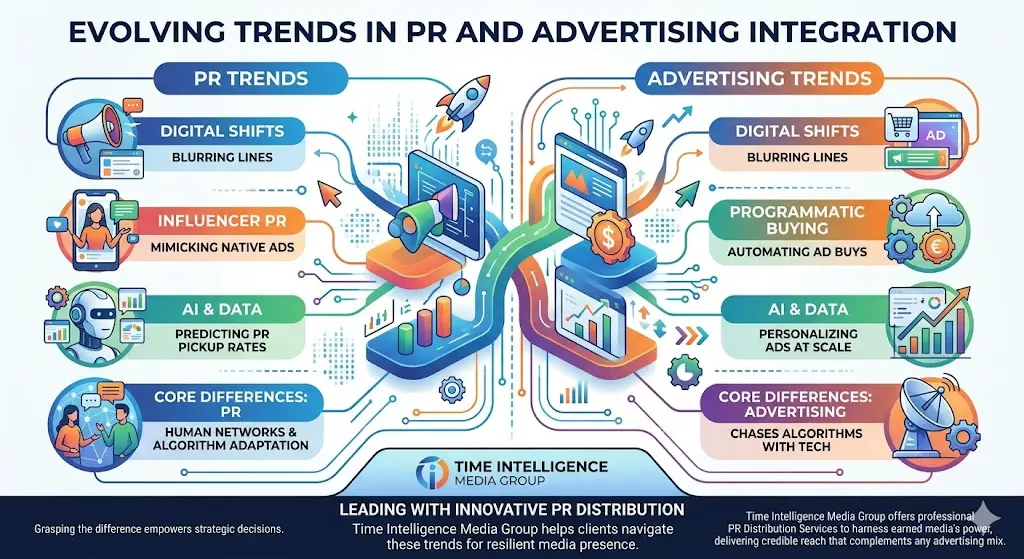
Digital shifts blur lines, with influencer PR mimicking native ads and programmatic buying automating ad buys. AI tools now predict PR pickup rates, while data-driven ads personalize at scale.
Yet, core differences persist: PR adapts to algorithm changes via human networks, advertising chases them with tech. Brands ignoring PR risk commoditized visibility in ad-saturated feeds.
Time Intelligence Media Group leads with innovative PR distribution, helping clients navigate these trends for resilient media presence.
Grasping the difference between PR and advertising empowers strategic decisions. Time Intelligence Media Group offers professional PR Distribution Services to harness earned media’s power, delivering credible reach that complements any advertising mix.