
For mid-funnel marketers evaluating media amplification options, understanding PR distribution vs newswire services is crucial. PR distribution involves targeted, strategic dissemination of stories to curated journalist lists and outlets, prioritizing relevance and relationships. Newswire services, meanwhile, blast press releases to vast databases for broad but often generic exposure.
This comparison helps businesses choose tools that align with goals like lead nurturing or authority building. While newswires offer speed and scale, PR distribution excels in precision and engagement, making it ideal for sustained brand growth.
Defining PR Distribution and Newswire Services
PR distribution refers to the strategic process of sending tailored press releases, pitches, or media kits to handpicked journalists, bloggers, and influencers who cover your industry. Providers like Time Intelligence Media Group focus on audience-matched outlets, using data-driven insights to secure high-impact placements. This method emphasizes quality over quantity, fostering ongoing media relationships.
Newswire services, such as PR Newswire or Business Wire, operate as automated platforms that distribute content across thousands of websites, news aggregators, and email lists for a fee. They guarantee visibility on partner sites but lack personalization, often resulting in low-engagement “tombstone” placements where stories appear without context.
The core difference in PR distribution vs newswire services lies in approach: distribution builds targeted conversations, while newswires prioritize mass dissemination. For example, a fintech firm using PR distribution might land a feature in Forbes via a specialized pitch, whereas a newswire blast yields sidebar mentions on generic finance portals.
Key Differences in Targeting and Personalization
Targeting sets PR distribution apart from newswire services profoundly. PR distribution employs journalist databases, beat analysis, and AI-matching to send customized pitches—e.g., a healthcare pitch goes only to health reporters at outlets like Healthline or MedPage Today. This relevance boosts pickup rates by 5-10x compared to generic blasts.
Newswire services cast a wide net, routing content to predefined categories without customization. Releases land in inboxes of thousands, but open rates hover below 5% due to irrelevance. Personalization is minimal; a tech gadget release might clutter non-tech journalists’ feeds.
Consider a scenario: An e-commerce brand announces a sustainability initiative. PR distribution targets green business editors at outlets like Fast Company, yielding interviews and features. A newswire submission scatters it across unrelated sites, diluting impact. To grasp foundational concepts, start with our Difference Between PR and Advertising guide.
Customization Impact on Journalist Response
In PR distribution, pitches include exclusive data or expert quotes tailored to the recipient’s style, increasing response rates. Time Intelligence Media Group’s PR Distribution Services exemplify this by integrating multimedia and follow-ups for 20-30% higher engagement.
Newswires standardize formats, limiting hooks. This commoditizes content, making it skimmable filler rather than must-publish news.
Coverage Quality and Placement Guarantees
PR distribution prioritizes premium, contextual placements in editorial sections, driving SEO backlinks and reader trust. Outcomes include bylined articles or quotes in major publications, with no placement guarantees but high relevance ensuring organic pickups.
Newswire services promise “guaranteed” distribution to 5,000+ sites, but these are often low-authority wires or RSS feeds with minimal traffic. Editorial integration is rare; stories appear as paid listings, searchable but not prominently featured.
A real-world contrast: A SaaS company’s product update via PR distribution secures coverage in TechCrunch, generating 10,000+ referrals. The same via newswire hits aggregator lists, logging impressions but few clicks. Quality metrics like domain authority (DA 80+) favor distribution.
Cost Efficiency and ROI Metrics
Budget-wise, PR distribution vs newswire services varies by scale. Newswires charge flat fees ($300–$2,000 per release) for volume, appealing for one-offs but inefficient for campaigns due to poor conversion.
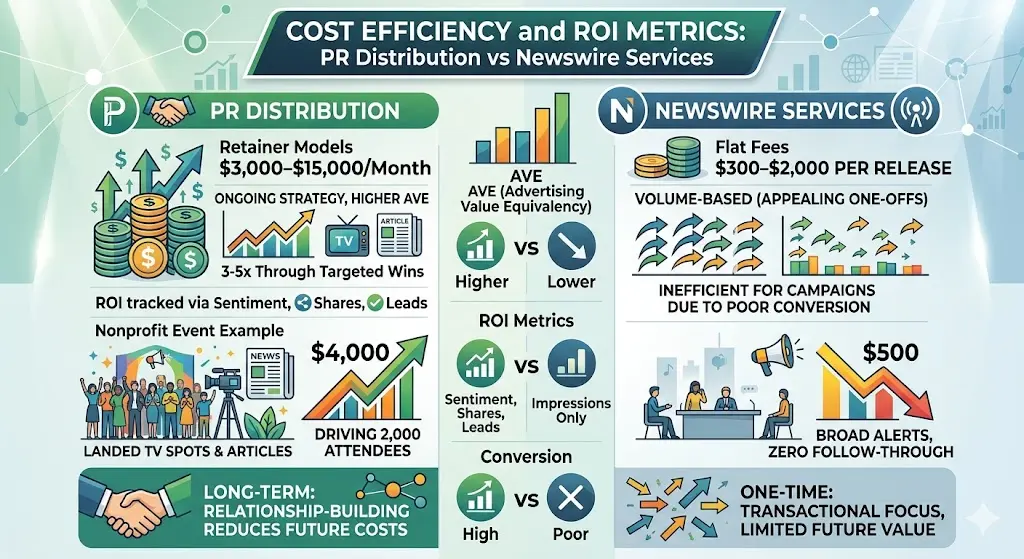
PR distribution uses retainer models ($3,000–$15,000/month) for ongoing strategy, yielding higher AVE (advertising value equivalency) per dollar—often 3-5x through targeted wins. ROI tracks via sentiment, shares, and leads, not just impressions.
For a nonprofit event, newswires cost $500 for broad alerts but zero follow-through. PR distribution at $4,000 lands TV spots and articles, driving 2,000 attendees. Long-term, distribution’s relationship-building reduces future costs.
Calculating True Value Beyond Impressions
Impressions mislead; PR distribution measures engagement (time on page, shares) and attribution (UTM-tracked traffic). Newswires inflate numbers with bots or low-value views.
Enterprise clients report 40% better lead quality from distribution, per industry benchmarks.
Speed, Scalability, and Tech Integration
Newswires win on speed, distributing instantly via APIs to global networks—ideal for earnings reports needing same-day visibility.
PR distribution takes 1-7 days for crafting and pitching but scales via automation tools for journalist matching and A/B testing. Modern platforms integrate CRM for seamless workflows.
A crisis response favors newswires for immediacy, but PR distribution handles nuance with follow-ups. Scalability shines in campaigns: distribution manages 50+ targeted outlets monthly.
Pros and Cons: Side-by-Side Comparison
Breaking down PR distribution vs newswire services:
- PR Distribution Pros: High relevance, relationship-building, premium placements, better SEO.
- Cons: Slower, no guarantees, higher upfront strategy costs.
- Newswire Pros: Fast, affordable entry, wide reach, measurable impressions.
- Cons: Low engagement, generic exposure, spam perception.
A B2B software launch blends both: newswires for alerts, distribution for depth. For decision-makers, review our Case Study: Successful PR Campaign Reach showcasing hybrid wins.
Industry Trends and Future Outlook
AI enhances both: PR distribution uses predictive analytics for pitch timing; newswires leverage NLP for categorization. Yet, journalist fatigue pushes toward hyper-targeted models.
Sustainability trends favor distribution’s efficiency, reducing digital waste from mass emails. By 2026, 60% of PR pros predict distribution dominance for quality-focused brands.
Choosing the Right Fit for Your Goals

Select newswires for urgency and budget constraints; PR distribution for authority and nurturing. Hybrids optimize: newswires seed awareness, distribution amplifies.
Time Intelligence Media Group delivers tailored PR Distribution Services, empowering strategies with precision reach that outpaces generic newswires.
While newswires provide quick breadth, PR distribution offers depth for meaningful media impact. Time Intelligence Media Group provides expert solutions to navigate PR distribution vs newswire services, ensuring your content resonates where it matters most.