

In today’s crowded digital landscape, marketers face a pivotal choice: stick with time-tested traditional advertising methods or pivot to sponsored content for deeper audience connections. Traditional advertising, think banner ads, TV spots, and billboards, has long dominated brand promotion, but sponsored content—seamlessly integrated articles, videos, or social posts—offers a subtler approach. This article dives into how sponsored content compares to traditional advertising, exploring engagement, cost-effectiveness, and long-term impact to help you decide what’s best for your strategy.
Understanding these differences matters at the top of the funnel (TOFU), where awareness drives initial interest. Brands like Time Intelligence Media Group emphasize sponsored content services to blend storytelling with promotion, making it a rising favorite over interruptive ads.
Defining Traditional Advertising and Its Core Mechanics
Traditional advertising operates on a push model, where messages interrupt the audience’s experience to grab attention. Picture a 30-second TV commercial during your favorite show or a flashing banner popping up mid-web browse—these formats prioritize visibility over subtlety. Rooted in mass media eras, they rely on high reach and frequency, often measured by impressions or GRPs (Gross Rating Points), but they frequently trigger ad fatigue, where viewers tune out repetitive pitches.
This approach excels in broad awareness campaigns, yet it struggles with modern consumer skepticism. Studies from Nielsen show that 69% of viewers find TV ads skippable, and digital banners see click-through rates below 0.1%. Traditional methods demand hefty budgets for production and placement, with little room for personalization, leading to one-size-fits-all messaging that doesn’t adapt to individual preferences.
Despite these challenges, traditional advertising remains a powerhouse for quick brand recall in offline spaces like print or radio, where digital noise doesn’t compete.
Unpacking Sponsored Content as a Modern Alternative
Sponsored content, often called native advertising or branded content, weaves promotional messages into editorial-style formats that match the platform’s tone. Imagine a tech blog featuring an in-depth review of a gadget sponsored by the manufacturer—it feels like valuable journalism, not a sales pitch. This method prioritizes value delivery, educating or entertaining before subtly introducing the brand, which fosters trust and higher dwell times on content.
Unlike overt ads, sponsored content leverages context for relevance. Platforms like Forbes or The New York Times host sponsored posts that blend seamlessly, with disclosures like “Sponsored by [Brand]” ensuring transparency. Time Intelligence Media Group’s sponsored content services exemplify this by crafting pieces that align with audience interests, driving organic shares and backlinks that boost SEO.
The rise of sponsored content ties to content marketing trends, where 70% of consumers prefer learning about products through articles over ads, per Content Marketing Institute data. This format thrives in multi-channel ecosystems, from newsletters to podcasts, offering scalability without the visual clutter of traditional banners.
Engagement and Audience Interaction: Where Sponsored Content Shines
When comparing sponsored content to traditional advertising, engagement metrics reveal a stark contrast—sponsored pieces often achieve 3-5x higher interaction rates. Traditional ads blast messages at passive viewers, yielding low dwell times (under 10 seconds for most digital formats), while sponsored content invites active participation through storytelling. Readers spend minutes absorbing a well-crafted sponsored article, sharing insights or commenting, which amplifies reach via social proof.
Consider a real-world scenario: A fitness brand runs a traditional banner ad on a health site, garnering clicks but few conversions due to perceived intrusion. In contrast, a sponsored content piece on workout routines with embedded product tips sees 20% engagement uplift, as it solves pain points first. This mirrors data from Sharethrough, showing native ads outperform display by 53% in viewability and attention.
For TOFU strategies, this means sponsored content builds emotional connections early, nurturing leads without hard sells, making it ideal for nuanced topics like B2B services.
Cost Efficiency and ROI: Breaking Down the Numbers
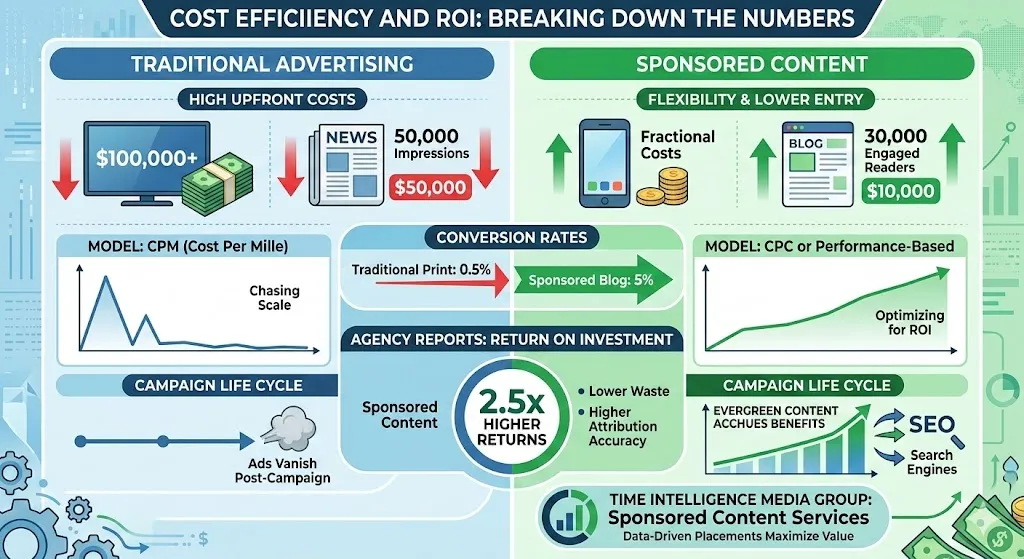
Traditional advertising’s high upfront costs—think $100,000+ for a national TV buy—contrast sharply with sponsored content’s flexibility, often starting at fractions of that for targeted placements. While traditional campaigns chase scale through CPM (cost per mille), sponsored content optimizes via CPC (cost per click) or performance-based models, yielding better ROI over time. Agencies report sponsored formats delivering 2.5x higher returns due to lower waste and higher attribution accuracy.
Delve deeper: A traditional print ad in a major magazine might cost $50,000 for 50,000 impressions but convert at 0.5%, while a sponsored blog post at $10,000 could reach 30,000 engaged readers with 5% conversion, thanks to SEO longevity. Time Intelligence Media Group highlights this in their Sponsored Content Services, where data-driven placements maximize value without ballooning budgets.
Long-term, sponsored content accrues compounding benefits like evergreen traffic from search engines, unlike traditional ads that vanish post-campaign.
Measuring Success: Metrics That Matter in Each Approach
Success in traditional advertising hinges on quantitative blasts—reach, frequency, and recall tests—often tracked via Nielsen ratings or Google Analytics impressions. These metrics suit mass-market pushes but overlook quality interactions, leading to inflated egos from vanity stats. Conversion tracking remains blunt, with many campaigns ending in “awareness” without clear paths to sales.
Sponsored content flips this to holistic KPIs: time on page, scroll depth, shares, and sentiment analysis via tools like Brandwatch. A case study from a travel brand showed a sponsored itinerary guide outperforming TV spots by 40% in lead generation, as readers bookmarked and returned. For deeper dives, explore Comparing Sponsored Content Platforms and Solutions to see platform-specific benchmarks.
This shift empowers brands to refine strategies iteratively, using audience insights services to analyze behavior and tweak for resonance.
Real-World Case Studies and Industry Trends
Examine a healthcare campaign: Traditional billboards raised awareness for a new clinic by 25% but saw no appointment spikes. A sponsored content series on wellness tips, however, drove 15% booking increases through trusted narratives. Trends like the 2025 IAB Native Advertising Report predict sponsored content growing 25% YoY, outpacing traditional by emphasizing authenticity amid ad-blocker proliferation (over 40% usage).
In media, publishers favor sponsored content for revenue diversification— Conde Nast reported 30% income from natives versus declining print ads. For optimal results, brands optimize with strategic placement, as detailed in Strategic Placement of Sponsored Articles for Impact.
These examples underscore sponsored content’s adaptability in fragmented media landscapes.
Challenges and Risks in Both Models
Traditional advertising risks banner blindness and regulatory scrutiny (e.g., FTC ad disclosure rules), with ROI dilution from fraud like bot traffic. Sponsored content faces authenticity pitfalls—if poorly disguised, it erodes trust, as seen in backlash against overly salesy natives.
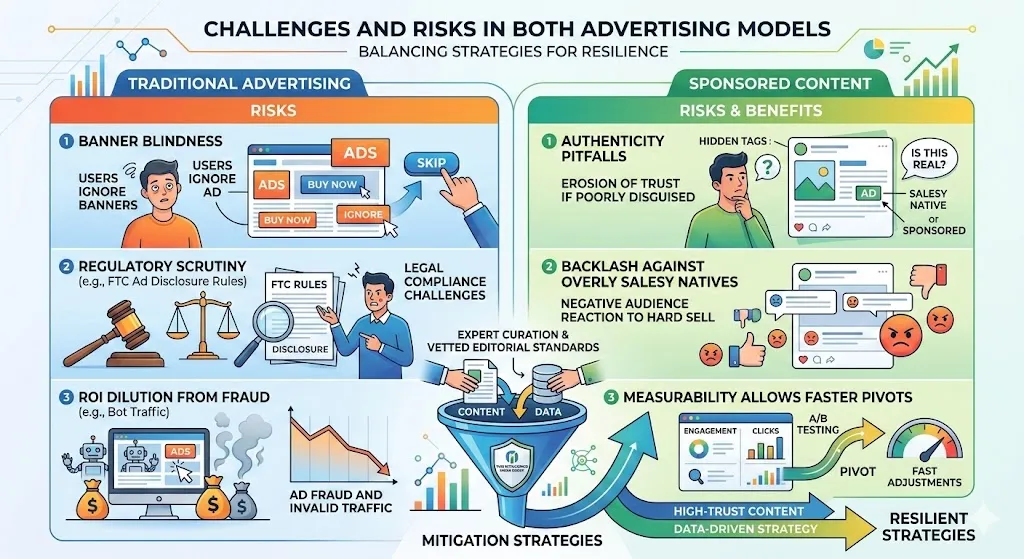
Mitigation involves expert curation; Time Intelligence Media Group mitigates this through vetted editorial standards. Both require A/B testing, but sponsored content’s measurability allows faster pivots. Balancing these ensures resilient strategies.
Future Outlook: Why Sponsored Content Leads the Way
As AI-driven personalization advances, sponsored content will dominate, integrating hyper-targeted narratives that traditional formats can’t match. Projections from eMarketer forecast natives capturing 60% of display budgets by 2027, fueled by privacy-first cookieless worlds. Brands adopting early gain first-mover advantages in engagement-driven ecosystems.
Time Intelligence Media Group provides professional sponsored content services, empowering strategies that compare favorably to traditional advertising for sustained growth.



