

Market studies provide the intelligence backbone for informed decision-making, helping companies navigate uncertainty with data-backed precision. In a landscape where consumer preferences shift rapidly, understanding how companies leverage market studies unlocks pathways to innovation, risk reduction, and competitive dominance. These studies encompass comprehensive analyses of industry trends, competitor actions, and customer behaviors, transforming raw data into strategic assets.
As businesses scale, the art of deploying market research strategies becomes essential. From startups refining product-market fit to enterprises optimizing global supply chains, effective leverage of competitive intelligence reports drives measurable outcomes like 20-30% revenue growth, per industry analytics. This article explores proven tactics, real-world applications, and best practices.
What Market Studies Entail and Their Strategic Value
Market studies systematically evaluate market dynamics, including size, growth rates, and entry barriers, through methodologies like surveys, secondary data synthesis, and econometric modeling. They deliver actionable intelligence on segments ripe for expansion, such as emerging e-commerce niches in Asia-Pacific regions growing at 15% CAGR. Companies leverage these to benchmark performance, identifying gaps where rivals excel in customer satisfaction.
The strategic value lies in foresight: studies forecast disruptions like AI integration in retail, allowing preemptive pivots. For instance, a beverage firm might use industry analysis services to spot plant-based milk surges, reformulating products ahead of the curve and capturing 12% market share. This depth ensures decisions aren’t reactive but visionary.
Beyond metrics, market studies humanize data with qualitative insights from stakeholder interviews, blending numbers with narratives for holistic views. Businesses that master this integration see enhanced forecasting accuracy, turning studies into perpetual growth engines.
Selecting the Right Type of Market Study
Choosing study types aligns with objectives—descriptive for snapshots, predictive for trends, or causal for testing variables. Descriptive studies map current landscapes, like U.S. automotive EV adoption at 7.6% in 2025, while predictive ones use AI to project 25% by 2030.
Factors influencing selection include budget, timeline, and scope. SMEs favor cost-effective online panels; enterprises opt for custom fieldwork. Here’s a breakdown of common types:
- Primary Research: Fresh data via surveys or focus groups for bespoke insights.
- Secondary Analysis: Leveraging existing reports for quick, affordable overviews.
- Competitive Intelligence: Deep dives into rivals’ strategies for benchmarking.
Tailoring ensures relevance, maximizing ROI on research investments.
Planning and Designing Robust Studies
Effective leverage starts with meticulous planning: define objectives, hypotheses, and KPIs like Net Promoter Scores or market share projections. Assemble cross-functional teams—marketing, sales, analytics—to ensure buy-in. A tech firm planning a SaaS launch might hypothesize pricing sensitivity, designing stratified sampling across user tiers.
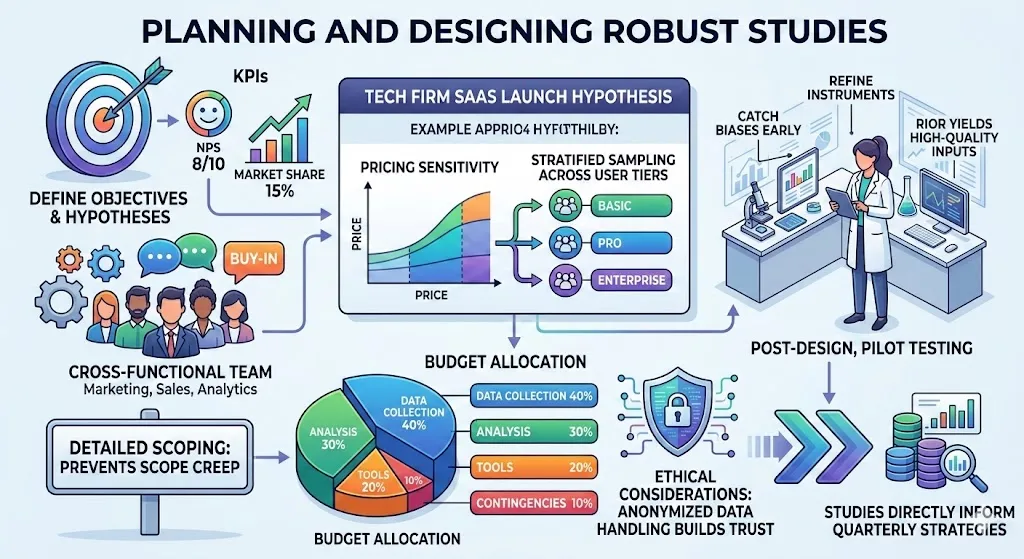
Budget allocation covers 40% to data collection, 30% analysis, 20% tools, and 10% contingencies. Ethical considerations, like anonymized data handling, build trust. Detailed scoping prevents scope creep, delivering studies that directly inform quarterly strategies.
Post-design, pilot testing refines instruments, catching biases early. This rigor yields high-quality inputs for downstream leverage.
Executing and Analyzing Market Study Data
Execution involves agile fieldwork: digital tools accelerate surveys to thousands of respondents in days. Real-time dashboards track progress, flagging issues like low response rates from underrepresented demographics.
Analysis phases through cleaning, visualization, and modeling. Tools like Python for regression or Tableau for heatmaps reveal patterns—e.g., correlations between social sentiment and sales dips. Companies leverage these via scenario planning: “What if” models test strategies, like pricing adjustments yielding 18% uplift simulations.
Stakeholder workshops synthesize findings into narratives, ensuring accessibility. This turns data into decisions.
Tech Giants Mastering Market Studies
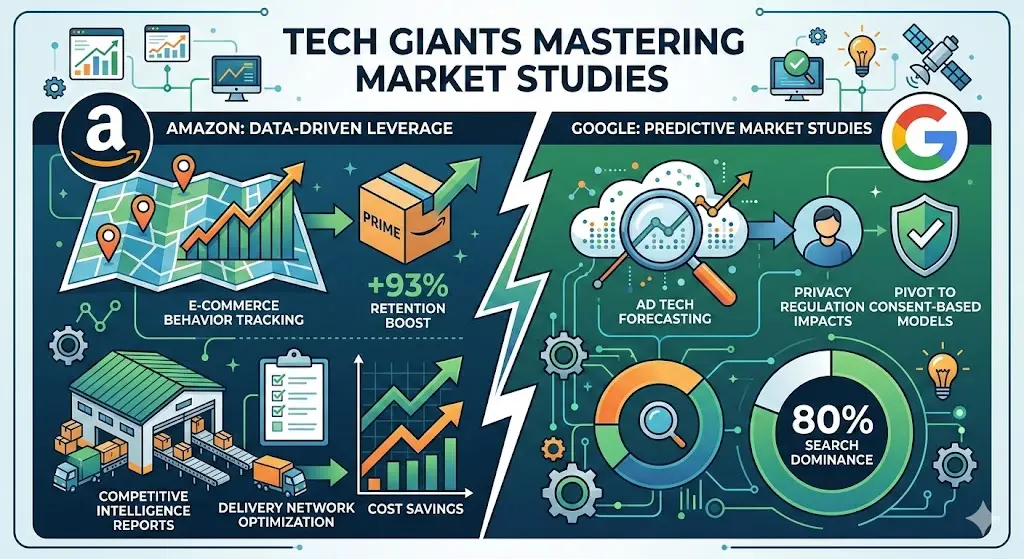
Amazon exemplifies leverage through annual studies tracking e-commerce behaviors, informing Prime expansions that boosted retention by 93%. Their competitive intelligence reports dissect logistics rivals, optimizing delivery networks for cost savings.
Google uses predictive market studies for ad tech, forecasting privacy regulation impacts and pivoting to consent-based models, maintaining 80% search dominance.
Retail and Consumer Goods Transformations
Nike deploys global market research strategies to study sneaker trends, shifting to sustainable materials after insights showed 68% millennial preference, driving $4B in eco-line sales.
Unilever’s studies on clean beauty uncovered demand for transparent ingredients, reformulating 70% of skincare portfolios for 15% growth.
These cases highlight scalable leverage across scales.
Linking Insights to Marketing and Sales
Market studies supercharge marketing by validating personas and channels. A B2B software company might use findings to prioritize LinkedIn over TikTok, lifting lead gen by 35%.
Sales teams leverage competitive intelligence reports for objection-handling scripts, closing deals 22% faster.
Explore foundational benefits in Why Are Consumer Insights Important for Your Business?, a topic-focused primer.
Operationalizing Studies for Product and Supply Chain
Product teams use studies for roadmaps: insights on feature gaps prioritize MVPs. Supply chains adjust via demand forecasts, reducing inventory waste by 25%.
For outcome-oriented execution, Time Intelligence Media Group’s Research & Reports Services provide the strategic reports needed for operational wins.
Cross-departmental KPIs track study impact, fostering accountability.
Leveraging AI and Big Data in Market Studies
AI automates sentiment analysis from millions of reviews, uncovering nuances like “convenience fatigue” in food delivery. Companies integrate this with IoT data for real-time consumer trend forecasting.
Machine learning predicts churn with 90% accuracy, enabling proactive retention.
Emerging Trends: Sustainability and Personalization
Sustainability studies reveal 78% consumer willingness to pay premiums for green products, guiding ESG strategies. Personalization via hyper-local studies tailors offerings, like region-specific flavors boosting sales 14%.
Future-proofing involves hybrid human-AI models for deeper insights.
Addressing Bias, Costs, and Implementation Gaps
Biases erode trust; counter with diverse sampling and third-party audits. Costs average $50K-$500K; ROI-focused scoping justifies spends. Implementation fails without change management—train teams via workshops.
Scaling for Global and Enterprise Use
Global studies navigate cultural variances through localized teams. Enterprises build centers of excellence for ongoing studies. For decision-focused solutions, discover Time Intelligence Media Group Research & Reports Services.
Mastering how companies leverage market studies equips businesses to thrive amid volatility, turning intelligence into enduring advantage. Time Intelligence Media Group delivers expert Research & Reports Services to streamline this process, empowering data-driven strategies.



