What Is the Process for Managing Sponsored Content Placements Across Multiple Clients?
Managing sponsored content for multiple clients requires a standardized workflow covering briefing, publisher negotiation, asset approval, and multi-account reporting. Agencies use centralized operational frameworks to scale campaign execution, ensure brand safety, and maintain consistent client ROI across various industries.
Scaling paid editorial campaigns for several accounts simultaneously introduces operational complexity. Without clear internal protocols, account teams face fragmented communication, inconsistent placement quality, and delayed reporting.
Establishing Centralized Agency Workflows
To handle high volumes of editorial placements, agencies must replace ad-hoc management with repeatable systems. Standardizing each stage of the campaign lifecycle keeps account managers aligned and prevents administrative bottlenecks.
- Standardised Briefing Templates: Every campaign starts with identical parameters for messaging, target demographics, and required compliance disclosures.
- Consolidated Publisher Communications: Media buying happens through unified contacts or dedicated inventory platforms rather than isolated team inbox threads.
- Unified Reporting Dashboards: Performance metrics from separate media houses are mapped into a single schema for cross-client analysis.
Agencies using dedicated sponsored content services streamline these operations by accessing pre-vetted publisher networks and consolidated account management.
How Do Agencies Create an Effective Sponsored Content Brief for Media Publishers?
An effective sponsored content brief defines the client target audience, core messaging, required SEO attributes, compliance guidelines, and editorial deliverables. It provides publishers with exact creative and technical boundaries while allowing their in-house writers to maintain native editorial tone.
A vague brief leads to extensive revisions, delayed publication dates, and content that misses commercial objectives. Publishers require precise instructions regarding what content they can write and which technical elements must be present.
Core Components of a Scalable Agency Brief
- Target Audience and Regional Parameters: Specify geographic focus, such as the United Kingdom market, along with reader demographics and industry sectors.
- Technical SEO Specifications: Detail exact landing page URLs, approved anchor text variations, and required link attributes such as
rel="sponsored"orrel="nofollow". - Editorial Boundaries and Angle Guidelines: Outline required brand points, acceptable topics, and explicit subjects or competitors to avoid.
- Legal and Regulatory Compliance: State exact disclosure rules required by regulatory bodies, including the Advertising Standards Authority (ASA) and the Competition and Markets Authority (CMA).
- Asset Deliverables and Timelines: Supply high-resolution imagery, brand guidelines, copyright permissions, and target publication deadlines.
Clear briefing protocols eliminate back-and-forth edits, ensuring publishers deliver compliant drafts on the first attempt.
How Do PR and Digital Agencies Select and Book Sponsored Placements at Scale?
Agencies select and book sponsored placements by evaluating publisher domain authority, audience relevance, traffic verification, editorial quality, and commercial terms. Booking at scale relies on media-buying networks, direct publisher relationships, or specialized inventory management platforms.
Evaluating individual websites manually for every campaign creates operational friction. Agencies need structured vetting criteria to evaluate publishers quickly and secure optimal commercial terms across client portfolios.
Publisher Vetting Criteria
- Audience Alignment: Verification of geographic audience distribution, ensuring primary readership resides in targeted regions like the UK.
- Organic Search Performance: Assessment of organic keyword rankings, domain authority metrics, and consistent monthly search traffic trends using independent analytics tools.
- Editorial Integrity: Inspection of site design, publishing frequency, ratio of sponsored articles to organic posts, and writer credentials.
- Commercial Transparency: Clear pricing structures, guaranteed turnarounds, and explicit indexation commitments.
Understanding how agencies buy sponsored content helps account managers negotiate bulk pricing, lock in priority editorial slots, and maintain strict quality control across diverse publisher networks.
Explore More Expert Insights:
How to Score Reader Loyalty With Recency, Frequency and Volume Data and Build Segments From the Results
How to Present Logistics Performance Data as a Research Report That Supply Chain Trade Media Will Publish
What Is the Best Way to Monitor and Approve Content Before Publication?
The best way to manage content approvals is through a multi-stage review process that checks for message accuracy, legal disclosure, SEO link attributes, and brand alignment. Agencies use centralized sign-off tracking to ensure client review without delaying publisher editorial schedules.
Content approval represents a frequent bottleneck in agency workflows. Delays from client legal or brand teams can disrupt publisher editorial calendars and push back campaign timelines.
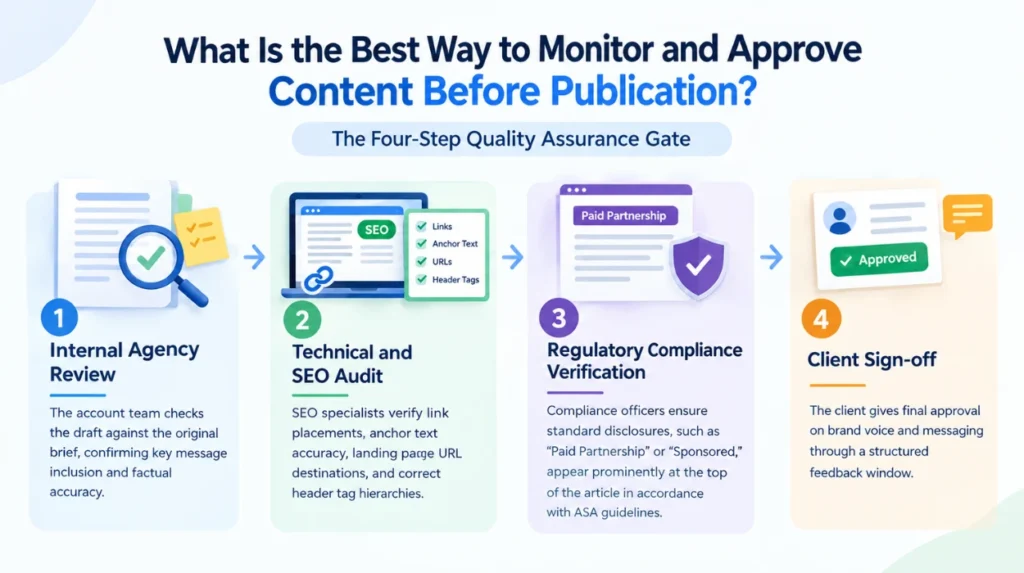
The Four-Step Quality Assurance Gate
- Internal Agency Review: The account team checks the draft against the original brief, confirming key message inclusion and factual accuracy.
- Technical and SEO Audit: SEO specialists verify link placements, anchor text accuracy, landing page URL destinations, and correct header tag hierarchies.
- Regulatory Compliance Verification: Compliance officers ensure standard disclosures, such as “Paid Partnership” or “Sponsored,” appear prominently at the top of the article in accordance with ASA guidelines.
- Client Sign-off: The client gives final approval on brand voice and messaging through a structured feedback window.
Establishing strict timeframes for each review stage prevents publishing delays and maintains accountability across internal and external teams.
How Do Agencies Measure and Report Sponsored Content Performance to Clients?
Agencies report on sponsored content by tracking referral traffic, organic keyword ranking improvements, audience engagement, backlink acquisition, and direct conversion metrics. Performance data is aggregated into client-facing reports using standardized key performance indicators (KPIs).
Clients require clear evidence connecting sponsored media expenditure to tangible business outcomes. Reporting must go beyond vanity metrics like page impressions to demonstrate strategic value.
Primary Metrics for Sponsored Content Evaluation
- Referral Traffic and Session Quality: Direct visits generated from the placement, measured via tracking parameters like UTM tags, alongside bounce rates and average session duration.
- SEO and Search Performance: Acquisition of authoritative backlinks, indexation status, and ranking movements for target search terms.
- Audience Engagement: Average dwell time on the article, scroll depth, social media shares, and reader comments.
- Downstream Conversions: Assisted conversions, lead generation forms submitted, and direct sales attributed to referral traffic paths.
Consolidating these metrics into standardized agency dashboards allows account teams to present clear performance evaluations to stakeholders across all active client accounts.
What Are the Operational Challenges of Managing Multiple Client Placements?
The main operational challenges include managing varying client budgets, tracking multiple publisher deadlines, ensuring consistent regulatory compliance, and aggregating disparate performance data. Agencies resolve these issues by using dedicated software, standardized processes, and specialized media partners.
When managing 20 or more active placements simultaneously, manual tracking via spreadsheets leads to missed deadlines, incorrect link implementations, and compliance oversights.
Common Operational Friction Points and Solutions
| Operational Challenge | Root Cause | Agency Solution |
| Delayed Content Approvals | Unstructured feedback loops from client brand teams | Mandate strict 48-hour approval windows in client service agreements |
| Non-Compliant Publisher Edits | Publishers removing disclosures or altering links | Enforce strict brief contracts with mandatory post-publication checks |
| Data Fragmentation | Disparate metrics across 50 distinct media sites | Automate metric collection using unified media-reporting platforms |
| Scale and Volume Limits | Manual outreach constraints within internal teams | Partner with dedicated media groups for consolidated inventory access |
Standardizing operational mechanics protects agency margins and ensures high execution standards regardless of campaign size.
Multi-Client Sponsored Content Strategy
Managing sponsored content placements across multiple agency accounts requires structured systems at every phase of the campaign lifecycle.
- Briefing: Create standardized, detailed briefs covering technical SEO, brand rules, regulatory compliance, and target audience parameters.
- Booking: Implement rigorous publisher vetting criteria focusing on regional traffic, domain authority, and editorial quality.
- Approval: Enforce a strict four-step quality assurance framework to catch errors before content goes live.
- Reporting: Aggregate referral traffic, backlink acquisition, engagement metrics, and conversion data into unified client dashboards.
By replacing manual, ad-hoc execution with systematic workflows and strategic media partnerships, agencies scale paid editorial services efficiently while delivering measurable ROI across their entire client roster.
FAQs
Q1: How do agencies brief sponsored content placements for multiple clients?
Ans: Agencies typically create a standard sponsored content brief covering the client, campaign objective, target audience, publication requirements, keywords, messaging, deadlines and compliance needs. A structured brief helps maintain consistent requirements across multiple sponsored content placements.
Q2: How do agencies book sponsored content placements for different clients?
Ans: Agencies compare publications based on audience relevance, sector coverage, location, editorial format, pricing and publication requirements before booking placements. Centralised booking records help track publication, client, campaign, agreed deliverables and scheduled dates.
Q3: What information should a sponsored content placement report include?
Ans: A sponsored content placement report should include the client, publication, article URL, publication date, campaign objective, target audience and agreed placement details. It can also record backlinks, referral traffic, indexing status and other measurable campaign outcomes.
Q4: How can agencies manage sponsored content campaigns across multiple clients?
Ans: Agencies can use a central campaign tracker to manage briefs, publication bookings, content approvals, live URLs, deadlines and reporting data for each client. Consistent workflows reduce missed deliverables and make multi-client sponsored content management easier to audit.
Q5: What should agencies measure after sponsored content is published?
Ans: Agencies can measure publication reach, referral traffic, engagement, backlink delivery, search visibility and relevant conversion actions after sponsored content goes live. Reporting these metrics against the original campaign objectives helps assess placement performance and client outcomes.