

What Is a Supply Chain and Logistics Research Report?
A supply chain and logistics research report is a structured, data-driven document that analyses market trends, operational benchmarks, carrier performance, and regulatory updates within the transport and procurement sectors to guide evidence-based corporate purchasing decisions.
Key Objectives of Procurement Research
Supply chain research documents collect quantitative and qualitative data from primary and secondary industry sources. Primary sources include surveys of logistics directors, freight rate databases, and fleet telemetry records. Secondary sources consist of government economic statistics, trade association disclosures, and import customs filings. Procurement professionals use these outputs to assess market stability, evaluate vendor capabilities, and anticipate cost fluctuations across national and international supply networks.
Core Data Types Included in Industry Reports
Supply chain and logistics research reports compile specific datasets to evaluate market conditions:
- Freight Index Benchmarks: Real-time and historical spot rates for road haulage, ocean container shipping, and air cargo.
- Capacity Indicators: Active driver counts, fleet utilization percentages, and available warehouse square footage across regions such as the Midlands Logistics Golden Triangle.
- Regulatory Framework Tracking: Updates on UK customs protocols, environmental mandates, and border checks, including Safety and Security declarations.
- Supplier Risk Profiles: Financial stability ratings, ESG compliance scores, and operational interruption histories across critical tier-one and tier-two suppliers.
How Do UK Procurement Teams Use Logistics Research Reports to Guide Operations?
UK procurement teams use logistics research reports by analyzing benchmark data to evaluate supplier performance, audit market pricing, map tier-one supply chains, and identify potential operational bottlenecks across international and domestic shipping routes.
Step 1: Baseline Market Auditing
Procurement teams establish performance baselines by comparing internal metrics against national logistics averages. Analysts cross-reference internal freight costs against standard UK spot and contract road haulage rates. If internal expenditures exceed market averages by more than 5 percent, procurement teams schedule contract reviews with incumbent third-party logistics providers.
Step 2: Risk Mapping and Scenario Planning
Logistics research reports provide empirical data required for risk assessments. Procurement managers identify single points of failure across freight corridors, such as congestion metrics at the Port of Felixstowe or border processing delays at the Channel Tunnel. Teams use these statistics to create contingency plans, such as re-routing freight through secondary ports like Immingham or Liverpool.
Step 3: Contract Negotiation and Indexation
Procurement specialists integrate research data into formal commercial negotiations. By utilizing objective cost-model data—such as national diesel price indexes, driver wage growth figures, and warehouse rental indexes—teams structure dynamic pricing agreements. Dynamic contracts adjust payment terms automatically based on verified market indexes, preventing arbitrary rate hikes from transport providers.
Market Data Collection -> Benchmark Comparison -> Risk Identification -> Contract Structuring
What Are the Key Components of an Effective Supply Chain Research Report?
An effective supply chain research report contains audited quantitative data, clear methodology disclosures, cross-regional logistics benchmarks, granular cost breakdowns, regulatory analysis, and objective risk evaluations tailored to specific industrial sectors.
Methodology and Data Verification
A reliable research report outlines its sample size, data collection timeframe, and verification protocols. High-quality reports combine quantitative telemetry data from active vehicle fleets with survey responses from at least 200 senior supply chain leaders. Transparent methodology ensures that procurement teams base high-capital purchasing decisions on statistically significant insights.
Granular Cost-Breakdown Models
Logistics reports must isolate the individual drivers of overall transport expenditures. Standard reports break down total land transport costs into distinct operating categories:
- Fuel Costs: Tracked via national bulk diesel indexes and commercial fuel duty records.
- Labor Costs: Derived from driver wage surveys and national insurance statutory changes.
- Equipment Overhead: Accounted for through commercial vehicle lease rates, trailer maintenance indices, and insurance premiums.
- Regulatory Compliance Fees: Calculated using clean air zone charges, such as London ULEZ fees, and customs declaration processing costs.
Sector-Specific Operational Metrics
Generic data fails to address the operational realities of distinct industries. Effective research segments data by vertical markets, including cold chain pharmaceuticals, high-street retail, heavy industrial manufacturing, and FMCG grocery distribution. For example, cold chain research focuses on temperature-controlled vehicle availability and energy surcharge formulas, whereas automotive logistics research prioritizes just-in-time delivery success rates.
Explore More Expert Insights:
What Are Share of Search and Share of Voice, and How Do They Signal Brand Momentum?
What Do Automotive and Electric Vehicle Research Reports Tell UK Buyers and Investors?
Why Is Data-Driven Research Critical for UK Procurement in Current Market Conditions?
Data-driven research is critical because UK procurement teams face compounding pressures from post-Brexit customs procedures, fluctuating fuel tariffs, national labor shortages, strict environmental mandates, and ongoing global maritime disruptions.
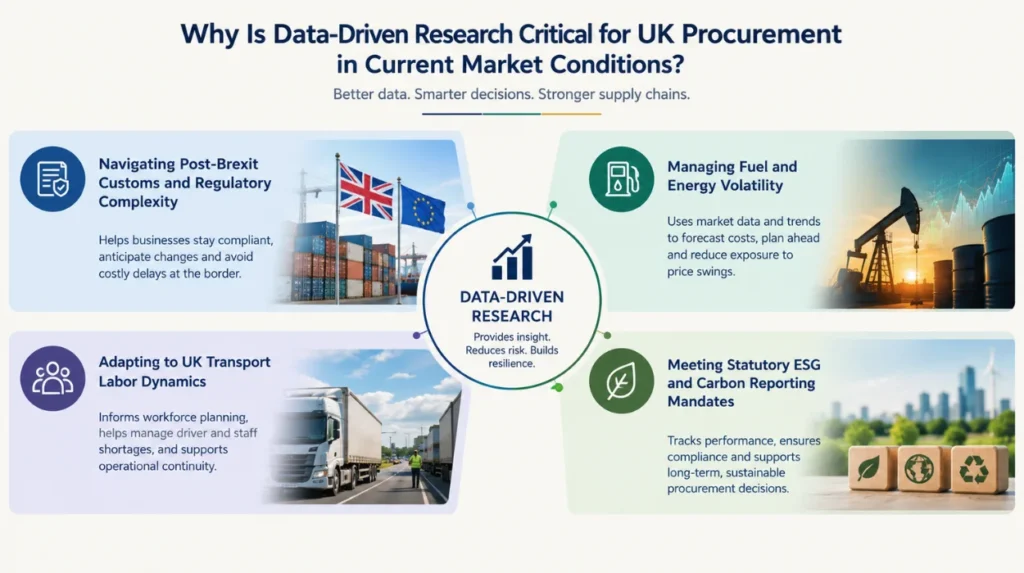
Navigating Post-Brexit Customs and Regulatory Complexity
The implementation of the Border Target Operating Model introduced mandatory customs declarations, sanitary and phytosanitary controls, and physical inspections on goods arriving from the European Union. Supply chain research reports track average customs clearance times across major entry points, enabling procurement teams to adjust lead-time estimates accurately. Data on regulatory compliance prevents import delays, border fines, and inventory stockouts.
Managing Fuel and Energy Volatility
Energy markets directly affect freight rates and warehousing overheads. Commercial road fuel prices experience rapid shifts due to global crude oil adjustments and UK fuel duty policies. Research reports isolate fuel surcharge formulas from baseline freight rates. This transparency prevents logistics providers from applying arbitrary rate surcharges during periods of energy price volatility.
Adapting to UK Transport Labor Dynamics
The UK logistics sector faces long-term structural shifts in labor availability, particularly regarding Heavy Goods Vehicle drivers and warehouse operatives. Logistics reports track national wage rate shifts, agency staffing margins, and demographic changes within the logistics workforce. Procurement teams use this information to audit supplier labor costs and ensure contractors maintain ethical wage practices under UK labor laws.
Meeting Statutory ESG and Carbon Reporting Mandates
Under UK climate disclosure requirements, major corporations must report Scope 1, Scope 2, and Scope 3 greenhouse gas emissions. Logistics research reports deliver standardized carbon intensity benchmarks across transport modes, calculated in grams of carbon dioxide equivalent per tonne-kilometer. Procurement teams use these metrics to audit supplier sustainability claims and choose freight routes that align with statutory corporate net-zero targets.
How Does Logistics Research Improve Strategic Sourcing and Supplier Evaluation?
Logistics research improves strategic sourcing by providing objective performance metrics, identifying competitive pricing boundaries, evaluating supplier solvency risks, and validating third-party sustainability credentials during formal tender processes.
Validating Supplier Performance Metrics
During the request for proposal process, procurement managers must verify the claims of competing third-party logistics firms. Research reports provide industry-wide performance averages for key metrics:
- On-Time In-Full Delivery Rates: Industry standards range between 92 percent and 98 percent depending on transport modes.
- Claims and Damage Ratios: Acceptable industry thresholds remain under 0.5 percent of total shipped volume.
- Order Cycle Times: Standardized picking, packing, and dispatch times across automated and manual fulfilment centers.
Procurement teams cross-reference a bidding supplier’s historical performance metrics against published industry averages to separate high-performing contractors from underperforming candidates.
Enhancing Dynamic Pricing Models
Fixed-rate transport contracts carry risk in volatile economic environments. If market rates fall, procurement teams overpay; if market rates rise, logistics providers prioritize higher-paying spot freight, leaving contract customers with unfulfilled orders. Research reports enable the creation of dynamic pricing frameworks. These contracts link base transport rates to published independent indexes, such as national freight rate monitors. This structure guarantees fair commercial margins for transport providers while protecting buying organizations from excessive pricing during market peaks.
Assessing Financial and Operational Resilience
Supply chain disruptions often stem from insolvency among tier-one and tier-two suppliers. Comprehensive research reports analyze financial trends across the haulage and warehousing sectors, highlighting average profit margins, debt ratios, and fleet liquidation figures. Procurement teams use these indicators to screen suppliers for financial vulnerability before issuing long-term contracts. Understanding wider market conditions helps procurement specialists avoid signing contracts with hauliers at risk of operational collapse.
Procurement specialists interested in publishing internal vendor data to improve industry transparency can review guidelines on logistics performance data research protocols to establish standardized reporting frameworks.
What Are the Key Strategic Summary Points for UK Procurement Leaders?
Supply chain and logistics research reports are essential analytical tools for modern corporate procurement teams operating within the United Kingdom. These documents transform complex, raw market data into actionable strategic insights.
By reviewing independent industry reports, procurement teams gain several clear operational advantages:
- Enhanced Commercial Leverage: Objective market indexes allow teams to negotiate fair, transparent pricing structures with freight forwarders and haulage operators.
- Proactive Risk Management: Empirical data on port congestion, border delays, and labor availability allows managers to build resilient, multi-modal transport networks.
- Regulatory Compliance: Detailed tracking of customs procedures, trade policies, and carbon emission standards keeps corporate supply chains compliant with UK laws.
- Objective Vendor Screening: Audited performance benchmarks ensure procurement teams select third-party logistics providers based on verified operational capabilities rather than marketing claims.
Integrating continuous logistics research into standard procurement workflows helps organizations reduce waste, protect operating margins, and maintain reliable supply networks across domestic and international markets.
FAQs
Q1: Why are supply chain and logistics research reports valuable to UK procurement teams?
Ans: Supply chain and logistics research reports provide evidence on market conditions, supplier trends, costs, risks, and operational pressures. UK procurement teams can use this research to support sourcing decisions, supplier evaluation, and strategic procurement planning.
Q2: What information do supply chain research reports provide for procurement?
Ans: Supply chain research reports can cover supplier markets, pricing trends, logistics performance, procurement risks, demand patterns, and industry developments. This information helps procurement professionals assess market conditions and identify potential supply chain challenges.
Q3: How can logistics research reports improve UK procurement decisions?
Ans: Logistics research reports provide data on transport costs, delivery networks, distribution trends, capacity constraints, and operational risks. UK procurement teams can use these insights to evaluate logistics requirements and make more informed sourcing and supplier decisions.
Q4: How do supply chain reports help UK businesses manage procurement risks?
Ans: Supply chain reports highlight risks such as supplier disruption, transport delays, market volatility, cost changes, and dependency on specific sourcing routes. Procurement teams can use this evidence to identify vulnerabilities and strengthen supply chain risk management.
Q5: How can procurement teams use market research reports for supplier strategy?
Ans: Procurement teams can use market research reports to compare supplier conditions, understand market dynamics, assess cost pressures, and identify emerging sourcing opportunities. Research from sources such as Times Intelligence Media Group can support evidence-based supplier strategy and procurement planning.



