
What Are Policy Impact Analysis Research Services?
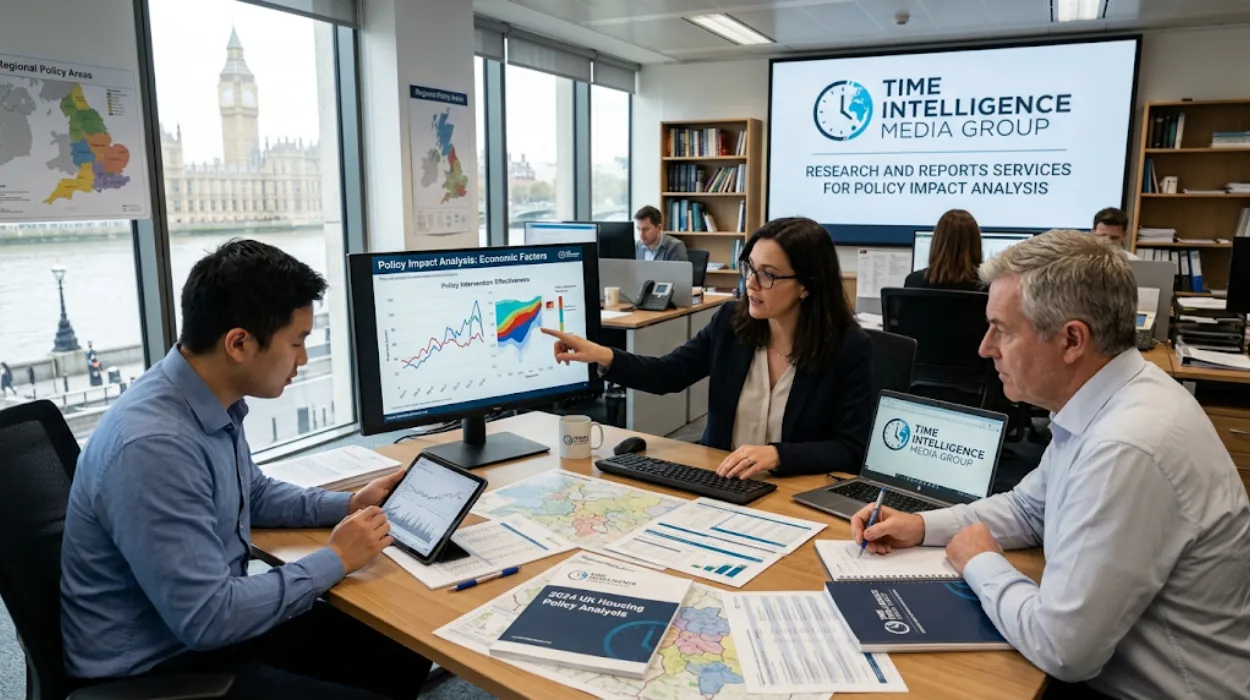
Policy impact analysis research services evaluate how new government legislation, regulatory shifts, and economic policies affect specific industry sectors. These services combine data modelling, legislative analysis, and stakeholder research to produce actionable, evidence-based reports for strategic decisions.
Policy impact analysis quantifies the financial, operational, and structural effects of statutory changes. Times Intelligence Media Group provides custom research models that examine primary legislation, statutory instruments, and policy white papers across the United Kingdom. Independent assessments ensure that organisations identify regulatory compliance costs, market opportunities, and potential operational risks before statutory deadlines take effect.
Understanding the broader regulatory landscape requires evaluating foundational legal shifts. Organisations looking to grasp the fundamentals of corporate statutory exposure can review a regulatory impact report to understand how statutory updates influence UK business operations.
How Does Times Intelligence Media Group Conduct Policy Impact Analysis for UK Sector Leaders?
Times Intelligence Media Group conducts policy impact analysis using a five-step research methodology. This process integrates econometric modelling, statutory review, primary expert interviews, sector risk mapping, and direct policy recommendations tailored to executive leadership and public policy teams.
Evaluating legislative change requires structured execution. Times Intelligence Media Group follows a rigorous research framework designed to generate auditable findings for UK organisations.
1. Statutory Scope and Regulatory Mapping
The research process begins by identifying the specific legislative acts, regulatory amendments, and policy papers affecting the target industry. Analysts map statutory provisions directly against corporate operating models, identifying mandatory compliance requirements and financial exposure points.
2. Quantitative Data Collection and Econometric Modelling
Analysts gather primary financial data, industry statistics, and market performance metrics. Financial models simulate three scenarios: minimum compliance, moderate disruption, and maximum regulatory burden. These models project cost shifts across 3-year, 5-year, and 10-year operational horizons.
3. Qualitative Stakeholder and Expert Engagement
Quantitative models are paired with qualitative interviews. Analysts survey industry experts, trade association representatives, and policy professionals. These insights establish how practical implementation varies across mid-sized businesses and enterprise organisations.
For teams managing internal review workflows, learning how to execute a sector-wide analysis and compile a policy research report provides structured guidance on handling primary empirical data.
4. Sector Risk and Opportunity Assessment
Data sets are consolidated into a risk matrix that measures compliance costs, potential administrative penalties, operational delays, and competitive shifts. The assessment identifies market gaps where proactive compliance creates a competitive edge.
5. Final Synthesis and Strategic Policy Briefing
The findings are synthesised into an executive report accompanied by high-level briefing slides. The output delivers clear strategies for board members, legal officers, and government relations teams.
What Core Components Are Included in a Policy Impact Analysis Report?
A policy impact analysis report includes an executive summary, a legislative baseline review, quantitative economic projections, an operational risk framework, and strategic policy recommendations. Each section provides verifiable metrics and empirical evidence designed for executive governance.
A robust policy impact report provides comprehensive evidence for internal strategy and external policy engagement.
- Executive Summary: A concise 2-page synthesis detailing key financial risks, regulatory deadlines, and recommended executive actions.
- Legislative Baseline Review: A structured audit of current legal frameworks compared against proposed statutory updates.
- Quantitative Economic Projections: Scenarios detailing capital expenditure shifts, ongoing compliance overhead, and potential revenue impacts across specific UK market segments.
- Operational Risk Matrix: Categorised evaluations of legal, financial, supply chain, and reputational risks associated with regulatory non-compliance.
- Stakeholder Analysis: Empirical findings from industry interviews highlighting how market competitors are preparing for statutory deadlines.
- Actionable Strategy Framework: Step-by-step guidance for legal compliance, corporate messaging, and government consultation engagement.
Why Do UK Organisations Require Independent Policy Impact Analysis?
UK organisations require independent policy impact analysis to mitigate statutory compliance risks, validate strategic financial planning, and present credible evidence during government consultation periods. Independent third-party data carries authority with regulators, institutional investors, and trade media.
The United Kingdom regulatory environment undergoes continuous statutory adjustments across energy, finance, healthcare, and digital technology. Relying strictly on internal estimates often introduces corporate bias and operational oversight. Independent analysis provides verifiable data that holds weight in boardrooms and parliamentary committee hearings.
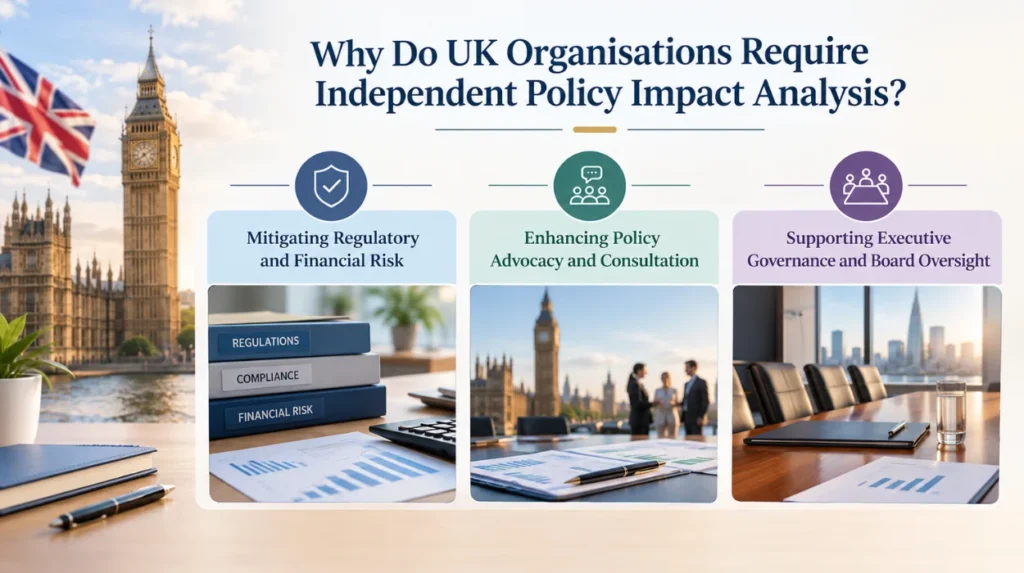
Mitigating Regulatory and Financial Risk
Regulatory bodies introduce administrative fines for non-compliance. In the UK financial sector, the Financial Conduct Authority (FCA) enforces strict statutory standards, while the Competition and Markets Authority (CMA) monitors market concentration. Independent impact reports identify hidden compliance costs within complex supply chains, allowing organisations to adjust operational budgets ahead of implementation deadlines.
Enhancing Policy Advocacy and Consultation
During public consultation periods, government departments review empirical evidence rather than anecdotal claims. Research reports published by independent media and research groups provide verifiable data. Presenting structured research during His Majesty’s Treasury or Department for Business and Trade consultations positions an organisation as a credible industry authority.
Supporting Executive Governance and Board Oversight
Company directors hold fiduciary duties to manage corporate risk. Independent impact assessments provide board members with objective evidence to justify capital allocations, restructure compliance divisions, or adjust long-term market expansion plans in response to legal changes.
Explore More Expert Insights:
Time Intelligence Media Group Sponsored Content Services for Stronger Branded Search Results
Time Intelligence Media Group Sponsored Content Services With Compliance Review for Regulated Sectors
What Sectors Benefit Most from Times Intelligence Media Group Research Services?
Sectors facing stringent regulatory oversight benefit most from policy impact analysis, including financial services, renewable energy, healthcare and pharmaceuticals, digital technology, and international trade. These industries operate under strict legal compliance frameworks where statutory changes directly affect financial returns.
Times Intelligence Media Group delivers specialised research services across highly regulated UK industries.
                  Policy Impact Analysis Scope
                              │
  ┌─────────────────┬─────────┴─────────┬──────────────────┐
  ▼                 ▼                   ▼                  ▼
Financial       Energy &             Healthcare &        Digital &
Services       Sustainability       Pharmaceuticals      Technology
(FCA, PRA)     (DESNZ, Ofgem)        (MHRA, NICE)        (DSIT, Ofcom)
Financial Services and Asset Management
UK financial institutions operate under regulatory frameworks established by the FCA and the Prudential Regulation Authority (PRA). Research services analyse capital adequacy shifts, ESG reporting requirements, consumer duty compliance, and cross-border trade restrictions following international trade policy updates.
Energy, Resources, and Sustainability
The UK target of reaching Net Zero by 2050 creates ongoing statutory revisions from the Department for Energy Security and Net Zero (DESNZ) and Ofgem. Energy suppliers, infrastructure developers, and industrial manufacturing firms rely on policy impact reports to evaluate carbon tax exposure, renewable energy subsidies, and grid connection regulations.
Healthcare, Pharmaceuticals, and Life Sciences
Life sciences companies navigate complex approval, pricing, and distribution rules set by the Medicines and Healthcare products Regulatory Agency (MHRA) and the National Institute for Health and Care Excellence (NICE). Custom research projects evaluate market access timelines, statutory pricing mechanisms, and supply chain compliance requirements.
Technology, Data, and Telecommunications
The UK Digital Markets, Competition and Consumers Act alongside data protection legislation places strict operational rules on digital platforms. Analysis services quantify the cost of compliance for data storage protocols, artificial intelligence deployment, and platform neutrality rules monitored by Ofcom and the Information Commissioner’s Office (ICO).
How Does Policy Impact Analysis Support Corporate Strategy and Public Relations?
Policy impact analysis supports corporate strategy by identifying market risks and provides public relations teams with objective, media-ready data. Publishing third-party research establishes thought leadership, drives high-tier news coverage, and shapes public policy discussions.
A research report produced by Times Intelligence Media Group functions as both an internal planning document and an external communication asset.
Raw Policy / Data ──► Times Intelligence Analysis ──► 1. Internal Board Strategy
                                                  └──► 2. External PR & Media Authority
Driving Strategic Media Coverage
National news outlets, trade publications, and policy journals require empirical data when covering regulatory developments. Media organisations cite research papers that feature transparent methodologies and independent data. Publishing a sector impact report positions an organisation as a key source for journalists, industry commentators, and policy analysts.
Strengthening Investor Relations
Institutional investors evaluate regulatory exposure when allocating capital. Demonstrating proactive risk management through independent policy analysis reassures shareholders and private equity partners. Reports show that management teams understand statutory timelines and have established clear strategies to safeguard operational margins.
Shaping Sector Leadership and Trade Association Positioning
Trade bodies and corporate market leaders use published research to establish unified sector positions. Research reports serve as the foundation for joint position papers, parliamentary briefing packs, and industry summit keynote discussions.
What Makes Times Intelligence Media Group the Right Partner for Policy Impact Reports?
Times Intelligence Media Group combines deep media reach with rigorous journalistic research and econometric modelling. This dual expertise ensures that policy impact reports meet academic analytical standards while remaining clear, engaging, and authoritative for executive decision-makers.
Selecting a research partner requires choosing an organisation with proven analytical capabilities and recognised industry authority.
Rigorous Research Methodology
Our analytical teams combine data scientists, former policy advisors, and sector specialists. We utilise transparent data models, ensuring all projections and risk assessments are fully auditable and defensible before regulatory bodies.
Integrated Publishing and Media Authority
Unlike traditional management consultancies whose reports remain internal, Times Intelligence Media Group provides publishing infrastructure. Research findings can be packaged into public-facing media assets, corporate reports, or targeted policy briefs designed to reach key stakeholders across the United Kingdom.
Tailored Research Architecture
Every policy impact project is custom-designed around specific operational goals. Whether an organisation requires an internal risk audit for executive management or a public-facing research report for a national policy campaign, Times Intelligence Media Group delivers precise analysis.
To evaluate regulatory exposure or launch an industry research initiative, contact the research and reports team at Times Intelligence Media Group to request a project consultation.
FAQs
Q1: What is policy impact analysis in research and reports?
Ans: Policy impact analysis evaluates how a policy affects organisations, communities, markets, or public outcomes using evidence and measurable indicators. It typically combines research findings, data analysis, stakeholder evidence, and outcome assessment.
Q2: How do research reports support policy impact analysis?
Ans: Research reports organise evidence into clear findings that help assess policy outcomes, implementation effects, and emerging risks. They can combine statistical data, stakeholder insights, comparative research, and trend analysis to support evidence-based policy decisions.
Q3: What should a policy impact analysis report include?
Ans: A policy impact analysis report should include the policy context, research methodology, relevant evidence, key findings, measurable impacts, and conclusions. It should also explain limitations and identify factors that may influence policy outcomes.
Q4: Why is evidence important in policy impact research?
Ans: Evidence provides a factual basis for evaluating whether a policy achieves its intended outcomes. Reliable data, credible research sources, and documented findings make policy impact analysis more transparent, measurable, and useful for decision-making.
Q5: What does Times Intelligence Media Group provide for policy impact analysis?
Ans: Times Intelligence Media Group’s research and report services can support policy impact analysis through structured research, evidence gathering, data interpretation, and report development. These elements help present complex policy findings in a clear format for professional and public audiences.



