

What are sponsored articles and how do they relate to branded search results?
Sponsored articles are paid editorial-style publications created for a defined promotional purpose. When indexed, they become searchable pages that add another source of information to results for searches containing a brand name.
A sponsored article is paid content published by a media organisation, publisher, or website. It contains information supplied or commissioned by an advertiser. The article typically identifies its commercial nature through labels such as sponsored, advertisement, or paid content.
A branded search is a search query containing a company, organisation, product, executive, or service name. Examples include:
- Company name plus reviews
- Company name plus services
- Product name plus pricing
- Organisation name plus news
- Brand name plus industry
- Company name plus location
Search engines evaluate individual webpages rather than treating a brand name as a single webpage. A sponsored article therefore becomes one separate searchable document when it is crawled, indexed, and eligible for search visibility.
What does a sponsored article contain?
Sponsored articles commonly contain several identifiable components:
- Brand or organisation name
- Description of products or services
- Company background
- Industry information
- Named authors
- Supporting sources
- Images
- Publication date
- Publisher information
- Commercial disclosure
These elements create additional textual and entity context around the subject.
How does a sponsored article enter search results?
A sponsored article enters search results after publication when search engines discover, crawl, process, and index the webpage. Its visibility depends on indexing, relevance, page quality, search intent, competition, and the signals associated with the published page.
Publication alone does not guarantee search visibility. Search engines first need to discover the webpage through links, sitemaps, or other crawlable paths.
The crawler accesses the webpage and processes its content. The search engine then determines whether the page enters its index. Indexed pages become candidates for relevant searches.
The process contains several stages:
- Article publication
- Search engine discovery
- Crawling
- Content processing
- Indexing
- Query matching
- Search-result presentation
A sponsored article that contains a distinctive brand name gives search engines additional text associated with that entity. The page then becomes a separate document that can appear for relevant branded or non-branded queries.
Why does indexing matter?
Indexing determines whether a webpage enters the search engine database used to generate results. A page excluded from indexing does not function as an ordinary organic search result.
Indexing also differs from ranking. Indexing places a page into the searchable collection. Ranking determines its position for a particular query.
How can sponsored articles affect what people see when they search a brand name?
Sponsored articles add additional indexed pages that contain brand-related information. These pages create separate search-result opportunities and can change the set of documents presented for branded queries when they satisfy search intent and ranking requirements.
A branded search can produce multiple result types. These include the official website, social profiles, news coverage, directories, reviews, interviews, articles, and other relevant pages.
A sponsored article adds another document to this broader information environment.
For example, a search for a company name can return:
- The company homepage
- About page
- LinkedIn profile
- News coverage
- Industry publications
- Sponsored articles
- Review pages
- Business directories
The exact result set depends on the query, location, device, search history, language, freshness, and available indexed content.
Does one sponsored article control the search results?
No. One webpage does not control a branded search results page.
Search engines select results from many indexed sources. A sponsored article competes with official pages, independent publications, news stories, social profiles, directories, and other documents.
Its presence therefore expands the available information rather than replacing existing results.
Which factors determine whether a sponsored article appears for a branded search?
Relevance, indexing, content quality, search intent, authority, freshness, competition, and technical accessibility influence whether a sponsored article appears for a branded query. The article must first qualify as a searchable document before ranking becomes relevant.
Relevance to the branded query
Relevance connects the article’s content with the words and entities in the search query.
An article containing the exact organisation name, accurate company description, industry context, and related entities provides clear topical signals.
Search intent
Search intent describes the information a person seeks through a query.
A search for a company name alone has a different intent from a search for company name plus pricing or company name plus reviews.
The article’s content determines which query contexts it addresses.
Content quality
Useful content contains accurate information, clear structure, specific facts, and identifiable sources where evidence is required.
A page containing substantial original information provides more context than a page containing only repeated promotional statements.
Technical accessibility
Search engines need access to the webpage. Crawl restrictions, indexing directives, unavailable pages, or technical errors affect whether the article enters search results.
Competition
Branded queries often have several highly relevant pages. Official websites, established profiles, news publications, and established directories can all compete for visibility.
How do sponsored articles create additional brand-related search signals?
Sponsored articles create additional textual and contextual references to a brand across separate webpages. These references help establish relationships between the brand name, industry, products, services, people, locations, and other identifiable entities.
Search engines process entities and relationships across documents.
An article that identifies a company, its sector, headquarters, products, executives, and activities provides structured contextual information through natural language.
For example, an article about a technology company can connect:
- Company name
- Software category
- Founder
- Headquarters
- Product name
- Industry sector
- Geographic market
These relationships provide additional context around the named entity.
Why does entity consistency matter?
Entity consistency means that important identifying information remains accurate across different webpages.
A company name, official website, product name, location, and executive name need consistent representation when they refer to the same entity.
Inconsistent names create ambiguity. Accurate references create clearer contextual relationships.
Can sponsored articles replace a company website in branded search results?
Sponsored articles do not replace a company website as the primary source for official information. They create separate third-party documents that search engines evaluate alongside the website, profiles, news coverage, directories, and other relevant sources.
A company website remains a first-party source. It contains information published directly by the organisation.
A sponsored article is generally hosted by another publisher. It therefore provides information from a separate web domain.
This distinction matters in branded search.
A search engine can present several source types simultaneously:
| Source type | Information role |
|---|---|
| Official website | First-party company information |
| Social profile | Organisation or individual profile information |
| News article | Reported external information |
| Sponsored article | Paid editorial-style information |
| Directory | Business identification and listing data |
| Review page | Customer-generated information |
The result page can contain several of these sources at the same time.
How does publication diversity affect branded search visibility?
Publication diversity increases the number of independent webpages containing information about an entity. Different publishers provide separate documents, domains, authors, contexts, and publication dates that search engines process individually for relevant branded queries.
Multiple publications create a broader distribution of brand-related information.
For example, a company can have:
- An official website
- A business directory listing
- A professional profile
- A news article
- An industry publication article
- A sponsored article
Each page exists on a different URL. Each page receives separate crawling and indexing treatment.
Does more coverage automatically mean higher rankings?
No. Search engines do not rank pages based only on the number of publications mentioning a brand.
Each page remains subject to relevance, quality, technical accessibility, search intent, and other ranking systems.
The important distinction is between additional searchable coverage and guaranteed ranking improvement. Sponsored publication creates the former. It does not guarantee the latter.
Explore More Expert Insights:
What Extra Compliance Checks Does Sponsored Content Need in Regulated UK Industries?
Why Do Named Authors and Expert Credentials Matter for Sponsored Content Under Google’s E-E-A-T Guidelines?
What role do links in sponsored articles play in branded search?
Links provide navigational connections between webpages, while their search impact depends on how those links are implemented and evaluated. A sponsored article can link to relevant resources without guaranteeing higher organic rankings for the linked website.
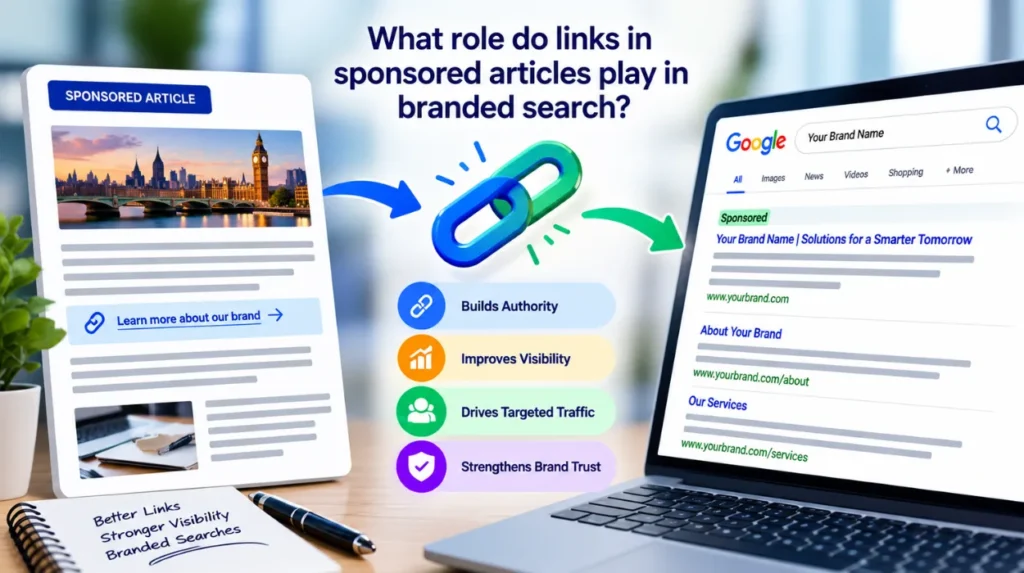
A sponsored article can contain links to an organisation’s website, product page, research document, or other relevant resource.
The link itself has several functions.
It can:
- Direct readers to supporting information
- Connect related webpages
- Identify the official website
- Provide additional context
- Support navigation
Search engines also evaluate the commercial nature of links. Paid links require appropriate handling under search engine policies.
A sponsored article therefore needs a clear distinction between editorial information and paid promotional placement.
How does article freshness influence branded search results?
Freshness determines how recently information was published or updated, while its importance depends on the query. Current events and recent developments require fresher information than stable company facts that remain unchanged over time.
Search results for a brand name can change as new webpages appear and older information becomes less relevant.
A recently published article can enter the searchable information environment alongside older pages.
Freshness has particular relevance for:
- Product launches
- Corporate announcements
- Leadership changes
- New research
- Market developments
- Events
- Recent partnerships
Stable information, such as a company founding date, does not require constant publication to remain relevant.
How should people evaluate sponsored articles appearing in branded search results?
People evaluating sponsored articles should identify the publisher, disclosure status, author, publication date, evidence, commercial relationship, and consistency with primary sources before treating the article as reliable information about a brand.
Sponsored status identifies the commercial relationship behind publication.
Readers can assess the article through several factual checks:
- Identify the publisher.
- Check the sponsorship disclosure.
- Review the author and credentials.
- Check the publication date.
- Examine supporting evidence.
- Compare factual claims with primary sources.
- Distinguish promotional statements from independently verified information.
This process separates the existence of a search result from the reliability of its claims.
Why is source comparison important?
Search results contain information from different source types. A company website provides first-party information. An independent news report provides external reporting. A sponsored article represents paid content.
Comparing these sources gives readers a clearer understanding of where each claim originates.
What is the relationship between sponsored content and a broader branded search strategy?
Sponsored content forms one part of a wider branded search environment that includes websites, profiles, news coverage, directories, reviews, and other indexed resources. Its role is to provide another identifiable source of information around the brand.
A broader branded search environment contains multiple content types.
The relationship can be understood as:
Brand entity → published sources → indexed webpages → relevant queries → search-result presentation
This process explains why a sponsored article can become visible when people search for a brand name without making the article the sole source of information.
For readers examining how sponsored content fits into a broader search strategy, planning sponsored content that strengthens branded search results provides the next level of information about coordinating published content with websites and profiles.
What should readers remember about sponsored articles and branded search?
Sponsored articles create additional indexed webpages containing information about a brand. They can appear in branded searches when relevant and eligible, but they do not guarantee rankings, replace official sources, or control which results search engines display.
The key concepts are straightforward.
A sponsored article is paid content published for a commercial purpose. Once indexed, it becomes a separate searchable webpage. Search engines evaluate that page alongside other documents.
Branded searches contain multiple source types. Official websites, social profiles, news publications, directories, reviews, and sponsored articles can all contribute to the visible result set.
The article’s relevance, quality, technical accessibility, search intent, authority, freshness, and competition influence its visibility.
Sponsored content therefore affects branded search primarily by adding another source of indexed information. Understanding that distinction separates search-result presence from ranking guarantees and helps readers evaluate branded search results using identifiable evidence and source context.
FAQs
Q1: Do sponsored articles affect what appears when people search for a brand name?
Ans: Sponsored articles can influence brand search results by creating additional indexed pages that mention the brand, its services, and relevant topics. Their visibility depends on factors such as content quality, relevance, authority, indexing, and search intent.
Q2: Can sponsored content improve branded search visibility?
Ans: Sponsored content can expand a brand’s presence in search results by generating relevant third-party pages about the brand. For Times Intelligence Media Group, the impact depends on whether the published content is useful, properly indexed, and relevant to branded search queries.
Q3: How do sponsored articles influence brand reputation in search results?
Ans: Sponsored articles can add authoritative or informative content to the search results associated with a brand name. Consistent, accurate coverage can help provide searchers with more context about the brand, while weak or misleading content may have the opposite effect.
Q4: Do sponsored articles help Google understand a brand?
Ans: Relevant sponsored articles can provide contextual signals by consistently associating a brand with its services, expertise, and industry topics. Google evaluates many factors when understanding entities and ranking pages, so sponsored content alone does not guarantee stronger brand visibility.
Q5: What makes a sponsored article more likely to appear for branded searches?
Ans: Clear brand references, relevant topics, original information, credible sources, and technically accessible pages can support visibility for branded searches. Proper disclosure and appropriate link attributes are also important when publishing paid or sponsored content.



