

What does compliance-reviewed sponsored content mean for regulated UK sectors?
Compliance-reviewed sponsored content is paid editorial content checked against applicable regulatory, advertising, factual, disclosure, and publication requirements before release, with evidence retained for claims, approvals, sources, authorship, and commercial disclosures.
Sponsored content combines editorial presentation with a commercial relationship. In regulated sectors, publication requires more than strong copy. Claims, supporting evidence, disclosures, financial promotions, author credentials, comparisons, statistics, and product descriptions require controlled review.
The applicable requirements depend on the subject and audience. Financial promotions, for example, must be fair, clear and not misleading. FCA rules also address identification, balance, accuracy, relevant risks, and presentation.
This makes compliance review a defined production stage rather than a final proofreading task.
Businesses publishing regulated sponsored content need a documented process covering:
- Claim identification
- Source verification
- Regulatory relevance
- Promotional classification
- Disclosure requirements
- Author and credential checks
- Internal approval
- Editorial review
- Publication controls
- Post-publication records
For financial services, an unauthorised person communicating a financial promotion can require approval from an appropriately authorised person or rely on a relevant exemption.
How does Times Intelligence Media Group structure a compliance review?
Times Intelligence Media Group structures compliance review around subject classification, evidence verification, promotional assessment, editorial controls, stakeholder approval, publication checks, and documentation so regulated sponsored content reaches publication with defined evidence and accountability.
The process begins before the article reaches final copy. The subject, commercial purpose and intended audience establish the review requirements.
1. Subject and sector classification
The content is classified according to its subject and regulatory context. Examples include financial services, insurance, mortgages, pensions, investment products, payment services and qualifying cryptoassets.
Classification determines which claims require closer scrutiny. The FCA identifies financial promotions across websites, social media, email, newspapers, television, radio and other media channels.
2. Claim identification
Every material claim is identified.
A claim stating that a financial product reduces costs requires evidence. A statement describing investment performance requires supporting data and appropriate context. A comparison with a competitor requires meaningful and balanced presentation.
3. Evidence verification
Sources are checked against the claims they support.
Primary regulatory sources, official statistics, published research, company documentation and verifiable datasets provide an evidence trail. Unsupported superlatives and unverified performance statements are removed or rewritten.
4. Approval workflow
The review identifies the person responsible for approving regulated promotional material. This is particularly important where financial promotion rules apply.
The FCA states that an authorised person approving a financial promotion must ensure that the promotion complies with applicable rules, including requirements that it is fair, clear and not misleading.
The related compliance preparation for regulated sponsored content process provides the foundation for this review.
What components are included in compliance-reviewed sponsored content services?
Compliance-reviewed sponsored content services include research verification, claim checking, source validation, regulatory screening, commercial disclosure review, author verification, editorial control, approval coordination, publication checks, and evidence documentation.
Each component addresses a different publication risk.
Evidence and source checking.
Evidence checking connects individual claims with identifiable sources. The process records the source, relevant data, publication date and claim supported.
This creates a traceable relationship between statement and evidence.
Regulatory screening
Regulatory screening identifies content that falls within specific promotional requirements.
For example, FCA financial promotion rules apply across multiple financial products and communication channels. Requirements also differ according to product type, audience and activity.
Disclosure review
Sponsored material requires clear identification of its commercial nature. Disclosure wording, placement and visibility form part of the review.
Financial promotion rules also contain requirements for communications to be clearly identifiable as financial promotions in applicable circumstances.
Author and credential verification
Author information establishes responsibility and subject relevance.
A technical article about an investment product requires an identifiable author profile and accurate credentials where those details form part of the content. Credentials are checked against supplied evidence.
Editorial accuracy
Editorial review checks names, dates, statistics, product descriptions, regulatory references and terminology.
The objective is factual consistency across the article, headline, introduction, metadata and supporting material.
Final publication review
The final version is reviewed separately from the working draft.
This check covers:
- Headline claims
- Promotional disclosures
- Links
- Citations
- Author details
- Regulatory references
- Images and captions
- Calls to action
- Formatting
- Landing-page consistency
This separation prevents changes introduced during final editing from bypassing the compliance process.
Which regulated sectors can use compliance-reviewed sponsored content?
Compliance-reviewed sponsored content applies to sectors where commercial editorial material contains regulated claims, product information, consumer-facing promotions, financial statements, professional credentials, or evidence-sensitive information requiring documented review before publication.
Financial services
Financial services require particular attention because FCA rules apply to financial promotions across products including investments, loans, insurance, mortgages, pensions, payment services and qualifying cryptoassets.
A sponsored article promoting an investment service requires different scrutiny from an article providing general financial education.
Insurance
Insurance content requires accurate descriptions of products, coverage and limitations. Claims about benefits need supporting evidence and appropriate context.
Banking and payments
Banking, payment services and electronic money content require accurate product descriptions and clear customer-facing information. FCA rules include specific requirements for communications in these areas.
Investment and wealth management
Investment content requires particular attention to performance statements, risk information, comparisons and promotional wording.
An article describing a fund’s historical performance requires source verification and appropriate presentation rather than unsupported promotional language.
Other regulated professional sectors
The same controlled workflow supports sponsored content where sector-specific rules govern claims, advertising, professional representations or consumer communications.
The exact regulatory framework remains dependent on the subject, product, audience and communication.
How does compliance review improve sponsored content before publication?
Compliance review improves sponsored content by identifying unsupported claims, incomplete disclosures, inaccurate information, unsuitable promotional language, weak sources, incorrect credentials, and approval gaps before publication.
The principal benefit is controlled publication.
Better claim governance
Each significant statement receives a defined evidence basis. This reduces unsupported claims and creates a review trail.
Clearer promotional communication
Regulated promotional material requires clarity. FCA rules state that financial promotions must be fair, clear and not misleading. They also require balanced treatment of benefits and relevant risks in applicable circumstances.
Stronger source control
Source control gives editorial teams a consistent method for checking statistics, research findings, regulatory information and commercial claims.
More controlled approvals
Approval responsibilities become explicit. The workflow identifies which material requires client, legal, compliance or authorised-person review.
Consistent publication standards
A documented process produces repeatable checks across multiple sponsored campaigns. This is particularly useful for organisations publishing several articles across different regulated products.
Explore More Expert Insights:
Times Intelligence Media Group Sponsored Content Services With Named Authors and Credentials
Times Intelligence Media Group Sponsored Content Services for Explainer and How-To Articles
What does a typical compliance-reviewed sponsored content workflow look like?
A typical workflow moves from brief and sector classification to claim mapping, evidence collection, regulatory screening, drafting, editorial review, stakeholder approval, final compliance checks, publication, and record retention.
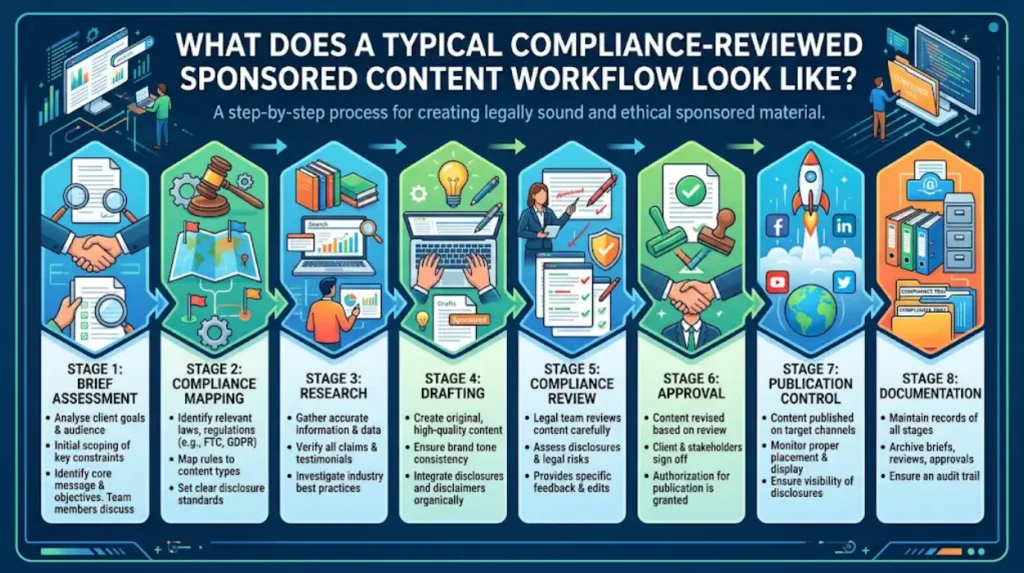
The sequence establishes control at each stage.
Stage 1: Brief assessment
The campaign objective, sponsor, subject, target audience, publication format and intended call to action are recorded.
Stage 2: Compliance mapping
The content team identifies applicable regulatory considerations and specific claims requiring evidence.
Stage 3: Research
Sources are collected before final drafting. Regulatory documents, official datasets, company information and relevant research provide the evidence base.
Stage 4: Drafting
The article is written around verified information. Promotional claims remain distinguishable from factual editorial information.
Stage 5: Compliance review
The draft undergoes claim, disclosure, source, regulatory and accuracy checks.
Stage 6: Approval
Required stakeholders review the controlled version. Where applicable, financial promotions require an authorised approval process.
Stage 7: Publication control
The approved version is checked against the published version to identify unauthorised changes.
Stage 8: Documentation
The final article, sources, approval records and relevant review notes are retained as evidence of the production process.
Why choose Times Intelligence Media Group for regulated sponsored content?
Times Intelligence Media Group combines sponsored content production with structured compliance review, evidence verification, editorial controls, source management, author checks, approval coordination, and publication checks for organisations operating in evidence-sensitive UK sectors.
The service supports organisations that need sponsored content prepared for publication without separating commercial content production from editorial quality control.
The workflow connects research, writing and review.
It also supports content teams managing multiple stakeholders. A marketing team can provide the commercial brief. Subject specialists can verify technical information. Compliance stakeholders can assess regulated claims. Editors can control the final publication version.
This creates a defined production record from brief to publication.
The service is particularly relevant when sponsored content contains regulated product information, financial claims, statistics, professional credentials, comparisons or calls to action.
For organisations already preparing content internally, preparing evidence-backed sponsored content for regulated sectors provides the preceding process for claim and approval preparation.
How can businesses start a compliance-reviewed sponsored content project?
Businesses can start by defining the regulated sector, sponsored content objective, target audience, claims, publication requirements, approval stakeholders, source material, author information, and desired publication timeline before the editorial production process begins.
A practical project brief includes:
- Regulated sector and product
- Sponsor and commercial objective
- Target UK audience
- Proposed subject
- Primary claims
- Available evidence
- Required disclosures
- Author and credentials
- Required approvers
- Target publication date
Times Intelligence Media Group can then structure the sponsored content workflow around the project’s editorial and compliance requirements.
For regulated-sector campaigns, the review process needs to begin before publication rather than after concerns appear. The FCA states that financial promotions must meet applicable requirements regardless of communication channel, while specific rules depend on the product and activity.
Compliance-reviewed sponsored content therefore provides a controlled route from commercial brief to evidence-backed publication. The process connects claims, sources, disclosures, authorship, approval and final publication into one documented workflow.
FAQs
Q1: What compliance checks does sponsored content need in regulated sectors?
Ans: Sponsored content in regulated sectors should undergo evidence, claims, disclosure, legal, and industry-specific compliance checks before publication. The review should verify that factual statements are supported by reliable sources and do not create misleading impressions.
Q2: How does compliance review improve regulated sponsored content?
Ans: A compliance review checks claims, statistics, terminology, disclosures, references, and regulatory requirements before publication. This helps identify unsupported statements and reduces the risk of publishing inaccurate or non-compliant sponsored content.
Q3: What should be checked before publishing sponsored content in the UK?
Ans: UK sponsored content should be checked for factual accuracy, advertising disclosures, substantiation of claims, and relevant sector-specific rules. The review should also confirm that paid or commercial relationships are clearly identifiable to readers.
Q4: Can Times Intelligence Media Group review sponsored content for regulated industries?
Ans: Times Intelligence Media Group can apply a structured compliance review to sponsored content intended for regulated sectors. The process can include checking evidence, source quality, factual claims, disclosures, and content requirements before publication.
Q5: What evidence should regulated sponsored content include?
Ans: Regulated sponsored content should support material claims with credible, relevant, and verifiable evidence. Sources can include official regulatory publications, government data, recognised industry bodies, research studies, and primary documentation.



