
Sponsored content in regulated UK industries requires additional compliance checks because published claims can affect consumer decisions, financial choices, healthcare decisions, or legal rights. Standard editorial checks focus on accuracy and clarity. Regulated content adds sector-specific requirements for evidence, disclosures, approvals, terminology, and advertising standards.
The exact requirements depend on the industry, the product, the intended audience, and the type of claim. Financial services, healthcare, pharmaceuticals, gambling, legal services, and other regulated sectors operate under different regulatory frameworks.
Understanding these checks helps content teams identify compliance requirements before sponsored material reaches publication.
What makes sponsored content different in regulated UK industries?
Sponsored content in regulated industries combines commercial communication with subject-specific compliance requirements. The content requires accurate claims, transparent commercial identification, reliable evidence, appropriate terminology, audience protection, and documented approval processes before publication across relevant UK media channels and platforms.
Sponsored content is paid or otherwise commercially connected editorial-style material. The commercial relationship requires clear identification so audiences understand the nature of the communication.
The Advertising Standards Authority regulates advertising standards through the UK advertising codes. The Committee of Advertising Practice develops the UK Code of Non-broadcast Advertising and Direct & Promotional Marketing, commonly called the CAP Code. Broadcast advertising follows the separate BCAP Code.
Regulated sectors add further requirements. Financial promotions fall under rules administered by the Financial Conduct Authority. Medicines and healthcare advertising involves rules from bodies including the Medicines and Healthcare products Regulatory Agency and the ASA.
The content therefore requires two layers of review:
- General advertising and editorial compliance
- Sector-specific regulatory compliance
A financial product article provides one example. The article requires commercial disclosure and accurate financial information. It also requires compliance with financial promotion rules where the content constitutes a financial promotion.
Which compliance checks apply before regulated sponsored content is published?
Pre-publication checks examine factual accuracy, evidence quality, commercial disclosure, regulatory terminology, prohibited claims, audience suitability, source reliability, and required approvals. Each check establishes whether published statements satisfy the applicable UK advertising, regulatory, and sector-specific requirements.
The process begins with identifying every material claim in the content. A claim is a statement that presents information as factual, measurable, comparative, or capable of verification.
Claims include:
- Product performance statements
- Health outcome statements
- Financial return statements
- Safety claims
- Environmental claims
- Comparative statements
- Statistical claims
- Professional or regulatory credentials
Each claim requires an appropriate evidence source.
The evidence review then checks whether the source directly supports the wording. A study showing an association does not automatically support a statement claiming causation. A product specification does not automatically support a claim about consumer outcomes.
The disclosure check examines whether commercial intent is sufficiently clear. Sponsored content requires transparency about its commercial nature.
The terminology check identifies regulated words and expressions. Terms such as investment, guaranteed, clinically proven, licensed, authorised, risk-free, treatment, cure, and certified carry specific implications depending on their context.
The final stage checks whether the content requires specialist approval before publication.
How does evidence checking work for regulated claims?
Evidence checking matches every material claim with a credible and current source that directly supports the published wording. The review records source details, dates, data limitations, calculation methods, and approval status for claims requiring regulatory substantiation.
Evidence-backed content requires a traceable relationship between the statement and its supporting material.
For numerical claims, the evidence review checks the original dataset, publication date, sample size, calculation method, and relevant population. A statistic describing UK consumers requires evidence representing the stated UK population rather than an unrelated international sample.
For healthcare claims, evidence checking examines the clinical or scientific basis for the statement. A clinical study must support the specific outcome described. A general study about an ingredient does not automatically substantiate a specific product claim.
For financial content, evidence checking verifies figures, rates, fees, risks, eligibility conditions, and relevant dates. Market data requires a clear date because financial information changes.
For comparative claims, the review checks both sides of the comparison. Statements such as faster, cheaper, safer, or more effective require evidence supporting the comparison against the named or identifiable alternative.
A documented evidence register creates a clear record of:
- Published claim
- Supporting source
- Source date
- Relevant evidence
- Reviewer
- Approval status
- Publication date
This process also supports later updates when evidence changes.
What extra checks are required for financially sponsored content?
Financially sponsored content requires additional checks for financial promotion status, risk information, factual accuracy, fair presentation, regulatory permissions, audience suitability, and required disclosures. Claims about returns, benefits, costs, or security require particular scrutiny before publication.
The Financial Conduct Authority regulates financial markets and financial services firms in the UK.
A sponsored article discussing investments, pensions, insurance, credit, mortgages, or other financial products requires assessment of whether its content constitutes a financial promotion.
The review examines whether the communication presents an invitation or inducement to engage in financial activity. It also checks whether the responsible firm has the relevant regulatory status or whether another authorised party approves the communication where required.
Risk information receives specific attention. A statement describing potential benefits without presenting relevant risks creates an incomplete representation.
Examples of financial claims requiring verification include:
- Annual percentage rates
- Investment performance figures
- Fees
- Historical returns
- Tax statements
- Eligibility requirements
- Product availability
- Capital protection statements
- Risk descriptions
Historical performance also requires careful wording. Past performance does not establish future performance.
Financial terminology requires precise use. A term such as guaranteed has a materially different meaning from an indicative or projected outcome.
What additional checks apply to healthcare and pharmaceutical sponsored content?
Healthcare and pharmaceutical content requires checks for clinical evidence, permitted claims, product status, safety information, audience suitability, medical terminology, and regulatory requirements. Promotional statements must accurately reflect the evidence and applicable rules for the specific medicine, treatment, or healthcare product.
Healthcare content covers different regulatory categories. Medicines, medical devices, health services, supplements, cosmetic products, and general health information do not follow identical requirements.
Medicine advertising requires particular attention to authorisation and claims. A medicine cannot be promoted through unsupported therapeutic claims.
Clinical terminology also requires accuracy. Terms such as clinically proven, reduces symptoms, prevents disease, treats, and cures communicate specific health outcomes. Evidence must support the exact proposition.
Safety information forms another important compliance area. Content describing benefits without relevant limitations can create an incomplete representation.
Examples include:
- Adverse effects
- Contraindications
- Usage restrictions
- Patient groups
- Clinical evidence
- Product indications
- Dosage information
- Regulatory status
The intended audience also matters. Content directed at healthcare professionals follows different considerations from material directed at the general public.
A healthcare article discussing a treatment therefore requires more than ordinary spelling, factual, and editorial checks. The claims require subject-specific verification.
What checks apply to gambling and other highly regulated sectors?
Gambling content requires checks covering responsible gambling information, age restrictions, promotional claims, inducements, risk presentation, audience targeting, and applicable advertising rules. Other regulated sectors require equivalent checks based on their products, audiences, statutory obligations, and regulatory authorities.
Gambling advertising operates under specific UK advertising requirements. Content must not present gambling as a solution to financial problems or misrepresent the nature of gambling activity.
Age and audience controls form part of the compliance process. Marketing communications must not be directed toward children or irresponsibly target vulnerable audiences.
Promotional statements require verification. Claims about bonuses, offers, winnings, odds, or promotional conditions must accurately reflect the applicable terms.
Other regulated industries have their own compliance areas.
Legal services content requires accuracy around professional status, service descriptions, outcomes, and claims about expertise.
Energy and environmental claims require evidence when content describes carbon reductions, sustainability performance, renewable energy use, or environmental benefits.
Alcohol advertising involves audience and social responsibility requirements.
Food advertising requires accurate product and health-related claims. Nutrition and health claims require particular attention to applicable rules.
Each sector therefore requires a defined compliance matrix before content production begins.
Explore More Expert Insights:
Why Do Named Authors and Expert Credentials Matter for Sponsored Content Under Google’s E-E-A-T Guidelines?
What Is a Sponsored Explainer Article and When Does It Work Better Than a Brand Announcement?
How should sponsored content be reviewed before publication?
A regulated sponsored article requires a documented review sequence covering claims, evidence, disclosures, sector rules, audience suitability, legal requirements, editorial accuracy, and final approval. Each stage records the reviewer, supporting evidence, corrections, and publication status.
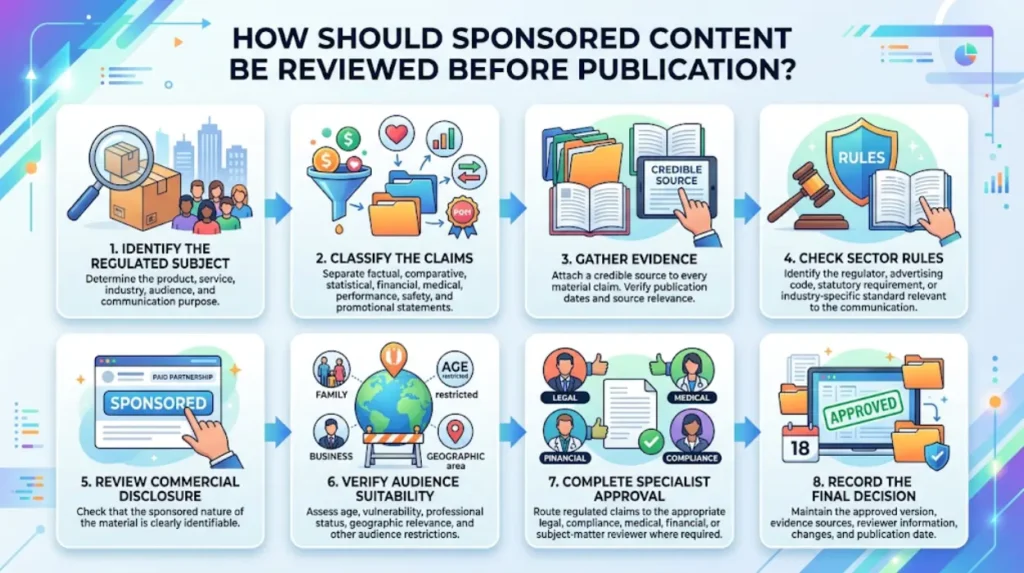
A structured review process reduces gaps between editorial production and regulatory requirements.
Step 1: Identify the regulated subject
Determine the product, service, industry, audience, and communication purpose.
Step 2: Classify the claims
Separate factual, comparative, statistical, financial, medical, performance, safety, and promotional statements.
Step 3: Gather evidence
Attach a credible source to every material claim. Verify publication dates and source relevance.
Step 4: Check sector rules
Identify the regulator, advertising code, statutory requirement, or industry-specific standard relevant to the communication.
Step 5: Review commercial disclosure
Check that the sponsored nature of the material is clearly identifiable.
Step 6: Verify audience suitability
Assess age, vulnerability, professional status, geographic relevance, and other audience restrictions.
Step 7: Complete specialist approval
Route regulated claims to the appropriate legal, compliance, medical, financial, or subject-matter reviewer where required.
Step 8: Record the final decision
Maintain the approved version, evidence sources, reviewer information, changes, and publication date.
This workflow creates a traceable compliance record rather than relying on an informal final read.
Why are compliance records important for regulated sponsored content?
Compliance records demonstrate how published claims were substantiated and approved. They preserve evidence sources, review decisions, corrections, disclosures, and publication versions, creating an auditable record that supports content governance and future updates across regulated communications.
Regulated content often changes as products, evidence, regulations, prices, approvals, and market conditions change.
A documented record helps content teams determine why a statement appeared in its published form. It also identifies which evidence supported the statement at the time of publication.
Version control is particularly important for sponsored articles that remain online for months or years.
A compliance record can include:
- Original article
- Final published version
- Claim inventory
- Evidence register
- Source dates
- Regulatory references
- Approval records
- Reviewer names
- Disclosure wording
- Amendment history
- Publication date
This information supports future content audits.
It also helps identify outdated claims. For example, a financial article containing an interest rate from January 2026 requires review if the rate changes later. A healthcare article referencing an older clinical recommendation also requires reassessment when authoritative guidance changes.
Content governance therefore continues after publication.
How can regulated sponsored content remain accurate after publication?
Post-publication compliance requires monitoring material changes to evidence, regulations, product information, pricing, approvals, and promotional conditions. Content teams review affected statements, update outdated information, preserve change records, and maintain transparent commercial disclosures.
Publication does not end compliance responsibility.
Monitoring focuses on information that can materially change the meaning of the article. Financial rates, healthcare guidance, product authorisations, promotional offers, legal requirements, and statistical data can all change.
A review schedule can prioritise content according to regulatory sensitivity.
High-change content requires more frequent checks. Financial rates and promotional offers are examples. Stable explanatory content requires a different review cycle.
Updates require evidence verification before publication. A changed statistic requires a new source. A changed regulatory requirement requires confirmation from the relevant authoritative body.
Content that cannot remain accurate requires correction or removal.
This process supports long-term accuracy while maintaining a clear connection between published claims and current evidence.
For teams moving from general awareness into practical preparation, evidence-backed and approved sponsored content can provide the next stage of understanding.
What is the core compliance framework for regulated sponsored content?
The core framework combines commercial disclosure, claim identification, evidence verification, sector-specific rules, audience protection, specialist approval, version control, and post-publication monitoring. These controls create a structured process for producing accurate sponsored communications within regulated UK industries.
Regulated sponsored content begins with classification. The subject determines which regulatory framework applies.
The next stage is evidence. Every material factual claim requires appropriate substantiation.
The following stage is regulatory review. Sector-specific rules determine additional requirements for terminology, risk information, audience restrictions, promotional statements, and approvals.
Transparency remains essential. Audiences need to recognise commercial content clearly.
Approval creates accountability. A documented reviewer and evidence trail establish how the content passed compliance checks.
Post-publication monitoring completes the framework. Regulations, evidence, products, prices, and promotional conditions change over time.
The main compliance components are therefore:
- Regulatory classification
- Claim identification
- Evidence substantiation
- Commercial disclosure
- Sector-specific review
- Audience suitability
- Specialist approval
- Version control
- Publication monitoring
- Corrective updates
These checks apply differently across financial services, healthcare, pharmaceuticals, gambling, legal services, energy, food, and other regulated sectors. The exact requirements depend on the communication, product, audience, and applicable UK regulatory framework.
Understanding these distinctions provides a clear foundation for evaluating sponsored content before publication and maintaining compliance after publication.
FAQs
Q1: What compliance checks does sponsored content need in regulated UK industries?
Ans: Sponsored content in regulated UK industries should be checked for accurate claims, transparent commercial disclosure, evidence, and sector-specific advertising rules. Financial, healthcare, legal, and other regulated topics may require additional review before publication.
Q2: Does sponsored content need to disclose that it is paid for?
Ans: Yes, sponsored content should clearly identify its commercial nature so readers are not misled about its purpose. Disclosure should be prominent, understandable, and consistent with applicable UK advertising and consumer protection requirements.
Q3: What extra checks are needed for financial services sponsored content?
Ans: Financial services sponsored content requires careful checks on factual accuracy, financial claims, risk information, and whether statements could be considered financial promotions. Content should also be reviewed against applicable Financial Conduct Authority requirements before publication.
Q4: How is healthcare sponsored content checked for compliance in the UK?
Ans: Healthcare sponsored content should be reviewed for evidence, medical accuracy, misleading claims, and appropriate presentation of benefits and risks. The content may also need to comply with UK advertising rules and relevant healthcare-specific requirements.
Q5: What should publishers check before accepting regulated sponsored content?
Ans: Publishers should verify the advertiser, commercial disclosure, factual evidence, claims, author credentials, sources, and relevant industry regulations. A documented compliance review helps ensure sponsored content meets UK advertising and editorial standards before publication.



