

What is audience overlap between UK news titles?
Audience overlap is the proportion of people who consume content from two or more UK news titles during a defined period. It shows where readership intersects across newspapers, broadcasters, digital publishers, regional outlets, and specialist news platforms.
Audience overlap measures shared news consumption rather than total readership alone. A person who reads The Guardian and BBC News belongs to the overlapping audience between those two titles.
The measurement uses a defined population and timeframe. A media planner can examine overlap across one day, seven days, 30 days, or another fixed period. The result identifies how many readers appear in multiple publisher audiences.
UK news titles include national newspapers, regional newspapers, television news brands, radio news services, digital-first publishers, and specialist publications. Examples include BBC News, The Guardian, The Times, Daily Mail, Manchester Evening News, and Birmingham Mail.
Audience overlap therefore answers a specific media planning question: How much of the audience available through one news title is also available through another title?
What does audience overlap measure?
Common measurements include:
- Shared readers between two titles
- Percentage of one title’s audience that reads another title
- Percentage of combined audiences represented by duplicate readers
- Unique reach across several titles
- Frequency of exposure across overlapping audiences
- Regional and demographic intersections
These measurements separate total audience size from unique audience reach.
How is audience overlap between UK news titles calculated?
Audience overlap is calculated by identifying people exposed to multiple news titles, dividing the shared audience by the relevant audience base, and expressing the result as a percentage for a defined period and population.
Suppose a study measures two UK news titles across 1 million people. Title A reaches 400,000 people. Title B reaches 300,000 people. If 150,000 people consume both titles, those 150,000 people represent the overlapping audience.
The overlap rate depends on the denominator.
If the calculation uses Title A as the base, the overlap is:
150,000 ÷ 400,000 × 100 = 37.5%
If Title B is the base, the result is:
150,000 ÷ 300,000 × 100 = 50%
This distinction matters because the same shared audience produces different percentages depending on the measurement framework.
What is unique reach?
Unique reach counts people once, even when they consume several news titles.
For example, three titles reach 500,000, 400,000, and 300,000 people. Adding these figures produces 1.2 million audience exposures. The unique audience is lower when some people appear in more than one title’s audience.
Unique reach therefore provides a clearer measure of how many distinct people a media plan reaches.
Why does the measurement period matter?
Audience behaviour changes across time. A person who reads one title on Monday and another title on Saturday counts as overlapping during a seven-day measurement period.
A one-day measurement captures a narrower behaviour pattern. A 30-day measurement captures broader news consumption across the same population.
Which UK news titles can have overlapping audiences?
UK news audience overlap exists across national newspapers, regional newspapers, broadcasters, digital publishers, specialist titles, and local news platforms because the same people routinely consume news from multiple sources and formats.
National and regional news titles frequently serve interconnected audiences. A reader in Leeds can consume a national newspaper for UK political coverage and a Yorkshire publication for local transport or council reporting.
Broadcast and digital audiences also intersect. A person can use BBC News through television, radio, and its website while also reading national newspaper websites.
Which types of news titles create audience overlap?
Key groups include:
National news titles
National titles cover audiences across the United Kingdom. Examples include The Times, The Guardian, Daily Mail, and The Daily Telegraph.
Regional news titles
Regional publishers focus on specific geographic areas. Examples include Manchester Evening News, Liverpool Echo, and Birmingham Mail.
Broadcast news
Broadcast news includes television and radio news services. Examples include BBC News, ITV News, Sky News, and regional television news programmes.
Digital news publishers
Digital publishers distribute news primarily through websites, applications, newsletters, search platforms, and social channels.
Specialist news titles
Specialist publishers serve defined sectors or interests. Examples include financial, technology, healthcare, legal, retail, and professional news publications.
Why does audience overlap matter for UK media planning?
Audience overlap matters because media planners need to distinguish total audience exposure from unique audience reach, identify duplicate readership, control unnecessary repetition, and understand how different UK news titles collectively reach a defined population.
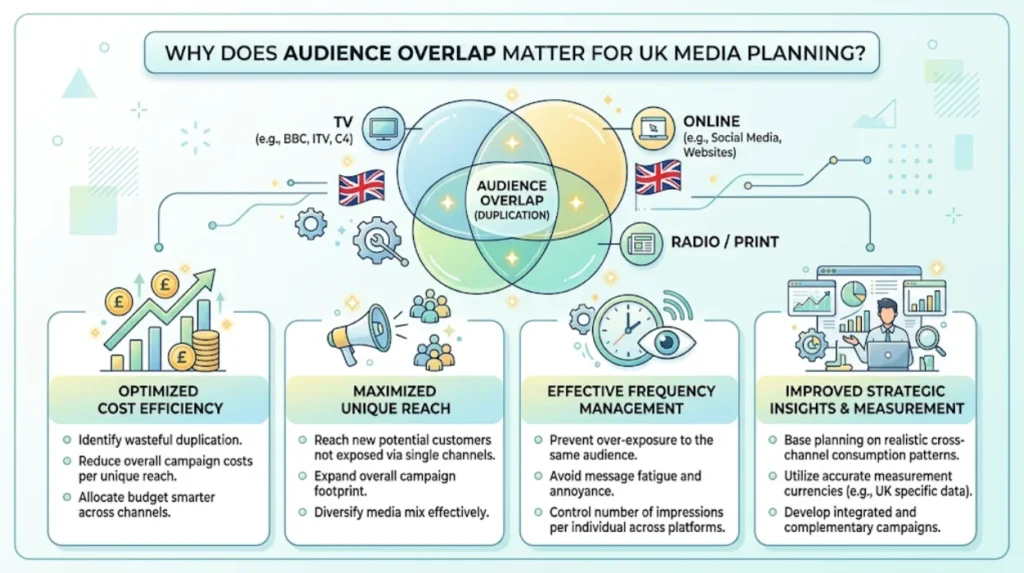
Two publications with different names do not automatically provide two completely different audiences.
A media plan using several titles needs to account for shared readership. Without overlap data, total reach can be overstated when audience figures are simply added together.
How does overlap affect reach calculations?
Consider a plan involving three titles:
- Title A reaches 500,000 people
- Title B reaches 400,000 people
- Title C reaches 300,000 people
The combined reported audience equals 1.2 million exposures. If 250,000 people appear across multiple titles, the unique audience is smaller.
The distinction is fundamental:
Total exposures measure audience contacts. Unique reach measures distinct people.
Media planning uses both measurements because reach and frequency answer different questions.
How does overlap affect frequency?
Frequency measures how often the same person encounters content or advertising.
High audience overlap can increase repeated exposure among existing readers. Lower overlap between selected titles increases the opportunity to reach people who were not reached through another title.
The correct interpretation depends on the campaign objective, audience definition, measurement period, and desired exposure level.
What factors create audience overlap across UK news titles?
Audience overlap develops through shared demographics, geography, interests, news consumption habits, distribution channels, search behaviour, social media use, and similar editorial subjects that attract the same people to multiple UK news titles.
Audience overlap is not produced by one factor. It results from several characteristics operating within the same audience.
How does geography influence overlap?
Geography creates strong connections between regional and national readership.
A reader living in Manchester can consume Manchester Evening News for local developments and The Guardian for national reporting. A reader in Birmingham can consume Birmingham Mail alongside national broadcast and newspaper coverage.
Regional audiences therefore do not exist separately from national audiences.
How do demographics influence overlap?
Age, occupation, income, education, household composition, and other audience characteristics influence news consumption patterns.
Two titles with similar demographic profiles can have substantial shared readership even when their editorial formats differ.
How do interests influence overlap?
People follow multiple titles when they need information about different subjects.
A business professional can read a national newspaper for economic coverage, a regional title for local business developments, and a specialist publication for sector-specific information.
How can media planners analyse audience overlap?
Media planners analyse audience overlap by defining the target population, selecting comparable news titles, collecting audience data, measuring shared readership, calculating unique reach, and comparing the results across geographic, demographic, and behavioural segments.
A consistent methodology is essential. Audience figures from different research systems require careful interpretation because definitions, samples, time periods, and measurement technologies differ.
What data is needed?
Useful inputs include:
- Audience size for each news title
- Measurement period
- Geographic coverage
- Demographic characteristics
- Shared audience counts
- Platform usage
- Content consumption frequency
- Unique reach estimates
The data set becomes more useful when every title uses compatible definitions.
What does an overlap matrix show?
An overlap matrix compares titles against one another.
For example:
| News Title | Title A | Title B | Title C |
|---|---|---|---|
| Title A | — | 35% | 22% |
| Title B | 44% | — | 28% |
| Title C | 37% | 31% | — |
The percentages need a clearly defined denominator. A 35% overlap can mean different things depending on whether the calculation uses Title A, Title B, or their combined audience.
Explore More Expert Insights:
What Is a Rapid-Response Data Report and When Does Reacting to Breaking Industry News Make Sense?
How Do Sponsored Articles Help Search Engines and AI Assistants Associate Your Brand With the Right Attributes?
What is the difference between audience overlap and audience duplication?
Audience overlap describes shared readership between titles, while audience duplication describes repeated exposure to the same people within a media plan. Both concepts identify audience intersections but support different interpretations of reach and campaign exposure.
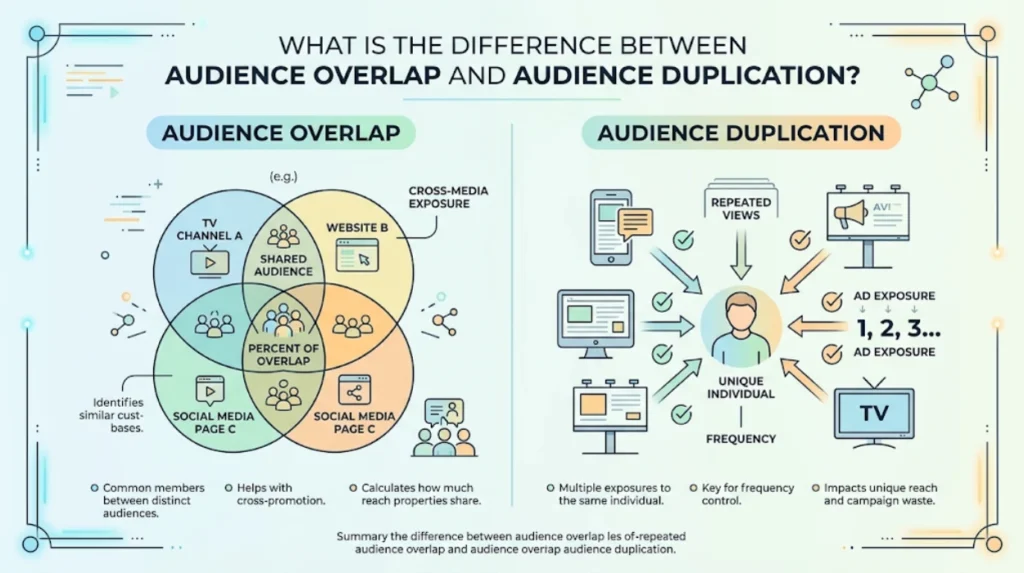
Overlap is primarily an audience relationship measure.
Duplication is a media planning consequence of that relationship. When two selected titles share many readers, placing content or advertising across both can expose the same people repeatedly.
The two concepts therefore connect but are not identical.
Why is unique audience important?
Unique audience identifies the number of distinct people reached across selected titles.
For a campaign seeking broad awareness, unique audience provides essential context. For a campaign seeking repeated exposure, duplication also matters because repeated contacts contribute to frequency.
Neither measurement exists independently of the campaign objective.
When is UK news audience overlap most useful?
UK news audience overlap is most useful when comparing national and regional titles, planning multi-publication campaigns, evaluating unique reach, analysing audience duplication, or determining how different news channels collectively reach a defined UK population.
Several practical situations require overlap analysis.
How does overlap help with national and regional planning?
A national title provides broad geographic coverage. A regional title provides concentrated local coverage.
Analysing their shared audience reveals how much regional readership is already represented within the national audience.
This distinction helps separate incremental reach from repeated reach.
How does overlap help with multi-channel planning?
Modern news consumption spans websites, applications, print, television, radio, newsletters, and social platforms.
The same person can interact with multiple formats. A cross-channel media plan therefore needs audience data that accounts for shared users.
How does overlap help with audience segmentation?
Overlap can be analysed within specific groups.
Examples include:
- London adults aged 25–34
- UK business decision-makers
- Scottish news consumers
- Parents with children under 16
- Technology professionals
- Readers aged 55 and above
Segment-level analysis reveals relationships that national averages can conceal.
What should be considered before comparing UK news audience overlap?
Audience overlap comparisons require consistent definitions, equivalent time periods, compatible research methods, clearly defined populations, and careful separation of reach, frequency, exposure, and unique audience measurements.
A comparison becomes unreliable when one title uses a daily audience measure, and another uses a monthly audience measure.
Platform differences also matter. Print readership, website users, application users, video viewers, and social media audiences represent different forms of consumption.
Which measurement questions need clear answers?
Before interpreting overlap data, establish:
- Who is included in the audience?
- What geographic population is measured?
- What period is measured?
- What counts as exposure?
- Which platforms are included?
- Is the audience daily, weekly, or monthly?
- What denominator is used for overlap percentages?
- Are the research methods comparable?
These definitions determine what the reported figures actually represent.
How does audience overlap support better understanding of UK media audiences?
Audience overlap provides a structured view of how UK news audiences intersect across publications, platforms, regions, and demographic groups, allowing media researchers to distinguish shared readership from unique reach and repeated audience exposure.
The concept connects individual news titles into a wider audience structure.
A national newspaper, regional publication, broadcaster, and specialist website can all reach some of the same people while retaining distinct audiences.
Understanding those intersections provides a clearer picture of UK news consumption.
The next stage of analysis examines how these relationships work across specific regional and national titles and how shared readership affects media planning decisions. Provide further information on audience overlap analysis.
FAQs
Q1: What is audience overlap between UK news titles?
Ans: Audience overlap refers to the proportion of people who consume content from two or more UK news titles. It helps media planners understand shared readership, cross-publication reach and potential duplication in media audiences.
Q2: Why does audience overlap matter for UK media planning?
Ans: Audience overlap helps media planners identify whether multiple news titles are reaching the same people. Understanding this can improve media mix decisions, reach analysis and audience coverage across UK news publications.
Q3: How is audience overlap measured between news publications?
Ans: Audience overlap can be measured by comparing the number of users or readers shared between different news titles against their total audiences. Audience research, readership surveys, digital analytics and media planning datasets can provide the underlying data.
Q4: Does high audience overlap reduce media campaign reach?
Ans: High audience overlap can reduce incremental reach when multiple publications repeatedly reach the same audience segments. Media planners can use overlap data to distinguish duplicated exposure from additional audience coverage.
Q5: How can Times Intelligence Media Group research support audience overlap analysis?
Ans: Times Intelligence Media Group research can be used to examine audience patterns, readership behaviour and relationships between UK news titles. Such media research can help inform audience segmentation, publication comparisons and data-led media planning.



