

Rapid-response data reports turn fresh information into structured, evidence-based reporting for organisations responding to breaking industry developments. The process requires current research, source verification, statistical checking, editorial interpretation, and rapid delivery without removing essential accuracy controls.
Times Intelligence Media Group provides research and reporting services designed for this specific reporting requirement. The service connects current data collection with structured analysis and media-ready reporting. It supports organisations that need verified information within an active news cycle.
Understanding how rapid-response data reports are developed helps decision-makers assess the research depth, verification process, reporting structure, and delivery requirements before commissioning a report.
What are research and reports services for rapid-response data reports?
Research and reports services collect, verify, analyse, and structure current information into accurate data reports that support rapid responses to breaking industry developments, media opportunities, market changes, and emerging public-interest topics within defined reporting deadlines.
A rapid-response data report starts with a defined information requirement. The research team identifies the event, industry development, dataset, market change, or emerging issue requiring immediate analysis.
The reporting process then establishes the evidence base. This includes current statistics, authoritative sources, industry information, relevant datasets, and supporting documentation.
Research and reports services combine several controlled activities:
- Research planning
- Data collection
- Source verification
- Statistical validation
- Data interpretation
- Content structuring
- Plain-English editing
- Citation checking
- Final quality control
For example, a UK organisation responding to a newly published industry statistic requires more than a summary of the headline figure. The report needs the underlying source, publication date, relevant historical comparison, geographic scope, methodology, and implications supported by the available evidence.
This structure gives decision-makers a verified information asset instead of an unprocessed collection of sources.
Organisations exploring the educational foundations of this process can review rapid-response data reporting before evaluating a specific research service.
How does Times Intelligence Media Group create a rapid-response data report?
Times Intelligence Media Group creates rapid-response data reports through a defined workflow covering research scoping, current-source discovery, evidence verification, data analysis, report development, editorial review, and final accuracy checks before delivery to the client.
The workflow begins by defining the reporting requirement. The subject, audience, geographic scope, timeframe, required datasets, and reporting purpose establish the research parameters.
1. Research scope definition
The first stage identifies exactly what the report needs to establish. A narrow research question produces a more controlled evidence base.
For example, a report examining changes in UK consumer behaviour needs defined parameters such as consumer group, industry, reporting period, geographic market, and relevant behavioural indicators.
2. Current data research
Researchers identify relevant and recent information from appropriate sources. These sources include government publications, regulatory bodies, industry datasets, research organisations, company reports, academic research, and credible media sources.
The research stage prioritises information that directly supports the reporting question.
3. Source verification
Each important claim is checked against its originating source. Verification establishes whether the statistic, statement, publication date, methodology, and geographic scope accurately correspond with the intended report.
This prevents secondary reporting from being treated as primary evidence when stronger source material exists.
4. Data analysis
Relevant figures are organised and interpreted according to the defined reporting objective. Researchers compare data points, identify measurable changes, and establish the context required to explain the findings.
For example, a percentage increase requires a defined comparison period. A current figure without its corresponding timeframe does not provide sufficient context for a reliable trend statement.
5. Report development
The verified findings are converted into a structured report. The document separates key findings, supporting evidence, methodology, contextual information, and relevant conclusions.
6. Editorial and accuracy review
The completed report undergoes checks for factual consistency, source attribution, statistical accuracy, terminology, structure, and readability.
This final stage ensures that rapid delivery does not replace evidence controls.
What components are included in rapid-response research and reports services?
Rapid-response research and reports services include research updates, source verification, data validation, statistical analysis, contextual research, structured reporting, citation checks, plain-English editing, and final quality control aligned with the required reporting deadline.
The exact components depend on the reporting requirement, but a complete service commonly includes several connected research functions.
Research and data updates
Current information is gathered according to the defined topic and reporting period. New developments receive priority when the report concerns an active news cycle.
Source and citation verification
Sources are checked against the claims they support. Citations provide traceability for important statistics, findings, and factual statements.
Statistical accuracy
Numbers are checked for calculation errors, inconsistent units, incorrect comparisons, and unsupported interpretations.
For example, comparing annual percentage growth with monthly percentage growth without clearly identifying the measurement period produces a misleading comparison.
Contextual research
Data receives the surrounding information required for accurate interpretation. This includes market conditions, historical figures, regulatory developments, sector changes, and relevant geographic distinctions.
Plain-English editing
Technical research findings are structured into language that business and media audiences can understand without removing the underlying factual meaning.
Structural consistency
The report maintains a logical hierarchy across headings, findings, evidence, tables, statistics, and supporting explanations.
Research integrity
Research integrity requires the report to distinguish verified evidence from interpretation. Unsupported claims are excluded from the final report.
These components are particularly relevant when research must move quickly from a developing event to a publication-ready information resource.
The related rapid-response media story content explains how verified fresh data moves into a UK media reporting context while maintaining accuracy.
What benefits do Times Intelligence Media Group research and reports services provide?
Times Intelligence Media Group research and reports services provide structured evidence, faster research preparation, verified sources, accurate statistics, clearer reporting, and organised findings for organisations responding to current industry developments and media opportunities.
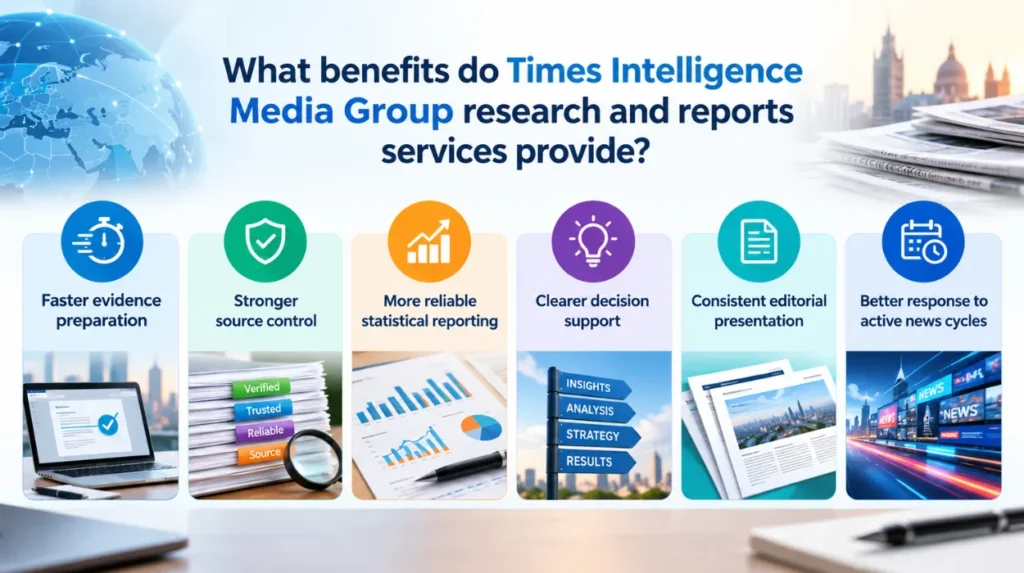
The primary benefit is structured research under a defined reporting requirement. Instead of managing separate research, verification, data analysis, and editing tasks internally, the organisation receives an integrated reporting workflow.
Faster evidence preparation
Rapid-response reporting depends on timely access to relevant evidence. A defined research workflow reduces unnecessary research activity and keeps attention on information directly connected to the reporting requirement.
Stronger source control
Source verification establishes where important information originates. This creates a clearer evidence trail for statistics and factual statements.
More reliable statistical reporting
Statistical checks reduce errors involving percentages, dates, units, comparisons, and datasets. This is essential when a report is intended for media or business communication.
Clearer decision support
Structured reports separate findings from supporting evidence. Decision-makers can therefore identify the central data points without reviewing every underlying research document.
Consistent editorial presentation
Research becomes easier to use when findings follow a consistent structure. Clear headings, concise explanations, verified statistics, and supporting sources improve usability.
Better response to active news cycles
Breaking industry developments create narrow reporting windows. A rapid-response research service provides an organised method for converting current information into a usable report within that timeframe.
For example, a UK trade organisation responding to newly released government statistics can use a rapid-response report to establish the relevant figures, compare them with previous data, verify the sources, and prepare evidence for subsequent media communication.
When should an organisation commission rapid-response data reporting services?
An organisation should commission rapid-response data reporting services when current events require verified research within a defined deadline, particularly for breaking industry news, new statistics, market developments, regulatory announcements, or emerging media opportunities.
The service fits situations where timing and evidence quality operate together.
Breaking industry news
A major industry announcement creates an immediate information requirement. Research services establish the relevant facts, supporting statistics, and contextual evidence.
Newly published datasets
Government agencies, regulators, industry bodies, and research organisations regularly publish new datasets. A rapid-response report converts these releases into structured findings.
Regulatory developments
New rules or regulatory announcements often require factual research before organisations communicate their relevance. Research and reports services establish the documented information needed for accurate reporting.
Market changes
Price movements, consumer trends, employment data, investment activity, and sector performance generate frequent reporting requirements.
For example, a UK retail organisation responding to newly published consumer spending data needs verified figures, reporting dates, sector context, and relevant comparisons before presenting the development as a market trend.
Media response opportunities
Organisations responding to current news require evidence that supports timely commentary. A research report provides the factual foundation for that response.
Research refresh requirements
Existing reports also require updates when underlying data changes. A research refresh identifies outdated statistics, checks current sources, updates findings, and maintains structural consistency.
How can an organisation choose the right rapid-response research service?
An organisation evaluating a rapid-response research service needs to examine research scope, source verification, statistical controls, reporting structure, turnaround requirements, editorial quality, geographic coverage, and the service’s ability to produce evidence within the required news cycle.
The evaluation process begins with the reporting objective. Organisations need to define whether they require a short data brief, detailed research report, media-support document, market analysis, or refreshed research asset.
The next consideration is source quality. A suitable research process needs clear methods for identifying authoritative and current information.
Data handling also requires attention. The service needs defined controls for statistics, comparisons, publication dates, units, and methodology.
Turnaround requirements form another important consideration. Rapid-response reporting has a specific deadline connected to the news cycle. The research workflow needs to operate within that timeframe.
Editorial requirements also matter. A report intended for media professionals requires clear language, concise findings, structured evidence, and accessible explanations.
Times Intelligence Media Group Research and Reports Services address these requirements through a structured research and reporting process focused on current information, evidence verification, data accuracy, and report usability.
Explore More Expert Insights:
Time Intelligence Media Group Sponsored Content Services for Brand Entity Building
Time Intelligence Media Group Sponsored Content Services With Google-Compliant Link Attributes
What can Times Intelligence Media Group research and reports services deliver?
Times Intelligence Media Group delivers structured research and reports that organise current evidence into verified, readable, and decision-ready reporting assets for organisations requiring rapid-response data analysis and timely information during active industry developments.
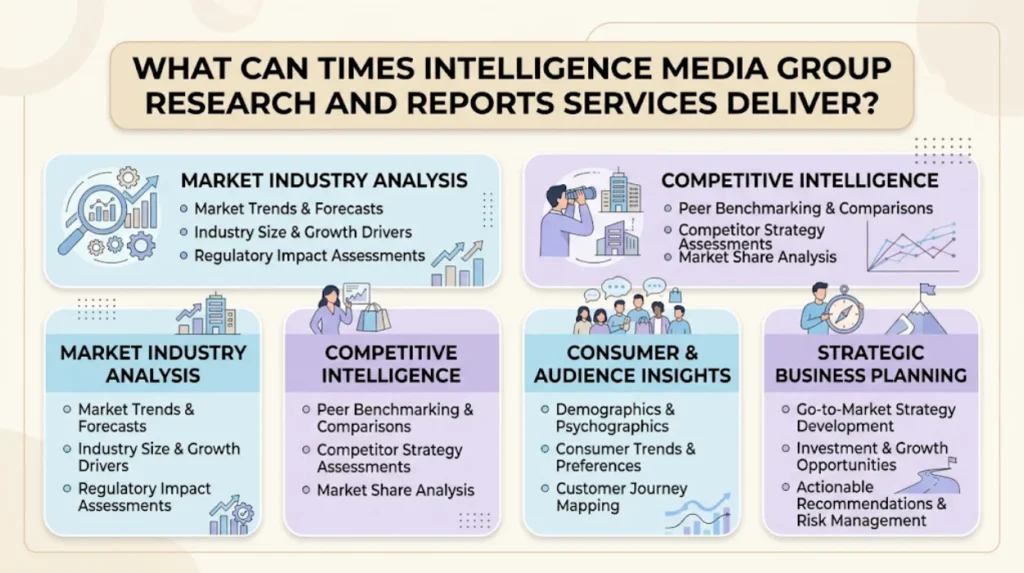
The service can support different reporting requirements based on the information objective and required output.
Potential deliverables include:
- Rapid-response data reports
- Research updates
- Data-led industry reports
- Research refreshes
- Source verification
- Statistical validation
- Evidence-based media research
- Structured market research
- Current-data reporting
- Plain-English research documents
The reporting process maintains a distinction between research evidence and editorial interpretation. This distinction supports clearer communication and stronger source traceability.
For UK-focused reporting, geographic relevance also remains important. Data from another country does not automatically represent UK conditions. The research process therefore needs to identify the relevant population, market, reporting period, and geographic scope before a finding is used.
A rapid-response report also requires temporal accuracy. A statistic published recently does not necessarily describe a current condition if the underlying dataset covers an earlier period. The report needs to distinguish publication date from data period.
These controls make the resulting report more useful for organisations operating within fast-moving media and industry environments.
How can organisations start a rapid-response research project?
Organisations can start by defining the reporting topic, required evidence, geographic scope, reporting deadline, target audience, and desired output, then provide these requirements to Times Intelligence Media Group for structured research and report development.
A clear project brief establishes the foundation for efficient research. It can identify the news development, industry question, target market, required data, reporting period, and intended use of the final report.
The brief can also specify whether the report supports media communication, internal decision-making, public reporting, research updates, or another defined business requirement.
Times Intelligence Media Group can then structure the research process around the required evidence and delivery requirements.
For organisations responding to an active news cycle, the key requirement is not simply speed. The report needs current evidence, verified sources, accurate statistics, clear context, and a structured final presentation.
Times Intelligence Media Group Research and Reports Services provide this process for organisations requiring rapid-response data reports based on current and verified information.
FAQs
Q1: What are rapid-response data reports?
Ans: Rapid-response data reports turn fresh research, statistics, and verified information into concise reports within a relevant news or industry cycle. They help organisations interpret emerging developments while maintaining data accuracy and source verification.
Q2: What is included in research and reports services?
Ans: Research and reports services can include data collection, source verification, statistical analysis, research updates, fact-checking, and plain-English reporting. For rapid-response reports, these processes are structured to support timely and evidence-based outputs.
Q3: How quickly can a rapid-response data report be produced?
Ans: Production time depends on the volume of research, data complexity, source availability, and reporting requirements. A rapid-response workflow prioritises relevant evidence and efficient verification so findings can be prepared within a suitable news or business reporting window.
Q4: Why is source verification important in rapid-response research?
Ans: Source verification helps confirm that statistics, claims, and research findings are accurate and traceable. It reduces the risk of publishing outdated, misleading, or unsupported information when responding to breaking industry developments.
Q5: How can Times Intelligence Media Group support rapid-response data reporting?
Ans: Times Intelligence Media Group Research and Reports Services can support rapid-response reporting through structured research, data analysis, source checking, and concise report preparation. The approach focuses on turning current information into clear, evidence-based data reports for timely use.



