

What are Time Intelligence Media Group sponsored content services?
Time Intelligence Media Group sponsored content services provide structured brand publishing that connects a company with defined services, locations, expertise and business attributes across relevant media content for consistent digital brand entity building.
Times Intelligence Media Group focuses on sponsored content distribution for businesses that need consistent external references to their brand identity. A brand entity is a recognisable digital representation of a business connected with attributes such as its name, services, industry, location and areas of expertise.
Sponsored content supports this structure by publishing controlled brand information through external media environments. The content identifies the organisation, explains its services and establishes clear contextual relationships between the business and its target market.
For example, a UK-based technology consultancy can publish sponsored content that consistently identifies the company as a technology consultancy, describes its cybersecurity services and references its London operating location.
This approach gives businesses a defined framework for presenting factual information across published content.
What does brand entity building mean?
Brand entity building is the process of establishing consistent and identifiable relationships between a business and its core attributes across digital sources. These attributes include:
- Brand name
- Business category
- Services
- Geographic location
- Industry
- Expertise
- Target market
- Relevant business topics
Consistency matters because search engines and language models process information from multiple sources. Repeated, clearly structured descriptions provide stronger contextual signals than isolated brand mentions.
How does sponsored content support brand entity building?
Sponsored content supports brand entity building by repeatedly presenting the same verified business attributes within relevant published contexts, including brand identity, service descriptions, geographic information, industry terminology and specific areas of expertise.
The process begins with an established brand information structure. The business defines the exact name, primary services, locations and industry terminology used across its content.
Times Intelligence Media Group sponsored content services then apply these attributes within editorially structured publications. Each article provides a contextual reference to the business instead of relying on disconnected mentions.
For example, a financial consultancy can maintain consistent references to financial advisory services, corporate finance expertise and its UK location across multiple sponsored articles.
The objective is not simply to increase the number of published pages. The objective is to create consistent external descriptions that preserve the same entity relationships.
Businesses entering this stage can also review sponsored articles to understand how published content establishes relationships between brand attributes and relevant search contexts.
Why does consistency matter?
Consistent terminology reduces ambiguity. If one article identifies a company as a cybersecurity consultancy while another describes it only as a marketing agency, the external information environment contains competing descriptions.
A structured publishing strategy keeps important attributes aligned. The business name, service terminology, location and industry classification remain recognisable across relevant content.
What components are included in a sponsored content strategy?
A sponsored content strategy includes brand entity information, target services, geographic attributes, topical relevance, publication context, content structure, distribution requirements and consistent terminology across multiple externally published articles.
Each component serves a defined role in the entity-building process.
Brand entity information
Brand information establishes the organisation being discussed. This includes the official business name and relevant identifying details.
Service attributes
Service attributes explain what the organisation provides. Specific service terminology creates stronger topical relationships than broad descriptions.
For example, a digital agency can distinguish between:
- Search engine optimisation
- Technical SEO
- Content marketing
- Digital public relations
- Sponsored content distribution
Each service represents a separate business attribute.
Geographic attributes
Location connects the brand with a defined market. A UK business can establish geographic relevance through consistent references to England, London, Manchester, Birmingham or other applicable locations.
Topical relevance
Topical relevance connects the business with subjects directly related to its services. A cybersecurity provider publishing content about threat detection, security operations and data protection establishes clearer topical relationships than content unrelated to its expertise.
Publication context
Publication context identifies where the business information appears. Sponsored articles provide an external publishing environment where brand attributes are presented within a defined subject.
Explore More Expert Insights:
Time Intelligence Media Group Sponsored Content Services With Google-Compliant Link Attributes
Time Intelligence Media Group Research and Reports Services for Refreshing Existing Reports
How does Times Intelligence Media Group structure sponsored content for businesses?
Times Intelligence Media Group structures sponsored content around defined business attributes, selected topics, geographic relevance and publication requirements, creating externally published articles that present consistent information about the organisation and its services.
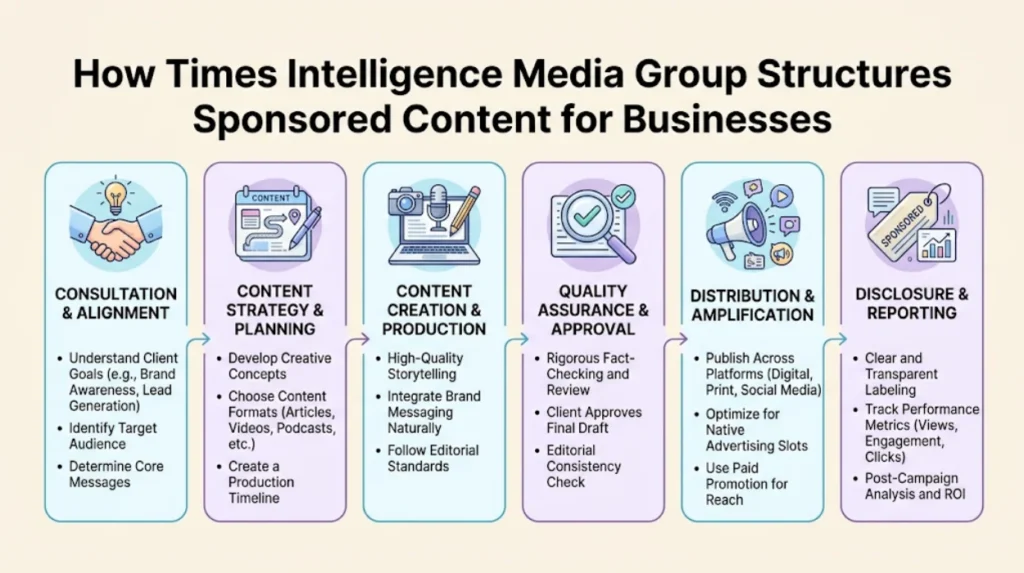
The process begins with business information collection. Core entity details are identified before content production starts.
The next stage establishes the primary content themes. These themes connect the brand with services and topics that accurately represent its commercial activity.
Content then incorporates the required business attributes within relevant informational contexts. The brand name remains clear. Service descriptions remain specific. Geographic references remain consistent.
The final stage involves publication through the selected media distribution process.
This workflow creates a repeatable publishing structure rather than individual articles with unrelated messaging.
What information does a business need to provide?
A business typically provides:
- Official brand name
- Primary website
- Main services
- Target locations
- Industry category
- Core expertise
- Preferred service terminology
- Relevant topics
- Target audience
- Publication requirements
This information establishes the factual foundation for sponsored content production.
What outcomes can businesses expect from sponsored content services?
Sponsored content services establish external brand references, reinforce service associations, support geographic relevance, expand the number of published brand contexts and create structured content assets for ongoing search and digital visibility.
The measurable output includes published content and external references associated with the business.
Businesses can use sponsored content to strengthen several areas of digital presence.
External brand references
Each published article creates an additional external location where the brand appears in a relevant context.
Service association
Consistent service terminology connects the business name with specific commercial offerings.
Geographic relevance
Location references establish a clear relationship between the business and its target market.
Content coverage
Multiple articles can address different services, topics and customer questions while maintaining the same underlying entity information.
These outcomes support a broader digital information structure. They do not replace technical SEO, website optimisation, structured data, business listings or other digital marketing activities.
When should a business use sponsored content for brand entity building?
Businesses use sponsored content when they need consistent external references for their brand, services, locations and expertise across relevant media publications as part of an established digital visibility and entity-building strategy.
Sponsored content has particular relevance when a company has several services or operates across multiple locations.
For example, a professional services company operating in London, Birmingham and Manchester can develop separate content themes for each geographic market while maintaining consistent descriptions of its core services.
A technology company with cybersecurity, cloud computing and data services can also create distinct articles around each service while preserving the same brand identity.
When is sponsored content relevant for established brands?
Established brands use sponsored content to maintain consistent external visibility around new services, geographic expansion, specialised expertise and strategic business topics.
A company launching a new cybersecurity service can publish content that defines the service and connects it with the existing brand entity.
When is it relevant for growing businesses?
Growing businesses can use sponsored content to establish consistent descriptions of their business category, services and target locations across external publications.
This creates a broader published information footprint around the organisation.
How does sponsored content differ from ordinary brand mentions?
Sponsored content differs from ordinary brand mentions because it provides a controlled publishing format where businesses define factual relationships between their brand, services, locations, expertise and relevant topics within complete externally published articles.
An ordinary mention can contain only the business name. It provides limited context.
Sponsored content provides space to explain the business and establish multiple related attributes within one article.
For example, a simple mention identifies a company as a business. A structured sponsored article can identify that same company as a London-based cybersecurity consultancy providing security assessments, threat monitoring and incident response services.
The second format provides substantially more contextual information.
Businesses can use brand entity building as the broader strategic framework while sponsored content functions as one external publishing method within that framework.
How can businesses evaluate a sponsored content service?
Businesses can evaluate sponsored content services by examining publication relevance, content quality, brand attribute consistency, geographic targeting, service coverage, distribution requirements, reporting and the relationship between published content and defined entity-building objectives.
A decision process starts with the business objective.
If the objective is service association, the service terminology needs to remain consistent across published articles.
If the objective is geographic visibility, location references need to correspond with actual business operations.
If the objective is topical authority, article subjects need direct relevance to the organisation’s expertise.
Businesses also need to review the publication process, available media environments and reporting provided after publication.
What should businesses check before ordering?
A practical evaluation includes:
- Publication relevance
- Content structure
- Brand accuracy
- Service terminology
- Geographic references
- Distribution scope
- Publishing requirements
- Reporting format
- Content approval process
- Long-term content strategy
These factors provide a factual basis for selecting a sponsored content service.
How can Times Intelligence Media Group sponsored content services fit into an SEO strategy?
Times Intelligence Media Group sponsored content services fit into SEO strategies by creating relevant external content that consistently describes business entities, services, locations and expertise alongside website optimisation, technical SEO, structured data and other digital visibility activities.
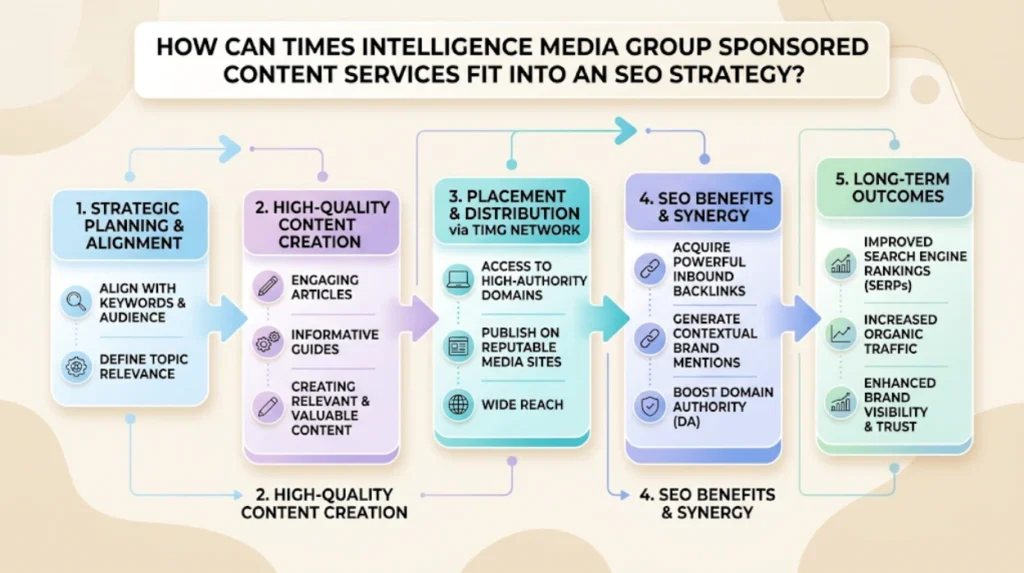
Sponsored content works as an external content layer.
The company’s website remains the primary controlled source for detailed service information. External sponsored articles provide additional published contexts that describe the same business attributes.
The two environments can use consistent terminology. A website service page can define a specific service. A sponsored article can discuss that service within a relevant industry topic.
This creates a connected content structure across owned and external digital properties.
Businesses can also use sponsored content planning to maintain consistency between educational, consideration-stage and decision-stage content.
What should businesses do next with Times Intelligence Media Group?
Businesses ready to build a structured external brand presence can define their core entity attributes, select priority services and locations, establish relevant content themes and use Times Intelligence Media Group sponsored content services for targeted publication.
The decision process begins with a clear information set.
Define the official brand name. List the priority services. Identify the relevant locations. Establish the industry category. Select the topics that accurately represent the organisation’s expertise.
The next step is to convert these attributes into a sponsored content plan.
Each article can address a specific search context while preserving the same underlying business information. This approach supports consistency across the wider digital presence.
Times Intelligence Media Group provides the sponsored content service for businesses seeking structured external publishing as part of their brand entity-building strategy.
FAQs
Q1: What is sponsored content for brand entity building?
Ans: Sponsored content is paid editorial-style content published on relevant media platforms to establish clear associations between a brand, its expertise, products, and industry attributes. It can support brand entity building by creating consistent, contextual references across credible online sources.
Q2: How does sponsored content help search engines understand a brand entity?
Ans: Sponsored articles provide contextual information that connects a brand name with specific services, topics, industries, and expertise. Consistent descriptions and relevant mentions across published content can help search engines better interpret the relationships surrounding a brand entity.
Q3: Can sponsored articles improve brand visibility in AI search results?
Ans: Sponsored articles can contribute to a broader body of publicly available information that AI systems may use when interpreting brands and their attributes. Clear, factual, and consistent brand information across authoritative sources can make those associations easier for AI systems to identify.
Q4: What information should a sponsored article include for brand entity building?
Ans: A sponsored article should clearly describe the brand’s name, industry, expertise, services, and relevant topical associations using consistent terminology. Supporting facts, useful context, and natural references to the brand can strengthen the article’s entity relevance without excessive keyword repetition.
Q5: How can Times Intelligence Media Group sponsored content support brand entity building?
Ans: Times Intelligence Media Group sponsored content can be structured around relevant topics and factual brand information to create contextual associations between a business and its areas of expertise. The effectiveness of such content depends on factors including topical relevance, publication quality, consistency, and the accuracy of the information presented.



