Refreshing a published research report means updating outdated evidence, statistics, findings, references and supporting sections while preserving the original report URL, structure and established authority. The process improves accuracy without unnecessarily replacing the existing publication or disrupting its accumulated search visibility.
A published research report contains more than research findings. It also contains a digital history built through search rankings, backlinks, citations, indexed pages and references from other publications.
A research report refresh updates the information that has become outdated while retaining the established publication wherever the underlying research remains relevant.
This distinction matters for UK businesses publishing market research, industry analysis, economic findings, customer research and corporate reports. A report published several years ago can continue attracting organic traffic and external references even when some statistics no longer represent current conditions.
The first stage is determining whether the report needs an update rather than a completely new publication. The decision depends on the research question, evidence base, search performance and extent of factual change.
Businesses reviewing this decision can first explore research report updates to understand the wider reasons for maintaining an existing report.
Why should an existing research report be refreshed instead of replaced?
An existing report deserves a refresh when its core research question remains relevant but specific evidence, statistics, references or explanations have become outdated. Updating the established publication preserves continuity while correcting information that no longer accurately represents current market conditions.
Replacing a report creates a separate publication. The new page starts building its own search visibility, backlinks and citations. The original page remains part of the website unless it is redirected or removed.
A refresh follows a different model. The existing publication remains the primary resource while selected content is revised.
When is the research still relevant?
The core research question provides the first test.
For example, a UK business report examining consumer purchasing behaviour remains relevant when the behaviour remains commercially important. Statistics from 2022 can then be replaced with verified 2026 evidence where suitable data exists.
A refresh is also appropriate when:
- The research topic remains commercially relevant
- New evidence extends existing findings
- Statistics require replacement
- References contain outdated sources
- Regulatory information has changed
- Market conditions have materially changed
- Search intent remains closely aligned with the original subject
A new report becomes more appropriate when the research question itself has changed substantially, or the original methodology no longer supports the intended conclusions.
How can you refresh a research report without losing existing rankings?
Preserving rankings requires maintaining the established URL, search intent, topical relevance and valuable content while improving factual accuracy. The refresh must strengthen the original resource rather than change its subject, purpose, structure and relevance so extensively that search engines interpret it differently.
The URL is one of the most important elements to preserve. Changing the URL unnecessarily creates additional technical and search-management requirements.
The main title also needs careful treatment. A refreshed title can improve clarity and reflect current information while retaining the original search intent.
Which content should be updated first?
Start with information that directly affects factual accuracy.
This includes:
- Statistics with outdated publication dates
- Market figures superseded by newer datasets
- Regulatory references that have changed
- Company information that is no longer accurate
- Research citations that have become obsolete
- Methodology notes requiring clarification
- Charts based on outdated datasets
- Conclusions affected by newly available evidence
The original research question remains visible throughout the update.
For example, a report about UK workforce trends can retain its central subject while updating employment statistics, workforce participation figures, sector-level findings and relevant policy references.
How should the introduction and conclusion be handled?
The introduction needs to establish the current context. The conclusion needs to reflect the updated evidence.
Neither section requires complete rewriting when the central findings remain valid.
This approach preserves continuity between the original publication and its refreshed version.
How do backlinks and citations affect a research report refresh?
Backlinks and citations provide external connections to an established research report. Preserving the original URL keeps those references connected to the updated resource, while refreshed citations replace outdated evidence and strengthen the report’s current factual foundation.
Backlinks are links from external websites pointing to the report. They often originate from industry publications, research organisations, news websites, academic resources and business websites.
Citations are references supporting specific claims, statistics or findings within the report.
Both require different treatment during a refresh.
How should existing backlinks be protected?
Keep the original URL whenever the report remains fundamentally relevant.
Avoid unnecessary URL changes because an address change requires redirects and additional technical management. A redirect also introduces a different page relationship from the original direct link.
Review the websites linking to the report and identify links associated with claims that have changed.
For example, a UK market research report can have backlinks from trade publications referencing a statistic published three years earlier. The refreshed report can preserve the backlink while clearly updating the underlying statistic.
How should outdated citations be replaced?
Review every citation connected to factual claims.
Replace sources that no longer represent the latest available evidence. Maintain citations that remain authoritative and relevant.
A citation audit can classify sources as:
- Current and relevant
- Current but requiring contextual clarification
- Outdated and requiring replacement
- Broken or inaccessible
- No longer supporting the stated claim
This process improves source quality without removing the report’s accumulated publication history.
Explore More Expert Insights:
How to Translate Technical Findings Into Plain-English Report Sections Without Losing Statistical Accuracy
How to Turn Fresh Data Into a Rapid-Response UK Media Story Within the News Cycle Without Sacrificing Accuracy in 2026
What is the correct process for refreshing a published research report?
A structured refresh process begins with an audit, followed by evidence verification, content revision, citation review, technical checks and post-publication monitoring. Each stage protects existing value while ensuring the refreshed report accurately reflects current evidence, search intent and business context.
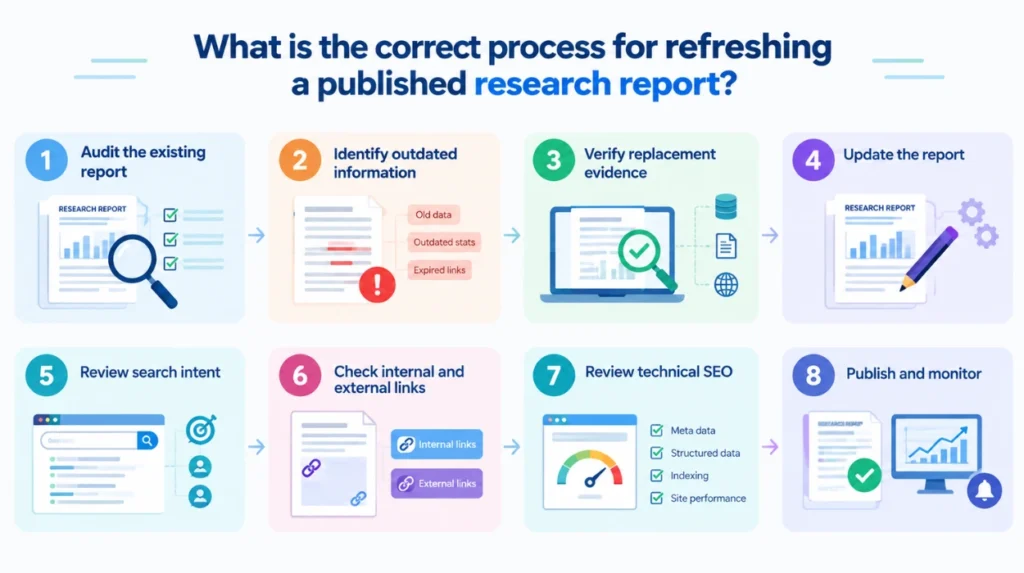
A controlled process reduces unnecessary changes and makes the refresh measurable.
Step 1: Audit the existing report
Review the URL, title, headings, statistics, citations, links, charts, metadata and publication date.
Record existing organic traffic, ranking queries, backlinks and referring domains where data is available.
Step 2: Identify outdated information
Create a list of statements requiring verification.
Prioritise numerical claims, dates, market figures, regulations, company information and research references.
Step 3: Verify replacement evidence
Use current and authoritative sources.
For UK business research, relevant evidence can include government datasets, recognised industry bodies, established research organisations and current corporate disclosures.
Step 4: Update the report
Replace outdated information while retaining sections that remain factually valid.
Do not change every paragraph simply because the report is being refreshed.
Step 5: Review search intent
Compare the updated content with the queries the report targets.
The refreshed report must continue answering the same core user need.
Step 6: Check internal and external links
Review links for accuracy, relevance and accessibility.
Update broken links and references to obsolete pages.
Step 7: Review technical SEO
Check the canonical URL, indexability, metadata, structured data where applicable, redirects and sitemap status.
Step 8: Publish and monitor
Record the refresh date and monitor rankings, organic traffic, indexed status, backlinks and engagement after publication.
Which parts of a research report need the most attention during a refresh?
Statistics, source citations, methodology notes, charts, regulatory references, market descriptions and conclusions require the closest review during a research report refresh. These elements directly influence factual accuracy and determine whether the publication continues supporting current business research needs.
Not every section requires equal revision.
The highest priority belongs to content that can become factually incorrect through time.
Statistics and datasets
Statistics have defined publication periods. A figure from 2023 does not automatically represent conditions in 2026.
Update the figure when a newer authoritative dataset directly supports the same measurement.
Charts and tables
Visual data must match revised statistics.
A report containing updated text but outdated charts creates an internal factual inconsistency.
Methodology
Methodology remains important when new data sources, sample sizes or research methods have changed.
If the original methodology remains valid, document the update clearly rather than presenting new evidence as part of the original research process.
Conclusions
Conclusions must correspond with the evidence currently presented.
If updated evidence changes a conclusion, revise the relevant section instead of retaining language supported only by historical data.
What are the SEO benefits of refreshing an existing research report?
Refreshing an established research report can preserve its existing URL, backlinks, indexed history and topical relevance while improving information freshness. The updated resource can continue serving established search intent and provide stronger evidence for users seeking current research information.
The SEO value comes from maintaining continuity while improving relevance.
A report that already receives organic traffic has measurable search visibility. A refresh allows the publisher to improve the page without automatically abandoning its existing digital footprint.
How does freshness support search visibility?
Search engines evaluate whether content satisfies search intent and provides useful information.
A report containing outdated statistics can become less useful for searches requiring current information. Updating the evidence improves the page’s ability to address those queries.
Freshness does not mean changing publication dates without substantive updates. The report needs genuine revisions supported by current evidence.
How can semantic relevance improve?
A refresh also creates an opportunity to incorporate current terminology.
For example, a report about UK digital transformation can incorporate current terminology relating to artificial intelligence, automation, data governance and workforce transformation when those concepts directly relate to the research.
The terminology must reflect the report’s actual evidence rather than function as keyword additions.
When is refreshing an existing report better suited to business use cases?
Report refreshing suits businesses that need current evidence while preserving an established publication. Common applications include market research, industry reports, customer studies, workforce analysis, technology research, regulatory reporting and corporate research where the central subject remains commercially relevant.
The approach applies across multiple research environments.
Market research
A market report can retain its original market definition while updating market size, growth indicators, customer behaviour and competitive information.
Workforce research
A workforce report can update employment data, skills information, recruitment conditions and sector-specific findings.
Technology research
Technology reports require frequent updates because product capabilities, standards, adoption levels and regulatory requirements change rapidly.
Regulatory research
Reports covering compliance environments require careful reference updates when legislation, guidance or regulatory frameworks change.
Corporate research
Businesses can refresh research supporting strategic planning, stakeholder communication and industry analysis when the original research question remains relevant.
The appropriate refresh scope depends on how much of the original evidence remains valid.
How can businesses manage a research report refresh efficiently?
Efficient report refreshing combines content auditing, evidence verification, SEO review, citation management and editorial quality control. A defined workflow prevents unnecessary rewriting and keeps the refreshed publication aligned with its original research purpose, current evidence and established digital presence.
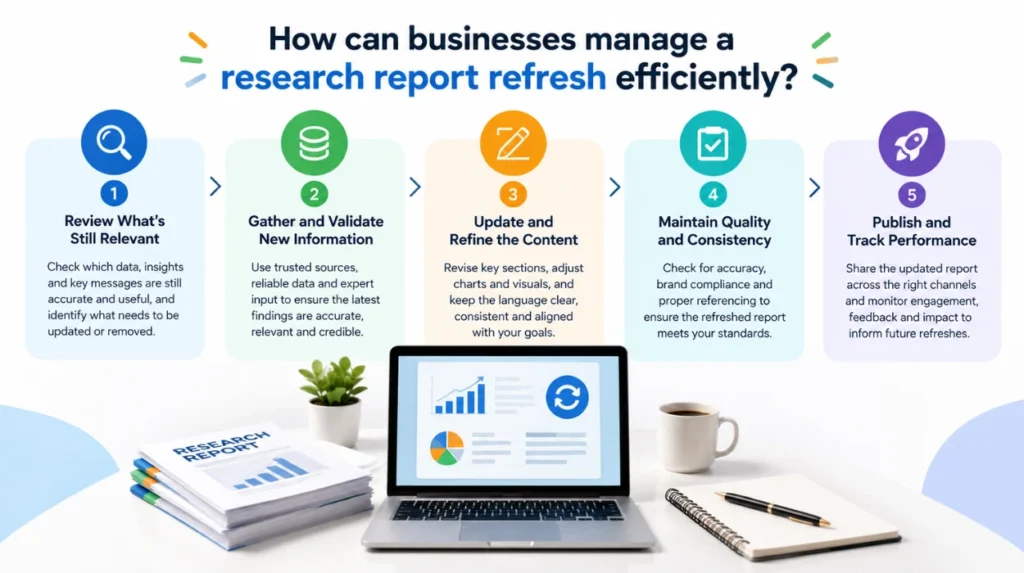
The process benefits from clear ownership.
Researchers verify evidence. Editors review clarity and consistency. SEO specialists review search intent and technical elements. Subject specialists verify technical accuracy where required.
A documented change log also improves accountability.
The change log can record:
- Original information
- Updated information
- Source of replacement evidence
- Date of verification
- Reason for change
- Reviewer responsible
- Publication date
This creates an auditable record of the refresh.
For organisations managing multiple reports, a standardised process also makes recurring reviews easier to schedule and compare.
Businesses moving from research maintenance toward professional report production can explore research and reports services when additional editorial, research or report-refresh support is required.
What should happen after a refreshed research report is published?
Post-publication monitoring confirms whether the refreshed report continues attracting relevant search traffic and retaining its digital connections. Review rankings, organic traffic, indexed status, backlinks, citations and user engagement against the report’s pre-refresh baseline.
The refresh does not end when the updated page is published.
Establish a comparison period using the report’s historical performance data.
Which metrics should be monitored?
Track:
- Organic impressions
- Organic clicks
- Ranking queries
- Average search positions
- Referring domains
- Backlinks
- Indexed status
- Organic engagement
- Conversion activity where relevant
Search performance can fluctuate after substantial content changes. The important task is identifying whether the refreshed resource continues serving the intended search demand.
How often should the report be reviewed?
Review frequency depends on the subject.
Fast-changing areas such as technology, regulation and economic conditions require more frequent evidence checks.
Stable research topics require less frequent updates.
A review schedule can assign each report a defined reassessment date based on the rate at which its evidence becomes outdated.
How does a research report refresh support long-term content value?
A research report refresh extends the useful life of an established publication by keeping its evidence current while retaining its existing digital identity. The approach connects historical search value with updated research information without requiring unnecessary replacement of relevant content.
The long-term objective is not simply to change an old publication date.
It is to maintain a reliable research asset.
A well-managed refresh preserves useful content, removes outdated evidence, strengthens citations and maintains continuity for websites that already reference the report.
This makes research maintenance an ongoing publishing process rather than a one-time correction.
For UK businesses, the approach is particularly relevant when a report continues answering an important business question but contains evidence that no longer reflects current conditions.
The key principle is straightforward: preserve what remains valuable, replace what has become outdated, verify every important claim and maintain the publication’s established digital connections.
FAQs
Q1: How can you refresh a published research report without losing its search rankings?
Ans: Update outdated statistics, findings and references while keeping the existing URL, page structure and core topic intact. This approach can help preserve accumulated search relevance, backlinks and organic visibility.
Q2: Should I update the existing research report or publish a new one?
Ans: Refresh the existing report when its core research question and topic remain relevant but the data, sources or findings need updating. A new report is more appropriate when the research scope, methodology or subject has changed substantially.
Q3: How do backlinks affect an updated research report?
Ans: Backlinks continue to point to the same established URL when a research report is refreshed rather than replaced. Keeping the URL stable helps retain the link equity and referral value associated with existing external citations.
Q4: How should citations be handled when updating a research report?
Ans: Review existing citations for accuracy, replace outdated sources where necessary and add current evidence that supports revised findings. Times Intelligence Media Group can maintain citation continuity while updating the report’s research evidence.
Q5: Can updating an old research report improve its SEO performance?
Ans: Yes, refreshing outdated content with current research data, relevant sources and clearer explanations can improve its usefulness and search relevance. Retaining the established URL also allows the updated report to build on its existing rankings, backlinks and citations.