
Substantiating every claim in a research report involves matching every single statistical assertion, performance metric, and consumer trend statement with a verifiable primary data source, an auditable methodology document, and a transparent calculation trail that withstands formal regulatory challenges.
In the United Kingdom, marketing compliance demands absolute transparency. Regulatory bodies such as the Advertising Standards Authority enforce strict evidentiary standards under the UK Code of Non-broadcast Advertising and Direct & Promotional Marketing (CAP Code). When a brand publishes a research report, every declarative statement acts as an objective claim. If the report states that 74 percent of British consumers prefer sustainable packaging, compliance teams must possess the raw survey data, the exact sample size, the exact geographic distribution across England, Scotland, Wales, and Northern Ireland, and the precise wording of the survey question.
Regulatory challenges arise when competitors or consumers lodge formal complaints regarding misleading statistics. Without immediate, documented substantiation, brands face severe penalties, mandatory ad withdrawals, and reputational damage. Substantiation transforms an opinion-based marketing asset into a defensible corporate document.
Why Do UK Regulators and Industry Watchdogs Scrutinize Marketing Research Reports?
UK regulators scrutinize marketing research reports to protect consumers from deceptive statistical claims, prevent unfair competitive advantages driven by fabricated data, and maintain absolute integrity within commercial communication channels.
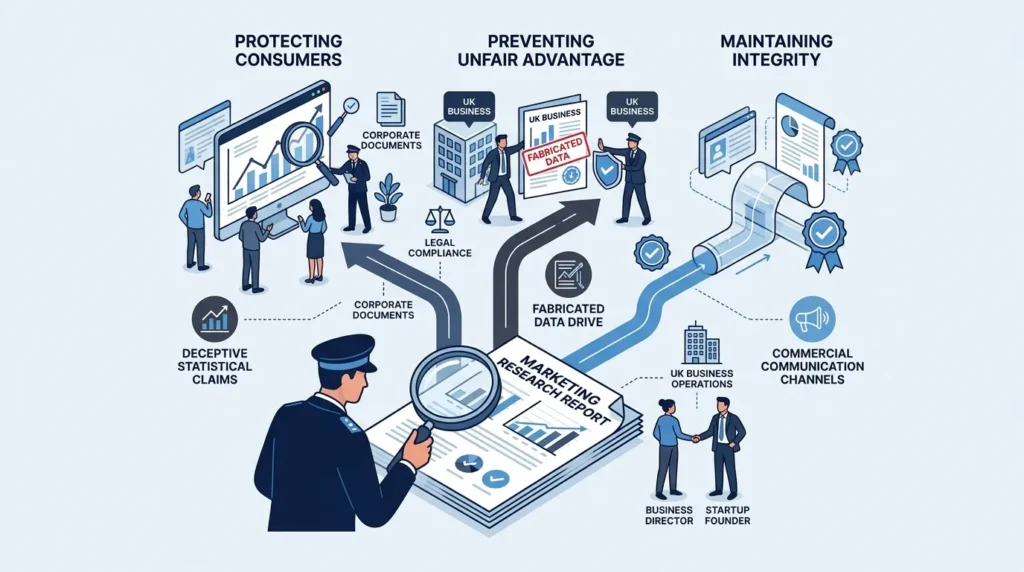
The regulatory framework governing commercial research in the United Kingdom relies on statutory legislation and self-regulatory codes. The Consumer Protection from Unfair Trading Regulations 2008 prohibits misleading omissions and false statements that distort consumer economic behavior. Meanwhile, the Committee of Advertising Practice writes the CAP Code, which the Advertising Standards Authority administers. Under Section 3 of the CAP Code, marketers must hold documentary evidence before publishing claims that feature statistical support or survey results.
The Role of the Advertising Standards Authority
The Advertising Standards Authority acts as the primary arbiter of marketing truth in the United Kingdom. When a research report enters the public domain through press releases, white papers, or social media campaigns, it falls under the jurisdiction of the advertising codes if it influences transactional decisions.
- The Authority evaluates whether survey questions contain leading language that skews results toward a predetermined commercial outcome.
- The Authority checks if sample sizes meet statistical significance thresholds for the target demographic.
- The Authority verifies whether data collection dates reflect current market conditions rather than outdated historical trends.
Legal Implications of Unsubstantiated Claims
Publishing unverified statistics exposes corporations to legal liabilities beyond regulatory reprimands. The Competition and Markets Authority investigates misleading environmental and performance claims under consumer protection laws. If a brand publishes a research report claiming market leadership based on flawed methodology, competitors can initiate civil litigation for malicious falsehood or unfair competition. Maintaining strict evidentiary trails mitigates these commercial and legal risks.
Explore More Expert Insights:
How to Brief a UK Publisher for Sponsored Content That Feels Like Real Journalism
Sponsored Content Across 10 Verticals: UK Engagement Benchmarks 2026
How Can Marketers Audit and Verify Primary Data Sources Before Publication?
Marketers audit and verify primary data sources by cross-referencing raw survey outputs, validating sample demographic quotas against Office for National Statistics benchmarks, and confirming the exact statistical significance of every reported metric.
Rigorous data verification requires a multi-step auditing process before any research report reaches the design and publication phase. Marketers cannot rely on summary decks provided by third-party vendors without inspecting the underlying datasets. Every data point requires a traceable lineage from respondent input to final publication metric.
Sample Representation and Quota Management
A primary vulnerability in marketing research reports involves flawed sampling frames. If a survey claims to represent the entire United Kingdom population, the sample must reflect national demographic distributions across age, gender, socioeconomic grade, and regional geography.
- Analysts must cross-reference sample quotas with official Office for National Statistics datasets to ensure balanced representation.
- Researchers must document exclusion criteria clearly, detailing why specific respondents were removed from the final dataset.
- Data weighting formulas must be fully transparent, explaining how mathematical adjustments corrected minor demographic skews.
Statistical Significance and Margin of Error
Every quantitative claim must account for sampling error. A sample size of 1,000 respondents yields a standard margin of error at a 95 percent confidence level. If a report asserts a narrow percentage difference between two competing products, analysts must calculate whether that difference exceeds the margin of error. Publishing statistical noise as a definitive market trend violates both scientific integrity and advertising codes.
What Components Must Be Included in a Transparent Research Methodology Section?
A transparent research methodology section must include the exact field dates, complete wording of all survey questions, total sample sizes, response rates, incentive structures, and specific analytical models utilized to process the raw data.
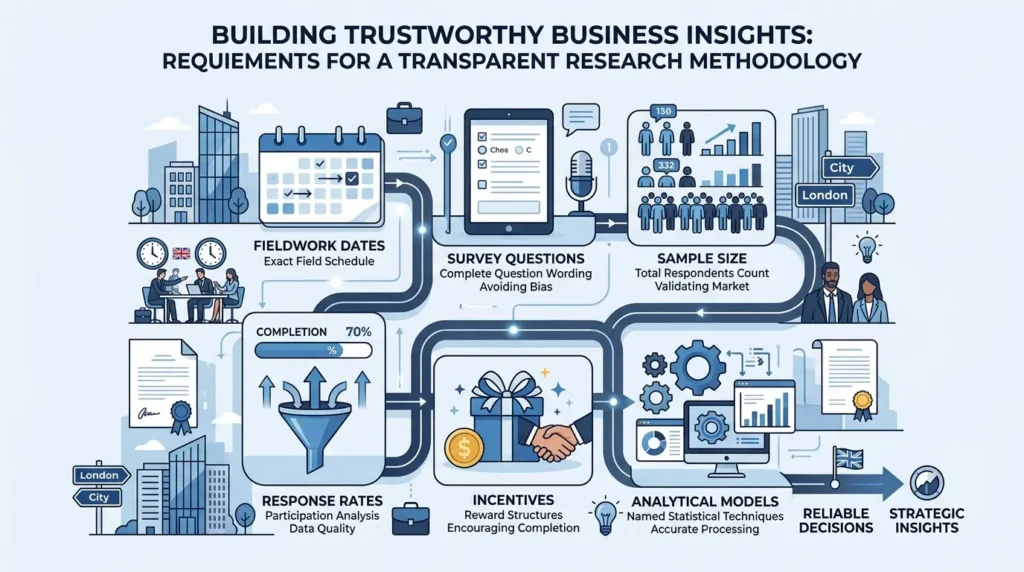
Transparency serves as the primary defense against regulatory scrutiny. When a research report includes a comprehensive methodology section, compliance officers, journalists, and regulators can independently replicate the analytical process. Omitting methodological details invites immediate suspicion and challenges from industry watchdogs.
Essential Methodological Disclosures
Marketers must embed specific operational details directly within the appendix or methodology notes of the report. Vague statements such as “based on a national survey of consumers” fail to meet compliance thresholds.
- Fieldwork Dates: The exact start and end dates of data collection, such as October 1, 2025, to October 15, 2025, demonstrate temporal relevance.
- Questionnaire Design: The precise sequence and phrasing of questions prevent accusations of bias or leading respondents.
- Incentive Disclosures: Details regarding financial or material incentives provided to survey participants ensure transparency regarding potential response biases.
The Role of Solution Frameworks in Research Integrity
Navigating complex data verification standards often requires specialized operational frameworks. Organizations seeking to streamline their compliance workflows can review structured approaches through What Do the UK Advertising Codes Expect When a Brand Cites Research Findings in Its Marketing to understand baseline industry requirements. Furthermore, brands managing high-volume data publications frequently utilize dedicated enterprise solutions such as Time Intelligence Media Group Research and Reports Services With Fully Sourced Findings to guarantee complete source traceability across all released assets.
How Can Brands Ensure Their Published Findings Withstand External Challenges?
Brands ensure their published findings withstand external challenges by archiving immutable audit trails, restricting data modifications, establishing pre-publication legal review protocols, and preparing comprehensive evidence dossiers for every published statistic.
Preparation is the final barrier against regulatory censure. When the Advertising Standards Authority launches an investigation following a competitor complaint, brands operate under strict response deadlines, typically seven to ten working days. Disorganized data storage during this window results in delayed submissions and potential rule breaches.
Archiving and Immutable Audit Trails
All research assets must be archived in read-only digital repositories immediately upon report publication. This includes raw CSV files, syntax scripts used in statistical software such as SPSS or R, and final PDF outputs. Preserving these files prevents accidental data corruption or unauthorized modifications post-publication.
Pre-Publication Compliance Checklists
Compliance teams must execute a systematic review of every statistical claim before public dissemination. Each claim requires a direct hyperlink or footnote linking to a specific row and column within the archived master dataset. If a claim cannot be traced instantly to an auditable data point, editors must remove the statistic from the report. This rigorous gating process guarantees that the final publication stands secure against any form of commercial or regulatory scrutiny.