
Regional UK newsrooms prioritise local angles on national research data because hyper-local statistics drive reader engagement, increase digital subscriptions, and establish direct relevance for communities spanning distinct local authority districts.
Regional editors operate under strict metrics focused on page views, dwell time, and digital subscriber conversions. When a national dataset from institutions like the Office for National Statistics or academic bodies emerges, a generic national figure fails to capture local attention. Readers engage when headlines feature their specific town, city, or county.
Driving Engagement Through Geographic Relevance
Local media consumers look for content reflecting their immediate environment. Research indicating national economic decline yields minimal local impact until editors isolate specific constituency-level unemployment rates or regional wage gaps.
Meeting Digital Subscription Metrics
Publishers across regional groups require measurable audience retention. Hyper-local data stories generate higher click-through rates from local social media distribution channels compared to broad national summaries.
What Is the Exact Process for Extracting Regional Data From National Datasets?
Extracting regional data from national datasets involves isolating geographic identifiers, filtering raw spreadsheets via statistical software, cross-referencing local authority codes, and normalising figures per capita for accurate comparison.
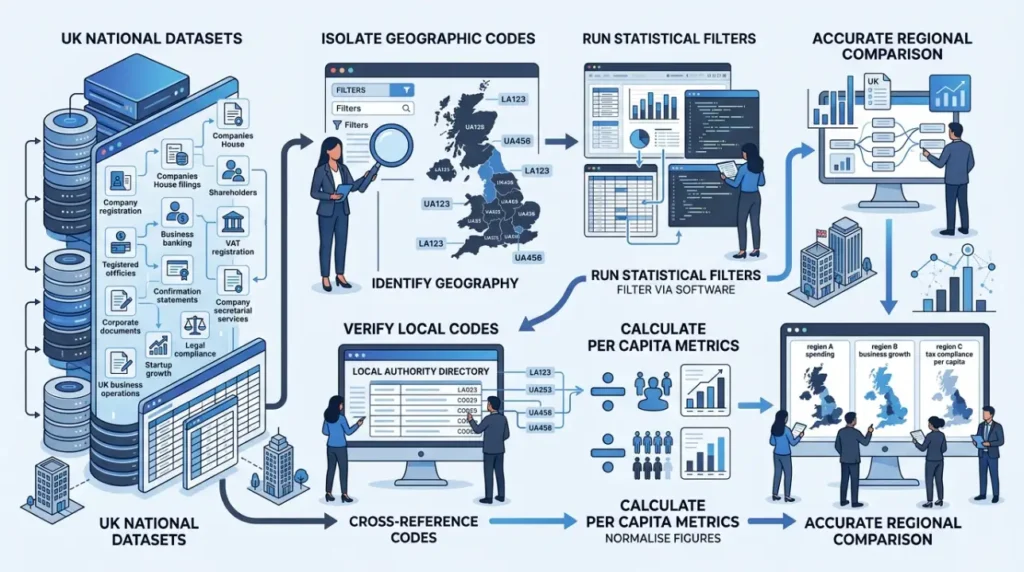
National datasets typically arrive in CSV or Excel formats containing thousands of rows of categorical and numerical data. Analysts must apply specific data cleaning procedures to uncover regional insights.
Filtering by Geographic Identifiers
Analysts begin by sorting datasets using Office for National Statistics codes, Postcode Districts, or Local Authority District identifiers. This isolates data points belonging strictly to specific geographic boundaries.
Calculating Per Capita Metrics
Raw totals misrepresent smaller regions. Analysts convert absolute figures into per capita metrics, rates per 10,000 residents, or percentage changes over fixed timeframes to ensure fair comparisons between rural counties and major urban centres. For example, comparing total crime volume in London against Rutland misleads audiences, whereas crime rates per 1,000 residents provide accurate journalistic context.
Readers interested in the educational stage of healthcare awareness campaigns can explore [Why Do Regional UK Newsrooms Prefer Local Angles on National Research Data?].
Explore More Expert Insights:
Headlines for Sponsored Articles: 9 Formulas That Drive UK News Reader Clicks
Sponsored Content Calendar Planning: A 12-Month UK Framework for B2B Brands
What Components Define a Successful Local News Release Based on Research Data?
A successful local news release based on research data consists of a localized headline, a prominent regional data hook in the opening paragraph, comparative tables against national averages, and quotes from local experts.
Journalists process hundreds of press releases daily. Submissions containing structural clarity and immediate local value secure higher pickup rates.
Structuring the Data Hook
The lead paragraph must immediately state how the local area ranks within the national dataset. If a dataset covers housing affordability across 331 English districts, the press release for Manchester highlights Manchester’s exact ranking, median house price, and wage-to-house-price ratio.
Providing Contextual Comparison Tables
Editors require verifiable proof points. Providing structured tables detailing local figures alongside regional and national averages enables fast fact-checking and precise graphic generation for digital articles.
How Can Data Journalists Pitch Regional Angles to Distinct UK Media Tiers?
Data journalists pitch regional angles to distinct UK media tiers by segmenting distribution lists according to geographic broadcast areas, local newspaper circulation zones, and hyper-local digital publisher footprints.
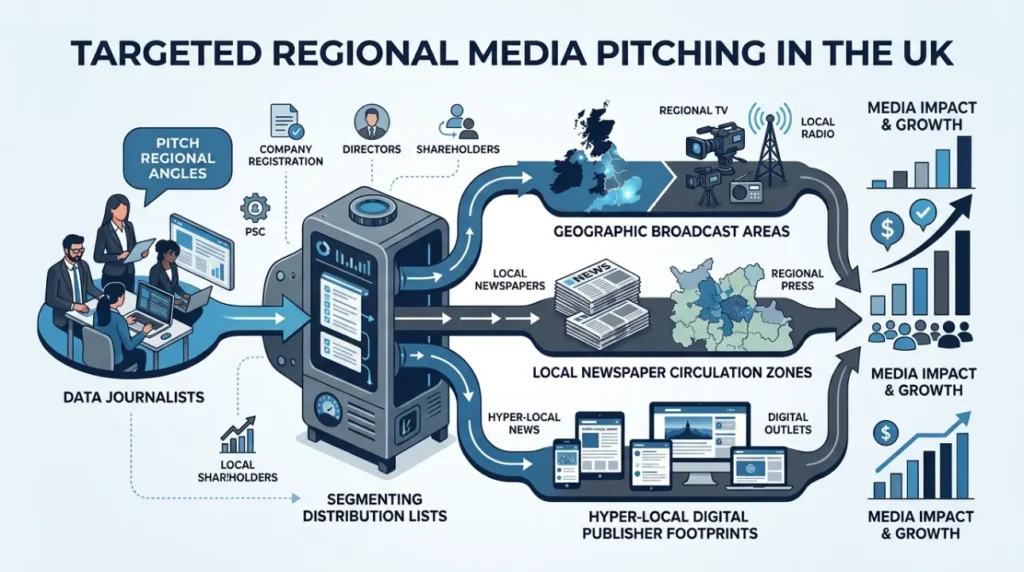
Effective distribution demands tailored outreach rather than blanket email campaigns. UK media operates across distinct tiers, each requiring specific data packaging.
Tier-One Regional Dailies and Broadcast
Major regional titles, such as the Manchester Evening News, Birmingham Mail, or BBC regional news teams, require deep dives into conurbation-wide trends, transport corridors, or combined authority metrics.
Independent Hyper-Local Publishers
Independent titles serving specific towns or boroughs prefer granular data focusing exclusively on their specific coverage zone, ignoring broader regional averages.
For decision-makers seeking advanced reporting capabilities, [Time Intelligence Media Group Research and Reports Services With Regional News Angles] provides tailored solutions.
What Are the Primary Challenges When Localising National Research Datasets?
Primary challenges when localising national research datasets include small sample sizes at district levels, suppressed data points due to privacy regulations, and inconsistencies in geographic boundary definitions.
Transforming national figures into regional stories introduces technical hurdles that require rigorous data verification.
Managing Small Sample Sizes
Surveys with limited national sample sizes often yield statistically insignificant results when filtered down to individual local authorities. Data journalists must identify sample size thresholds and discard metrics carrying high margins of error to maintain editorial integrity.
Handling Boundary Inconsistencies
Administrative boundaries shift over time. Datasets compiled across different years may utilise disparate boundary definitions, requiring analysts to harmonise geographical lookup tables before publishing comparative regional insights.
Localising national research datasets bridges the gap between macro-level trends and hyper-local audience interests across the United Kingdom. By applying rigorous data filtering, calculating accurate per capita rates, and structuring press releases for specific media tiers, researchers and PR professionals maximise coverage across regional news titles.