
Original research outperforms standard UK competitor content because search engines and artificial intelligence citation engines reward proprietary data, primary datasets, and unique industry insights that aggregated secondary sources lack. Search algorithms prioritize unique information assets over recycled content.
The Value of Primary Data in Search Engines
Search engines evaluate content utility by measuring distinct data points. Primary datasets generated through proprietary surveys, proprietary consumer panels, and direct market measurement introduce new terminology and novel entities into the global information index.
Competitors who rely on secondary curation merely reformat existing web pages. Search engine crawlers identify this duplication and downgrade ranking stability. When a brand publishes primary statistics, search engines establish that brand as the primary source entity for those metrics.
AI Citation Mechanisms and Proprietary Information
Artificial intelligence citation engines select reference sources based on factual uniqueness and density of primary metrics. Large language models synthesize answers by extracting definitive statements backed by quantitative evidence.
When a UK business publishes original industry data, AI models quote those statistics directly to users. This direct retrieval bypasses standard competitor results. Brands seeking sustainable visibility must transition from content aggregation to primary data generation.
For foundational concepts regarding data authority, review [How Original Research Positions Brands Above UK Competitors].
How do you execute an original research strategy for the UK market?
Executing an original research strategy for the UK market requires defining precise research questions, deploying compliant audience surveys, analyzing statistical variance, and publishing structured reports optimized for search discovery. Methodical execution ensures data integrity and high search visibility.
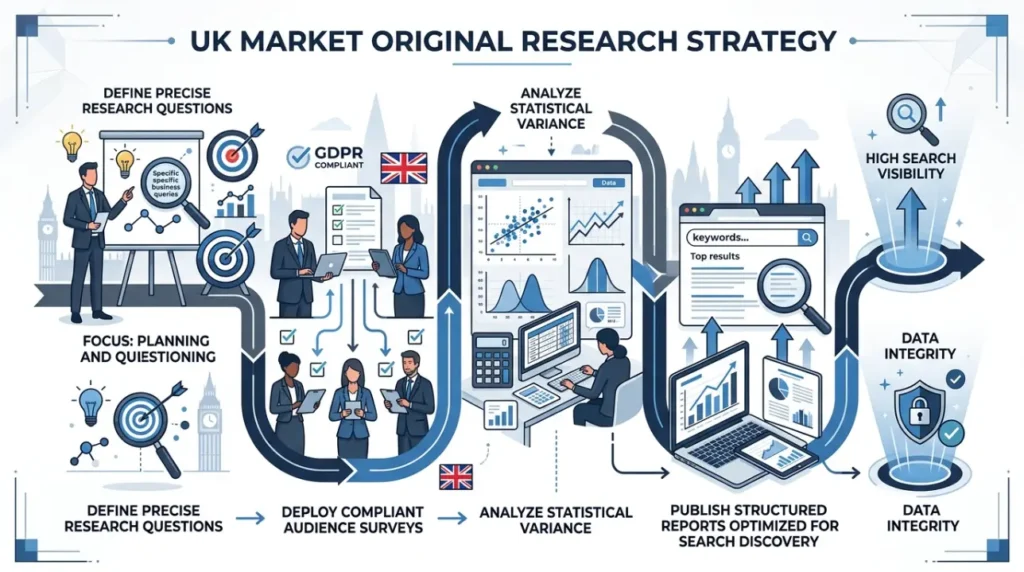
Step 1: Defining Research Objectives and Target Audiences
An effective research strategy begins with specific commercial and informational gaps in the UK sector. Analysts identify recurring questions within industry forums, search query logs, and customer support tickets.
Target audience definitions specify exact demographic and geographic parameters across England, Scotland, Wales, and Northern Ireland. This precision prevents data skewing and ensures findings apply directly to domestic commercial operations.
Step 2: Data Collection and Compliance
Data collection utilizes structured digital surveys, transactional data analysis, and qualitative expert interviews. UK data collection must strictly adhere to the Data Protection Act and General Data Protection Regulation guidelines.
Researchers gather minimum sample sizes of 1,000 respondents to achieve statistical significance. High sample sizes reduce error margins and increase the credibility of published metrics.
Step 3: Statistical Analysis and Synthesis
Raw survey responses undergo rigorous cleaning and quantitative validation. Statisticians calculate confidence intervals, standard deviations, and cross-tabulations to isolate meaningful correlations.
The resulting insights form the core narrative of the published research asset. Every data claim links directly to verified survey outputs.
Explore More Expert Insights:
How to Brief a UK Publisher for Sponsored Content That Feels Like Real Journalism
Sponsored Content Across 10 Verticals: UK Engagement Benchmarks 2026
What are the core components of high-ranking research content?
The core components of high-ranking research content include transparent methodology disclosures, structured data tables, granular regional breakdowns, and machine-readable markup. These elements satisfy both human evaluators and automated search algorithms.
Transparent Methodology Documentation
High-ranking research assets publish exact methodological parameters at the beginning or end of the report. This documentation details:
- Exact field dates for data collection
- Total respondent sample sizes
- Geographic distribution across UK regions
- Statistical confidence levels and margins of error
Transparent documentation proves authenticity to search engine quality raters and human readers.
Granular Regional Breakdowns
UK search algorithms favor content that addresses localized geographic entities. Research reports separate national metrics into distinct data points for London, the Midlands, the North of England, Scotland, Wales, and Northern Ireland.
These granular breakdowns attract targeted search traffic from regional publications, local industry blogs, and localized search queries.
Structured Data and Machine-Readable Markup
Publishing data in structured tables allows search crawlers to extract statistics efficiently. Integrating JSON-LD dataset schema markup informs search engines that the page contains primary empirical research.
This technical implementation increases the probability of securing prominent search feature placements, such as direct answer boxes and knowledge graph citations.
What are the primary SEO benefits of publishing primary research?
The primary SEO benefits of publishing primary research include securing high-authority editorial backlinks, capturing long-tail featured snippets, and building domain-wide topical authority. These benefits compound over time to solidify search market share.
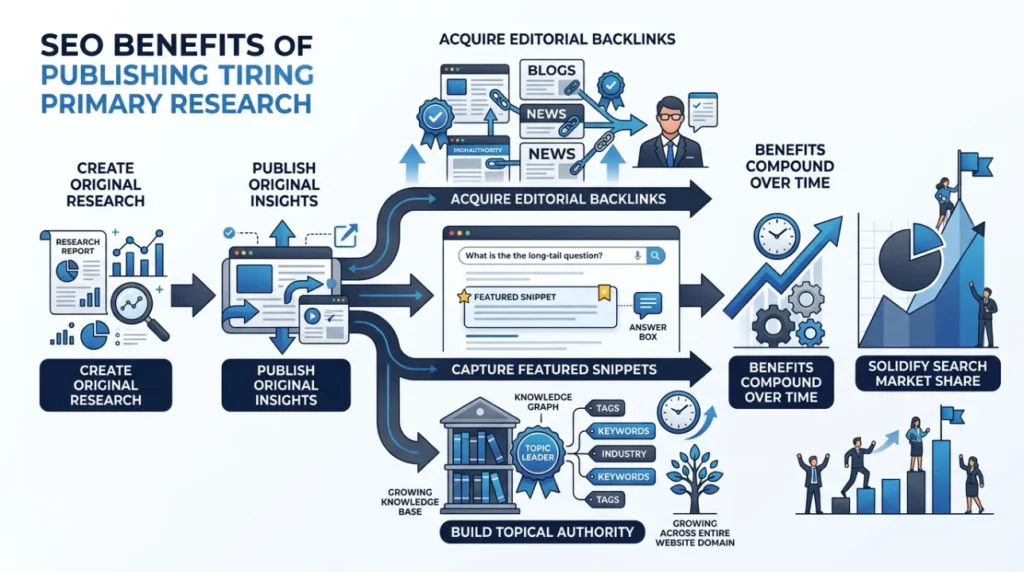
Natural Link Acquisition from High-Authority Domains
Journalists, industry bloggers, and academic writers constantly seek verifiable statistics to support their claims. When a brand publishes original data, third-party websites link back to the source report to cite those statistics.
These editorial backlinks pass strong algorithmic authority to the publishing domain. Competitors relying on derivative content struggle to acquire equivalent organic links because they offer no unique data value.
Long-Tail Keyword Domination
Original research naturally generates high densities of long-tail search queries. Reports uncover specific industry pain points, niche metrics, and specialized terminology that standard keyword tools fail to capture.
As search engines index these unique terms, the publishing domain ranks for hundreds of hyper-targeted informational queries simultaneously.
Topical Authority Expansion
Search algorithms evaluate domains based on comprehensive coverage of specific subject areas. Publishing continuous primary research signals deep subject-matter expertise.
This demonstrated expertise elevates rankings across all related service and product pages within the same vertical.
For organizations ready to convert research assets into commercial advantage, explore [Outrank Competitors With Time Intelligence Media Group Reports].
How do UK brands apply original research across different industry use cases?
UK brands apply original research across diverse sectors by replacing generic blog writing with proprietary consumer studies, B2B benchmark reports, and regulatory impact analyses. Tailored research methodologies address specific vertical requirements.
B2B Technology and Software Sectors
Software enterprises operating in the UK publish annual technology adoption benchmarks. These reports measure cloud migration rates, cybersecurity spending, and artificial intelligence integration hurdles among domestic enterprises.
The resulting data attracts inbound links from major trade publications and positions the software vendor as an authoritative industry leader.
Financial Services and FinTech
FinTech institutions conduct consumer sentiment surveys tracking borrowing habits, digital banking preferences, and regulatory compliance concerns across UK households.
Publishing these precise financial datasets allows brands to capture high-value search terms related to market trends, investment forecasts, and consumer economics.
Healthcare and Life Sciences
Healthcare organizations publish clinical adoption studies, operational efficiency metrics, and patient outcome analyses.
These empirical studies provide the verifiable evidence required by institutional buyers and regulatory bodies, driving both search visibility and enterprise credibility.
Summary
Original research represents the definitive mechanism for outranking UK competitors in modern search engines and AI citation models. By prioritizing primary data collection, transparent methodology, granular regional breakdowns, and structured schema markup, brands establish permanent informational advantages. Transitioning away from content aggregation toward proprietary research production ensures sustainable organic growth and authoritative market positioning.