
Quarterly report publishing by Time Intelligence Media Group is a specialized corporate communications service that transforms proprietary organizational data into media-ready research reports. It enables UK enterprises to establish authority, secure tier-one news coverage, and generate qualified commercial leads continuously.
Understanding Data-Driven Public Relations
Quarterly report publishing converts raw internal metrics, customer behavior data, and industry trends into structured market intelligence. Time Intelligence Media Group manages the entire lifecycle of these assets, ensuring each publication aligns with media standards and search engine indexing requirements.
Organizations in the United Kingdom face a saturated media landscape. Traditional press releases frequently fail to secure earned media coverage. Data-driven publications provide journalists with verifiable statistics, primary research, and objective market insights.
The Evolution of Strategic Media Placement
Modern corporate media strategy requires consistent publication schedules. Quarterly releases create a predictable cadence of brand visibility. Time Intelligence Media Group integrates Search Engine Optimization (SEO) and media distribution into every publishing framework.
By publishing four flagship research assets annually, companies maintain relevance across multiple news cycles. This continuous output builds long-term topical authority in both search engine results and national journalistic databases.
How Does the Quarterly Report Publishing Process Work?
The quarterly report publishing process follows a four-stage execution framework: data collection, editorial production, media distribution, and performance tracking. Time Intelligence Media Group completes this standard cycle within six weeks to ensure data freshness and timely news relevance.
Phase 1: Research and Strategy Formulation
The process begins by auditing internal data sources. Time Intelligence Media Group extracts anonymized metrics from platform databases, customer surveys, and operational logs.
- Identifying unique primary data points within the organization.
- Mapping data insights against current United Kingdom economic and sector news trends.
- Defining key performance indicators for media pickups and link acquisition.
- Establishing search intent target groups for digital indexing.
Phase 2: Editorial Production and Data Visualization
Raw metrics undergo rigorous statistical validation and narrative structuring. Technical writers transform data points into actionable market insights.
- Data Analysis: Data scientists structure datasets into clear statistical findings.
- Copywriting: Journalists draft report chapters adhering to declarative style guidelines.
- Visual Design: Information designers create publication-ready charts, infographics, and executive summaries.
- SEO Optimization: Digital strategists embed entity-rich vocabulary and target search queries.
Phase 3: Targeted Media Distribution and Syndication
Once finalized, the report is hosted on a custom media hub optimized for search engine crawlability. Time Intelligence Media Group then executes a multi-channel press campaign across United Kingdom media networks.
Phase 4: Performance Tracking and Lead Attribution
The final phase evaluates campaign performance against baseline metrics. Analytics platforms track referral traffic, earned media mentions, domain authority changes, and direct lead generation.
What Core Components Are Included in Every Quarterly Report?
Every quarterly report includes an executive summary, primary data visualizations, industry benchmarks, methodology documentation, and conversion-focused call-to-action sections. Time Intelligence Media Group structures these elements to maximize journalistic citations, reader engagement, and digital acquisition.
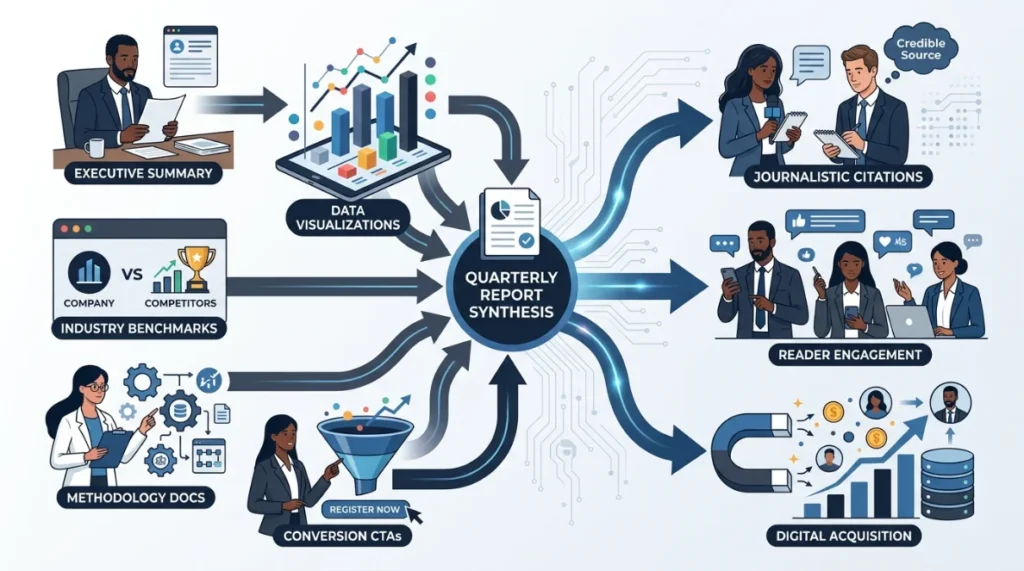
Executive Summaries for Rapid Consumption
Journalists and senior executives require rapid access to key statistics. The executive summary condenses complex research findings into concise, factual bullet points located on the first page of the publication.
- Headline statistics formatted for immediate press quotation.
- Core macroeconomic or sector-specific implications.
- Quarter-over-quarter growth and contraction metrics.
- Actionable takeaways for enterprise decision-makers.
Primary Data Visualizations
Visual assets increase content shareability and backlink acquisition. Data visualizations translate complex numerical trends into clear visual formats optimized for both print and digital publication.
| Visualization Type | Data Application | Journalist Utility |
| Comparative Bar Charts | Quarter-over-quarter percentage shifts | High (Immediate article embed) |
| Data Maps | UK regional distribution metrics | High (Geographic local coverage) |
| Trend Line Graphs | Multi-year longitudinal trajectory | Medium (Contextual background) |
| Sector Breakdowns | Industry segment market share | High (B2B sector analysis) |
Methodology and Citation Guidelines
Academic rigor and journalistic trust rely on complete methodology transparency. Each report contains a explicit technical section detailing sample sizes, survey dates, data cleaning protocols, and statistical margins of error.
Time Intelligence Media Group includes standard academic and newsroom citation templates within each report. Providing pre-formatted citations increases the likelihood of securing high-authority backlinks from news websites, educational institutions, and research repositories.
Digital Lead Generation Elements
Top-of-funnel public relations outputs must drive bottom-of-funnel commercial revenue. Reports incorporate gated downloadable PDF assets, embedded consultation scheduling tools, and strategic links.
Integrating structural links to strategic educational assets, such as [How Quarterly Reports Keep UK Brands in the News], bridges initial brand exposure with mid-funnel decision-making.
Explore More Expert Insights:
The 39% Quality Problem: Why Most UK Sponsored Content Fails to Convert in 2026
How Native Content on News Sites Earns 3× Longer Dwell Time Than Social Posts
Why Should UK Enterprise Brands Invest in Quarterly Reports?
UK enterprise brands invest in quarterly reports to build domain authority, secure earned national media coverage, establish thought leadership, and drive B2B lead pipelines. Time Intelligence Media Group delivers measurable commercial returns by aligning corporate data with public news agendas.
Earning Tier-One National Media Coverage
United Kingdom news publishers require objective data to support daily reporting. National news organizations, including The Financial Times, The Telegraph, and BBC News, routinely reference primary data sources.
Quarterly reports provide these outlets with non-promotional statistics. Brand mentions secured through data citations carry significantly higher trust ratings than paid advertising placements or standard commercial announcements.
Enhancing Search Engine Visibility and Entity Authority
Search engines prioritize websites that demonstrate expertise, experience, authoritativeness, and trustworthiness (E-E-A-T). Regular publication of primary research strengthens these digital signals.
- Acquiring natural backlinks from high-authority news domains.
- Establishing brand name co-occurrence with industry-specific entities.
- Capturing long-tail search traffic for sector statistics and trends.
- Accelerating domain authority growth through steady link acquisition.
Shortening the B2B Sales Cycle
Enterprise buyers require evidence of market expertise before engaging in procurement discussions. Quarterly research reports serve as high-value sales collateral during sales conversations.
Sales teams distribute these assets to prospects to validate market positioning. Demonstrating proprietary market knowledge builds trust, addresses prospect risk concerns, and accelerates contract signatures.
What Are the Primary Use Cases for Quarterly Media Reports?
Primary use cases for quarterly media reports include sector bench-marking, crisis communications mitigation, investor relations support, and inbound lead generation. Time Intelligence Media Group tailors report structures to address specific organizational goals across diverse commercial sectors.
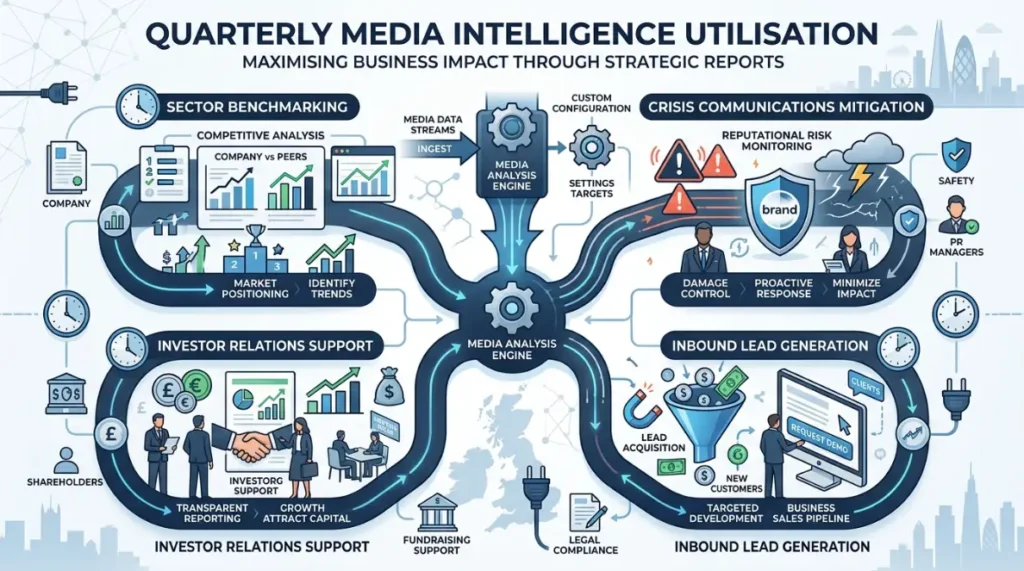
Use Case 1: Financial and Professional Services Benchmarking
Financial services firms utilize quarterly reports to track economic sentiment, consumer spending patterns, and market liquidity.
- Publishing quarterly lending indices to highlight market activity.
- Tracking institutional investor sentiment across key asset classes.
- Detailing regulatory compliance adoption rates among United Kingdom businesses.
- Providing authoritative metrics for financial news commentators.
Use Case 2: Technology and SaaS Growth Analytics
Software companies leverage platform data to publish industry usage trends. These reports establish software vendors as definitive authorities within their specific technology niches.
A cybersecurity platform, for example, can publish quarterly threat intelligence metrics detailing attack volumes across United Kingdom infrastructure sectors. This position establishes the vendor as an essential security infrastructure provider.
Use Case 3: Commercial Real Estate and Supply Chain Tracking
Logistics and property firms use quarterly data releases to map industrial space utilization, commercial lease rates, and supply chain lead times.
By releasing regional performance metrics every three months, these organizations capture continuous local and national trade press coverage. Understanding how to execute [Why Quarterly Reports Keep UK Brands Relevant in the News Cycle] ensures these publications achieve maximum visibility across regional and national outlets.
How Does Time Intelligence Media Group Drive Measurable Commercial Results?
Time Intelligence Media Group drives commercial results by combining journalistic production standards with targeted digital distribution systems. The firm guarantees structured data positioning, tier-one PR execution, and direct integration with corporate inbound revenue engines.
Full-Service Data Engineering and Editorial Execution
Managing research projects internally strains corporate marketing resources. Time Intelligence Media Group executes the complete production workflow, eliminating internal operational bottlenecks.
The publishing team consists of experienced financial journalists, statistical analysts, graphic designers, and technical SEO specialists. This multidisciplinary structure ensures every report meets newsroom publication standards and corporate messaging objectives.
Proprietary Media Syndication Networks
Time Intelligence Media Group maintains active relationships with journalists, editors, and industry analysts across the United Kingdom.
- Direct outreach to journalists covering specific business beats.
- Syndication across wire services and digital research repositories.
- Targeted distribution to industry newsletter editors and podcast hosts.
- Social amplification campaigns targeting executive decision-makers.
Direct Integration with Enterprise Conversion Funnels
Public relations activities must demonstrate clear attribution to revenue metrics. Time Intelligence Media Group designs quarterly report ecosystems that convert anonymous news readers into qualified commercial leads.
Digital media hubs feature embedded analytics, progressive profiling forms, and automated lead-nurturing triggers. Sales teams receive real-time notifications when target accounts download research publications.
Maximize Corporate Authority with Time Intelligence Media Group
Continuous media visibility requires a structured data strategy. Enterprise organizations in the United Kingdom rely on primary research assets to control sector narratives, secure high-authority press mentions, and acquire commercial clients.
Time Intelligence Media Group provides the technical expertise, editorial precision, and distribution networks necessary to convert organizational data into market dominance.
Contact Time Intelligence Media Group today to schedule a strategic media consultation and launch your quarterly report publishing framework.