
A UK sector research report is a structured, data-driven publication that analyses trends, policy impacts, workforce dynamics, or operational performance across primary, secondary, further, and higher education institutions in the United Kingdom to inform institutional strategy and sector governance.
Education providers, research bodies, and policy organisations produce these reports to capture original empirical data. Sector research synthesises quantitative metrics, such as enrollment figures, financial performance indicators, and graduate outcomes, alongside qualitative insights from educators, administrators, and students.
Primary Characteristics of Sector Reports
A standard education report contains distinct structural components designed to validate findings:
- Empirical Methodology: Standardised methodologies, such as surveys distributed to 1,500 school leaders or longitudinal tracking of 50,000 university graduates, ensure statistical validity.
- Sector Benchmarks: Reports compare performance metrics across regions, such as comparing further education funding allocation in Yorkshire with funding allocation in the West Midlands.
- Policy Analysis: Reports evaluate the direct consequences of government regulations, such as statutory updates from the Department for Education (DfE) or assessment updates from Ofsted.
Common Formats and Distribution Standards
Education research reports exist in digital formats, primarily structured PDF documents and interactive web dashboards. Institutions release these publications on predetermined schedules aligned with the UK academic calendar, such as the start of the autumn term in September or the end of the financial year in April.
How Do Education Providers Conduct Sector Research Projects?
Education providers conduct sector research projects through a structured five-stage process comprising project scoping, quantitative and qualitative data collection, rigorous analytical verification, report compilation, and targeted peer-reviewed or public distribution across established media and institutional channels.
The operational execution of research requires dedicated resources and clear methodological frameworks to ensure the final output withstands public, academic, and governmental scrutiny.
Step 1: Project Scoping and Hypothesis Definition
Research initiatives begin by identifying specific knowledge gaps within the UK education landscape. Research teams outline clear objectives, such as measuring the adoption rate of artificial intelligence tools in 200 secondary academies. Stakeholders define target demographics, sample sizes, and required confidence intervals before gathering data.
Step 2: Methodological Design and Data Collection
Researchers employ two primary collection methods:
- Quantitative Data Gathering: Automated surveys, statistical extractions from the Higher Education Statistics Agency (HESA) database, and public sector information requests under the Freedom of Information Act 2000.
- Qualitative Data Gathering: Structured interviews with headteachers, focus groups with university vice-chancellors, and observational case studies within active learning environments.
Step 3: Analytical Verification and Data Synthesis
Data analysts process raw dataset outputs using statistical software tools. The analysis isolates variables, identifies statistically significant correlations, and eliminates confounding factors. Peer review teams verify that all findings align with standard statistical practices.
Step 4: Publication and Strategic Dissemination
Once verified, writers synthesize the findings into formal report structures featuring executive summaries, data visualisations, and actionable recommendations. Distribution teams then package these insights into press releases, policy briefings, and academic submissions.
Explore More Expert Insights:
How Financial Services Build Trust Using Educational Banner Advertising
How Agencies Increase Buyer Engagement Using Display Remarketing Ads
What Key Components Make an Education Research Report Effective?
An effective education research report requires a clear methodology, verifiable primary data, accessible visual presentation, rigorous peer-reviewed analytical frameworks, precise contextual definitions, and evidence-based policy recommendations designed to inform institutional decision-makers and regional authorities.
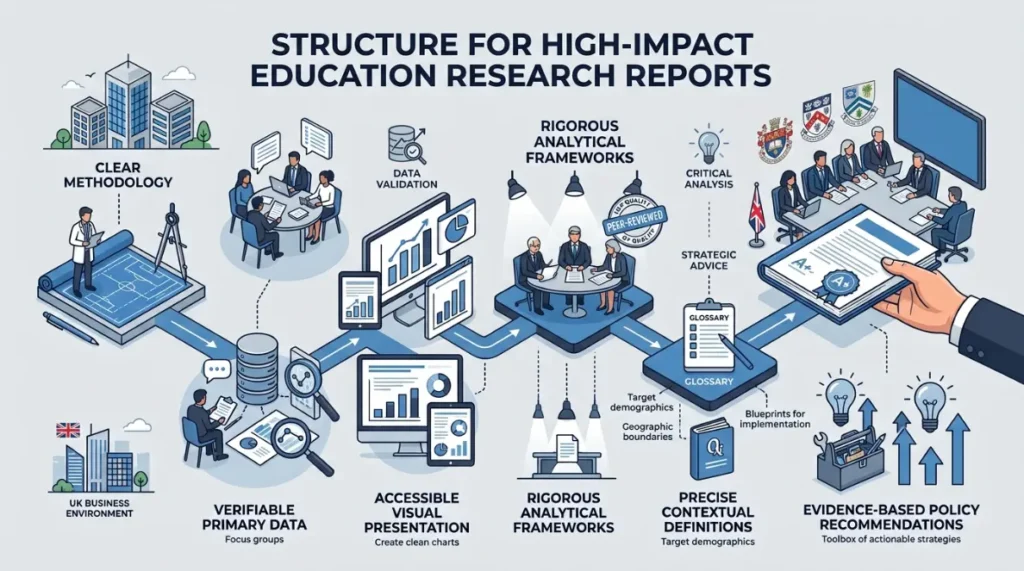
Without structural clarity, research fails to achieve the authority required to influence UK education policy or secure media engagement.
Essential Structural Components
Every published report relies on standard components to organize complex datasets:
- The Executive Summary: A concise overview containing the top 5 to 10 statistical findings, written for rapid comprehension by government officials and media editors.
- Methodology Statement: A dedicated section disclosing sample sizes, response rates, margin of error calculations, and potential survey limitations.
- Data Visualisation Frameworks: Charts, maps, and tables that present longitudinal comparisons, such as a bar chart tracking teacher retention rates over a 10-year period from 2014 to 2024.
- Actionable Policy Recommendations: Specific, clear statements directing actions for governing bodies, local authorities, or university leadership teams.
Precision in Language and Entity Definition
Effective reports avoid ambiguous phrases. Terms such as “academy trusts,” “further education colleges,” “Office for Students (OfS),” and “National Governance Association” are defined precisely to ground the research in the specific legal and regulatory contexts of the UK education system.
Why Do Education Providers Invest in Sector Research Reports?
Education providers publish sector research reports to establish institutional authority, influence government policy decisions, secure strategic funding, drive media visibility, support institutional recruitment goals, and provide baseline operational benchmarking data for leaders across the UK education sector.
Publishing sector research serves direct strategic objectives for institutions operating in a competitive national and international landscape.
Establishing Thought Leadership and Domain Authority
Institutions that publish original datasets position themselves as authoritative sources of domain knowledge. When a university releases a definitive study on early years literacy interventions, that institution becomes the standard reference point for subsequent academic literature and public discourse.
Influencing UK Public Policy and Regulatory Frameworks
Evidence-based reports provide parliamentarians, civil servants, and committees with the data needed to draft legislation and refine regulations. Submitting empirical data to parliamentary select committees allows education providers to directly shape funding formulas and assessment criteria.
Enhancing Institutional Reputation and Media Exposure
National news outlets prioritize stories backed by original empirical research. Reports containing statistics on workforce challenges, funding deficits, or student demographic shifts regularly secure coverage in major UK publications, increasing institutional visibility without direct advertising expenditure.
Understanding [how education research gets covered on UK news sites] enables research institutions to structure their findings for maximum journalistic reach and public clarity.
How Is Research Data Used Across Different Education Sectors?
Research data is used across primary, secondary, further, and higher education sectors to optimise curriculum design, allocate financial resources, manage workforce recruitment, update governance standards, and improve student retention rates through evidence-based operational interventions.
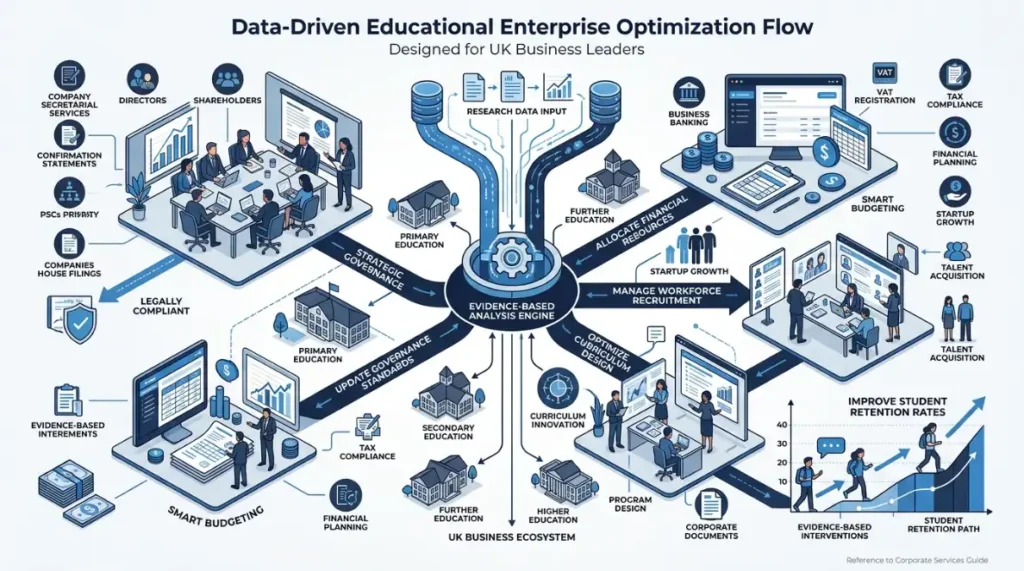
The application of research findings varies depending on the specific structural priorities of each educational tier.
Primary and Secondary Education (K-12)
Multi-Academy Trusts (MATs) and local authority schools utilize research reports to refine instructional strategies and resource distribution:
- Curriculum Development: Adopting evidence-based literacy programmes validated by national pilot studies.
- Resource Allocation: Redirecting Pupil Premium funds toward interventions proven to narrow the attainment gap for disadvantaged students.
- Workforce Retention: Implementing workload management structures derived from national teacher burnout surveys.
Further Education (FE) and Vocational Training
Colleges use sector research to align technical training programmes with regional economic requirements:
- Skills Gap Analysis: Adjusting apprenticeship course availability to match local labor market data published by Regional Skills Partnerships.
- Capital Investment: Securing infrastructure grants by presenting demographic growth projections and local industrial demand data.
Higher Education (HE) Institutions
Universities utilize sector research to navigate international student recruitment trends, research grant allocations, and graduate employability metrics:
- Global Student Mobility: Adjusting international recruitment strategies based on foreign enrollment data and visa policy updates.
- Graduate Outcome Optimization: Modifying degree course structures based on employer satisfaction surveys tracking long-term career outcomes.
Organizations seeking to maximize the reach and policy impact of their findings often collaborate with specialist publishing partners. Strategic execution services, such as those provided via [education sector reports by Time Intelligence Media Group], help institutions design, publish, and distribute high-impact research to key stakeholders across the United Kingdom.
Summary of Education Sector Research Dissemination
Sector research reports remain a primary mechanism through which UK education providers generate societal impact, demonstrate institutional value, and guide the strategic direction of the national learning ecosystem. By transforming raw operational data into rigorous public research, institutions directly contribute to the evidence base that drives educational standards, institutional performance, and national policy across the United Kingdom.