
Legal Sector Reports by Time Intelligence Media Group are high-authority B2B research publications designed to position United Kingdom law firms as market leaders. These reports analyze industry trends, provide regulatory insights, and distribute data across major national legal and business media.
Definition and Core Purpose
Time Intelligence Media Group produces data-driven intelligence tailored to the UK legal market. These reports transform complex legal data, market surveys, and regulatory updates into structured intelligence documents. Law firms use these publications to demonstrate deep practice-area expertise to corporate buyers, institutional investors, and high-net-worth clients.
The primary objective of these reports is to bridge the gap between technical legal knowledge and commercial media reach. By leveraging proprietary research frameworks, the publication establishes verifiable thought leadership. This positioning enhances direct client trust and drives high-value instruction lead generation.
Target Audience and Market Coverage
The reports target key decision-makers across the United Kingdom business landscape. Primary readers include in-house general counsel, chief executive officers, chief risk officers, and institutional investors.
Coverage spans major commercial legal disciplines across key UK economic hubs, including London, Manchester, Edinburgh, and Birmingham:
- Corporate Mergers and Acquisitions (M&A)
- Commercial Real Estate and Planning
- Financial Services Regulation and Compliance
- Intellectual Property and Data Privacy
- Employment Law and ESG (Environmental, Social, and Governance) Strategy
How does the publishing process for legal sector reports work?
The publishing process involves five sequential stages: research design, data collection, analytical review, editorial production, and targeted media syndication. Time Intelligence Media Group executes each phase to ensure institutional-grade research standards and maximum legal industry distribution.
Phase 1: Research Design and Methodology Setup
Every report begins with defining a specific market hypothesis or regulatory focus area. The analytical team outlines quantitative metrics and qualitative indicators relevant to UK legal practices.
- Framework Definition: Establishing primary research parameters, regulatory reference points, and market survey questions.
- Dataset Construction: Aggregating baseline data from public legal records, corporate filings, and industry databases.
Phase 2: Data Collection and Expert Interviews
Data collection combines primary field research with secondary legal analytics. Researchers survey senior partners, in-house legal teams, and corporate directors across the UK.
- Quantitative surveys measure market sentiment, legal spend, and risk allocations.
- Qualitative interviews capture nuanced commentary on emerging legal precedents and statutory shifts.
Phase 3: Analysis, Editorial, and Distribution
Raw data undergoes rigorous statistical validation and expert commentary integration. Editorial teams format the findings into structured, readable chapters supported by visual data charts. Once finalized, the distribution engine launches multi-channel syndication.
Reports are distributed directly to tier-one legal news outlets, financial publications, and industry-specific trade media. Digital copies are hosted on high-authority media hubs to optimize organic search visibility and digital citation.
What are the key components of a high-impact legal report?
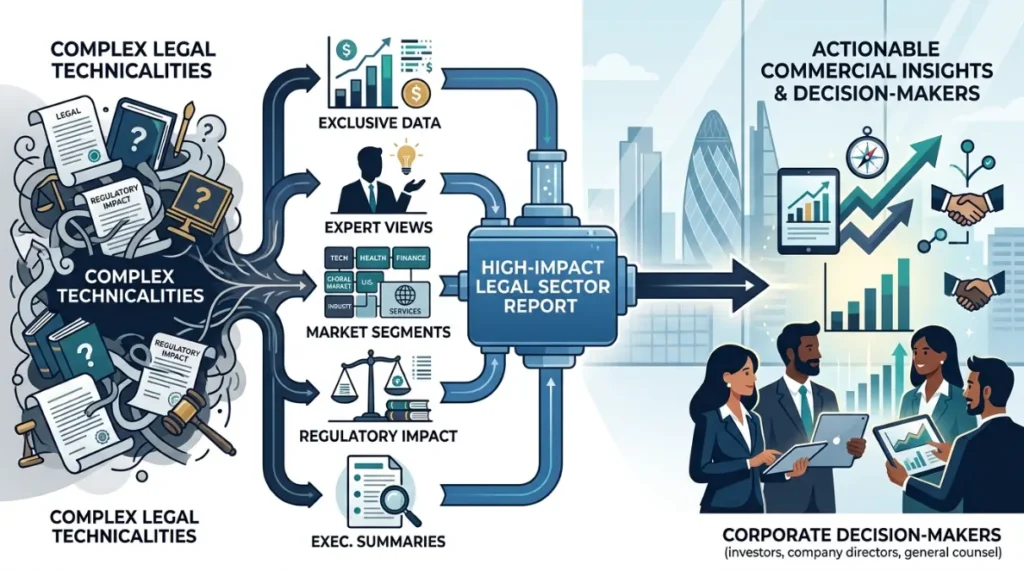
A high-impact legal sector report contains proprietary quantitative data, authoritative commentary, structured market segments, regulatory impact analyses, and clear executive summaries. These elements turn complex legal technicalities into actionable commercial insights for corporate decision-makers.
Empirical Data and Analytical Depth
Data forms the foundation of authority. Reports must contain original statistics rather than recycled third-party observations. Proprietary survey results, deal volume metrics, and litigation statistics validate the publication’s core arguments.
Visual data displays—such as market share tables, cross-border deal matrices, and regulatory compliance timelines—allow readers to process complex statistics quickly.
Expert Partner Commentary
Raw numbers require legal context. Authoritative reports integrate direct quotes and analytical commentary from subject-matter experts and law firm partners.
Including commentary from recognized practitioners anchors the research in real-world legal practice. This structure directly supports law firms seeking to highlight their specific capabilities in complex sectors like corporate restructurings or cross-border disputes.
Clear Regulatory Impact Assessments
UK corporate buyers require direct insights into how statutory changes affect operational risk. High-impact reports dedicate focused sections to breaking down specific legislation, such as the UK Procurement Act or updated Financial Conduct Authority (FCA) compliance frameworks. These assessments detail exact compliance steps, risk factors, and timeline enforcement dates.
Explore More Expert Insights:
Why Brands That Publish on News Sites Build Trust Faster Than Those on Social Only
The 39% Quality Problem: Why Most UK Sponsored Content Fails to Convert in 2026
What specific business benefits do law firms gain from these reports?
Law firms gain enhanced brand authority, premium media exposure, improved organic search rankings, and direct commercial client acquisition. Participating in Legal Sector Reports by Time Intelligence Media Group provides verifiable external validation that separates top-tier firms from competitors.
Authority Building and Media Recognition
Publishing proprietary legal research establishes direct thought leadership. National business press and legal trade journals routinely cite structured research reports. This media pickup generates high-value press mentions and positions firm partners as go-to commentators for broadcast and print journalism.
- Direct citations in top-tier financial press outlets.
- Increased invitations to speak at major industry conferences and trade summits.
- Enhanced credibility during competitive pitches and panel reviews.
To understand how research drives market reputation, explore [Why Legal Firms Use Research Reports to Build Authority].
Search Engine Dominance and Entity Authority
Search engines prioritize websites that demonstrate experience, expertise, authoritativeness, and trustworthiness. Research reports generate deep semantic relevance around specific legal entities, practice areas, and regulatory terms.
Digital versions of these reports attract authoritative backlinks from legal publishers, academic institutions, and corporate news outlets. This inbound link equity elevates the overall domain authority of participating law firms, driving higher organic rankings for lucrative practice-area keywords.
Direct Lead Generation and Client Conversion
Commercial clients prefer hiring firms that demonstrate proactive market intelligence. Distributing research reports to prospective corporate clients serves as a warm, high-value outreach strategy.
| Benefit Category | Direct Impact on Law Firm Performance |
| Client Outreach | Replaces cold prospecting with high-value educational content. |
| Sales Cycle Speed | Pre-educates buyers, reducing friction during instruction pitches. |
| Fee Justification | Validates premium billing rates through proven technical expertise. |
| Cross-Selling | Introduces existing clients to additional practice areas via report coverage. |
How do commercial organizations use these reports for decision-making?
Commercial organizations use legal sector reports to benchmark risk, prepare for regulatory changes, evaluate external legal counsel, and guide M&A activity. These publications provide corporate boards with objective external data to justify strategic compliance and operational decisions.
Risk Management and Statutory Compliance
Corporate directors operate under strict fiduciary duties to manage enterprise risk. Legal sector reports provide structured summaries of enforcement trends, penalty thresholds, and litigation risks across the United Kingdom.
- Compliance Auditing: Chief risk officers use report benchmarks to evaluate internal compliance programs against industry standards.
- Resource Allocation: Legal departments use market data to determine whether to resolve regulatory challenges internally or instruct external panel counsel.
Vendor Evaluation and Legal Panel Selection
Procurement departments and general counsel use structured sector reports to evaluate external law firms. Instead of relying solely on directory listings, corporate buyers assess firms based on the analytical depth of their published research.
To analyze how structured research moves through distribution networks to reach these buyers, review [How Legal Research Reports Reach UK Professional Media].
Strategic M&A and Market Expansion
Investment firms and corporate development teams rely on legal reports during pre-transaction planning. Reports covering M&A trends highlight potential regulatory hurdles, merger control scrutiny, and sector-specific deal structures. This intelligence helps acquirers price risk accurately before initiating formal due diligence.
How can UK law firms commission a sector report with Time Intelligence Media Group?
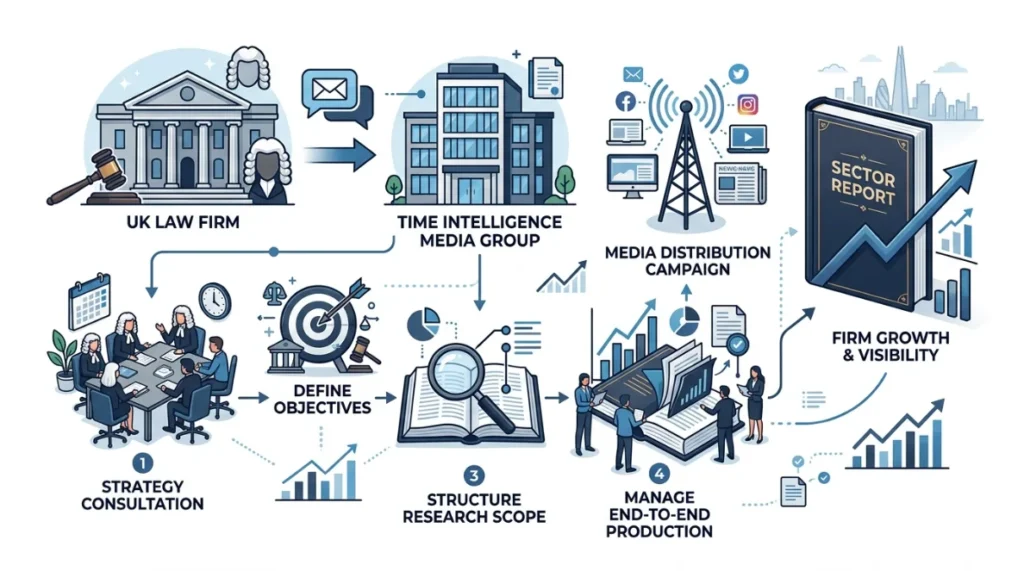
UK law firms can commission a sector report by contacting Time Intelligence Media Group to schedule an initial strategy consultation. The team defines practice-area objectives, structures the research scope, and manages the end-to-end production and media distribution campaign.
Step 1: Strategic Alignment and Scope Definition
The process begins with an alignment meeting to select target practice areas, target industries, and distribution goals. Time Intelligence Media Group collaborates with firm leadership to identify high-value market topics that resonate with target corporate buyers.
- Selection of specific regulatory or market focus areas.
- Identification of target audience personas across the United Kingdom.
- Establishment of clear project timelines and media release schedules.
Step 2: Research Execution and Content Co-Creation
Time Intelligence Media Group handles research administration, data gathering, and statistical analysis. Participating law firm partners provide expert commentary and review draft sections to ensure total alignment with firm positioning and legal accuracy.
Step 3: Media Distribution and Performance Tracking
Upon completion, Time Intelligence Media Group launches the coordinated syndication campaign. The publication is pushed directly across national media networks, legal industry platforms, and targeted digital channels. Commissioning firms receive detailed distribution analytics tracking media pickup, readership engagement, and digital reach metrics.
To commission a custom research publication and secure targeted media reach across the UK legal landscape, engage directly with [Legal Sector Reports by Time Intelligence Media Group] today.