
A sustainability report is a formal public disclosure detailing an organisation’s environmental, social, and governance performance. It functions as a standardized communication tool that translates corporate sustainability initiatives into verifiable quantitative data for investors, regulators, consumers, and commercial partners.
Core Purpose of Corporate Disclosures
Corporate disclosures provide transparency regarding a business’s operational impacts. Organizations release these documents annually to measure internal metrics, track long-term progress, and align commercial operations with national regulatory frameworks. In the United Kingdom, disclosure frameworks allow stakeholders to evaluate operational risks and opportunities outside of traditional financial reporting.
Primary Reporting Frameworks
Reporting frameworks standardise metrics so stakeholders can compare performance across different entities. The main international and national standards include:
- Global Reporting Initiative (GRI): Standardises disclosures on economic, environmental, and social impacts for multi-stakeholder audiences.
- Task Force on Climate-related Financial Disclosures (TCFD): Focuses on climate-related financial risk disclosures for investors and financial institutions.
- International Sustainability Standards Board (ISSB): Sets global baselines for sustainability disclosures to satisfy capital market requirements.
- UK Corporate Governance Code: Directs premium-listed companies on governance standards, board accountability, and ethical practices.
How Do Sustainability Reports Build ESG Credibility for Brands?
Sustainability reports build ESG credibility by providing third-party verifiable metrics that reduce greenwashing risks. Standardized disclosures demonstrate operational transparency, establish executive accountability, and show compliance with statutory reporting standards, which reassures investors, business partners, and retail consumers.
Mitigating Greenwashing Risks
Unsubstantiated environmental claims harm brand equity. Sustainability reports require structured data points, audit trails, and third-party assurance statements to validate performance assertions. When a brand publishes raw performance numbers alongside clear methodologies, it mitigates greenwashing allegations.
Regulatory Compliance and Market Access
Compliance with national disclosure standards signals institutional reliability. Companies in the UK operating under mandatory climate reporting legislation establish immediate market credibility by adhering to statutory requirements. Demonstrating compliance ensures continuous access to capital markets, public sector procurement processes, and corporate supply chains.
Investor and Stakeholder Trust
Institutional investors integrate environmental, social, and governance performance factors into valuation models. Transparent reporting provides capital allocators with the necessary data to assess long-term operational resilience, transition risks, and governance quality. Consistent disclosures reduce perceived investment risk and lower the cost of capital.
What Are the Key Components of an Effective Sustainability Report?
An effective sustainability report includes double materiality assessments, audited carbon accounting metrics, quantitative social impact data, and documented corporate governance structures. These core elements guarantee that disclosures remain precise, complete, actionable, and fully compliant with internationally recognised ESG standards.
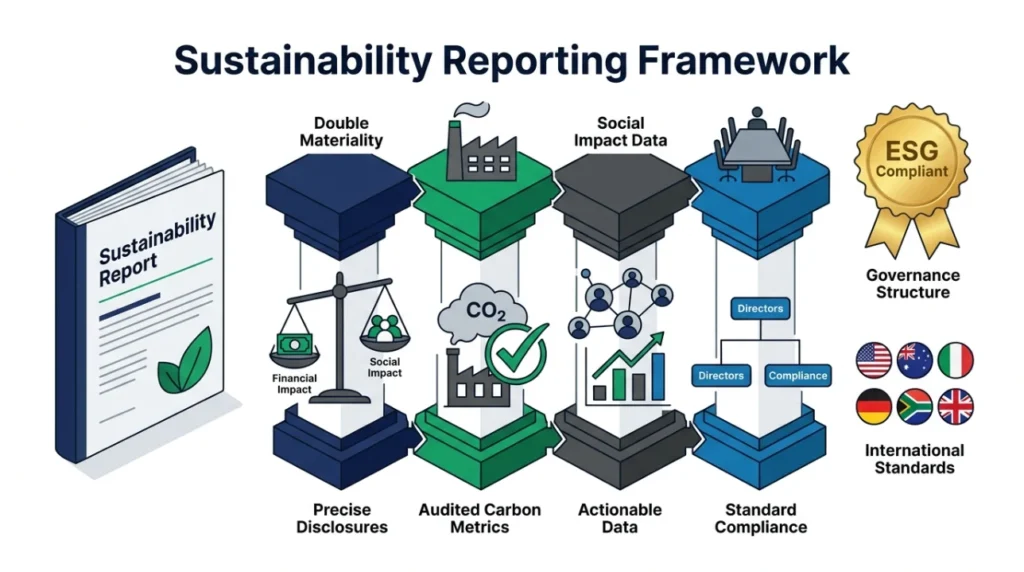
Double Materiality Assessments
Double materiality assesses two distinct perspectives: financial materiality and impact materiality. Financial materiality evaluates how sustainability issues affect a company’s economic value. Impact materiality measures how a company’s operations affect external environments and society.
| Materiality Type | Focus Area | Primary Audience |
| Financial Materiality | External ESG risks affecting corporate enterprise value | Investors, Lenders, Insurers |
| Impact Materiality | Corporate operational impacts on environment and society | Regulators, Communities, Consumers |
Quantitative Environmental Metrics
Environmental disclosures require precise numerical data rather than vague policy commitments. Key metrics include:
- Scope 1 Emissions: Direct greenhouse gas emissions from owned or controlled assets, such as manufacturing plants or commercial vehicle fleets.
- Scope 2 Emissions: Indirect emissions from the generation of purchased electricity, steam, heating, and cooling consumed by the reporting entity.
- Scope 3 Emissions: All other indirect emissions occurring across the upstream and downstream value chain, including business travel and waste disposal.
- Resource Efficiency Units: Standardised volume measurements of total water consumption, waste generation, and material recycling rates.
Social and Governance Disclosures
Social disclosures track human capital management metrics. These include gender pay gap figures, occupational health and safety statistics, employee turnover rates, and supply chain labour audits.
Governance disclosures detail board diversity metrics, executive remuneration structures, anti-corruption policies, and risk management systems. Clear governance disclosure proves that executive oversight guides the execution of corporate strategy.
Explore More Expert Insights:
How Online Retailers Recover Abandoned Carts Using Banner Advertising
How E-commerce Stores Boost Sales Using Retargeting Banner Ads
How Does the Sustainability Reporting Process Work?
The sustainability reporting process follows a structured six-step workflow: setting boundaries, conducting stakeholder materiality assessments, collecting and auditing data, selecting recognized disclosure frameworks, drafting narrative disclosures, and securing external assurance from independent auditors prior to public release.
Step-by-Step Reporting Workflow
1.Establish Reporting Boundaries:Define operational and organizational limits.
Define organizational boundaries by determining which subsidiaries, facilities, and joint ventures fall under the scope of the report. Select the historical baseline year against which all future environmental and social progress will be measured.
2.Conduct Materiality Assessments:Engage key internal and external stakeholders.
Survey internal executive teams, institutional investors, key suppliers, and regulatory bodies to identify significant sustainability priorities. Rank these issues using a formal materiality matrix based on financial and societal impact.
3.Collect and Verify Data:Aggregate internal operational metrics.
Gather raw data across all business operations, including utility invoices, fuel receipts, human resources records, and procurement logs. Apply verified calculation methodologies to translate raw inputs into standardised metrics.
4.Select Reporting Frameworks:Align content with global standards.
Choose the appropriate reporting standards based on statutory requirements and target audience expectations. Align metrics directly with recognized templates from GRI, TCFD, or the ISSB.
5.Secure External Assurance:Engage independent third-party auditors.
Submit collected metrics, calculation methodologies, and underlying data sources to an independent auditor. Receive a limited or reasonable assurance statement confirming data accuracy and compliance with reporting guidelines.
6.Publish and Communicate:Distribute finalized disclosures.
Format the verified disclosures into accessible digital formats. Publish the finalized document publicly on corporate channels to ensure complete stakeholder transparency.
How Do UK Regulations Influence Brand ESG Credibility?
UK regulations directly impact ESG credibility by establishing legally binding disclosure mandates for large organizations. Statutory frameworks remove voluntary reporting ambiguities, penalize deceptive practices, and enforce audited transparency standards across corporate supply chains and capital markets.
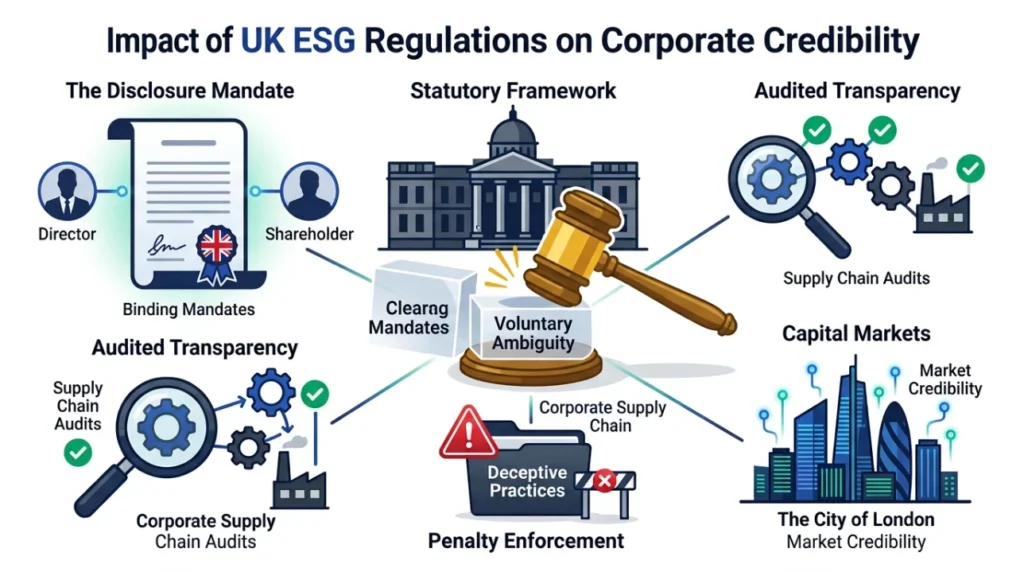
Statutory Frameworks in the UK
UK corporate law requires large enterprises and financial institutions to report climate risks and environmental performance metrics. Mandatory regulatory frameworks include:
- Streamlined Energy and Carbon Reporting (SECR): Mandates large UK companies to disclose annual energy use, greenhouse gas emissions, and energy efficiency actions within their Directors’ Report.
- Climate-related Financial Disclosures: Requires large UK companies and financial institutions to make disclosures consistent with TCFD recommendations under the Companies Act 2006.
- UK Taxonomy: Establishes clear criteria for economic activities that qualify as environmentally sustainable to direct sustainable investments.
Impact of Green Claims Codes
The UK Competition and Markets Authority (CMA) enforces the Green Claims Code to eliminate misleading environmental marketing. The code mandates that all consumer-facing environmental assertions must be accurate, clear, substantiated by objective evidence, and reflective of the entire life cycle of a product or service.
Under these rules, non-compliant organizations face direct regulatory enforcement, financial penalties, and serious loss of brand equity. Publishing an audited report that conforms to mandatory frameworks protects organizations from greenwashing liabilities while maintaining market trust.
What Are the Strategic Benefits of Sustainability Reporting for Businesses?
The strategic benefits of sustainability reporting include lower capital acquisition costs, enhanced supply chain positioning, reduced regulatory risk, superior talent acquisition, and higher enterprise valuation. Structured disclosures transform regulatory compliance obligations into permanent commercial advantages.
Operational Efficiency and Cost Reduction
Compiling sustainability disclosures requires rigorous mapping of resource consumption across facilities. This process reveals operational inefficiencies, material waste, and unnecessary energy expenditures. Addressing these operational gaps reduces overhead costs and improves resource efficiency.
Supply Chain Alignment and Competitive Advantage
Large multinational enterprises increasingly require supply chain partners to submit audited environmental data as a condition of procurement. UK businesses that maintain structured disclosures secure commercial advantages during competitive tender processes over non-reporting peers.
Talent Attraction and Retention
Corporate reputation directly influences recruitment outcomes in competitive job markets. Job seekers prefer employers that demonstrate transparent ethical governance, clear environmental stewardship, and measurable social impact. Publishing verified ESG disclosures improves employer branding, elevates employee retention rates, and attracts high-performing workforce talent.
Organizations seeking to build market authority can learn more about [sustainability reports publishing on UK media] or evaluate options for specialized corporate communications through [sustainability reports by Time Intelligence Media Group 2026].
Sustainability reporting translates complex environmental and governance policies into verified quantitative disclosures. By committing to standardized frameworks, double materiality evaluations, and independent third-party audits, UK businesses establish lasting credibility with investors, regulators, commercial clients, and retail consumers. Systematic disclosures protect organizations against greenwashing risks, ensuring compliance with evolving legislative frameworks while securing permanent market advantages in a decarbonising global economy.