
Startup research secures coverage in UK investor media by transforming proprietary market data, consumer metrics, and industry benchmarks into exclusive news stories. Financial journalists publish data-driven reports that validate market opportunities, quantify growth trajectories, and demonstrate clear sector disruption for UK venture capital readers.
UK investor media publications prioritize empirical evidence over corporate promotional claims. Publications such as Financial News, Sifted, and Investor’s Chronicle require verifiable metrics before evaluating an emerging company for editorial coverage.
By conducting structured research, early-stage enterprises convert internal operational metrics or broader sector analyses into public-facing intelligence. This intelligence addresses key analytical requirements used by institutional funds and high-net-worth individual investors across the United Kingdom financial ecosystem.
The Dynamics of Media Pitching in the United Kingdom
Media outreach in the UK financial sector relies on structured data distribution rather than standard press release dissemination. Editors expect raw data access, methodology documentation, and clear institutional relevance.
Startup founders and communications teams must align their proprietary data with current macroeconomic trends, such as interest rate adjustments by the Bank of England or shift patterns in private equity allocations.
What Is the Step-by-Step Process for Distributing Research to UK Media?
The process for distributing research to UK media involves six systematic steps: identifying data gaps, executing empirical methodologies, compiling structured findings, securing exclusive journalist distribution, issuing general press releases, and syndicating coverage across institutional financial platforms.
1.Identify Sector Data Gaps:Focus on unquantified industry shifts.
Analyze current coverage across UK venture capital publications to find missing metrics. Focus on unquantified sector challenges, such as regional fintech adoption rates in Manchester or green technology compliance costs in London.
2.Execute Empirical Methodology:Gather primary and secondary datasets.
Gather primary data through structured surveys, user activity audits, or transaction analyses. Ensure sample sizes meet statistical confidence thresholds, utilizing a minimum of 500 respondents for consumer studies or 100 C-suite executives for business-to-business reports.
3.Compile and Audit the Research Report:Document data collection protocols.
Draft the final document with clear data visualizations, executive summaries, and methodology notes. Ensure full compliance with UK General Data Protection Regulation guidelines regarding data collection procedures.
4.Pitch Exclusive Embargoes to Target Journalists:Offer early access to tier-one publications.
Offer the research report exclusively to selected tier-one outlets, such as City A.M. or The Daily Telegraph business section, 5 to 7 business days prior to public release. Provide direct access to the lead analyst or startup founder for interviews.
5.Execute Public Release and Press Distribution:Issue across news wire networks.
Distribute the finalized research report broadly across financial news wire networks and investor relations channels once the exclusive embargo period expires.
6.Syndicate Across Investor Networks:Repurpose coverage into capital raising assets.
Repurpose published media coverage into investor communications, founder update letters, and capital-raising pitch decks.
What Core Components Make a Startup Research Report Newsworthy?
A newsworthy startup research report contains five core components: an original primary dataset, a transparent methodology, actionable market benchmarks, concise data visualizations, and clear executive commentary contextualizing the data within current UK macroeconomic conditions.
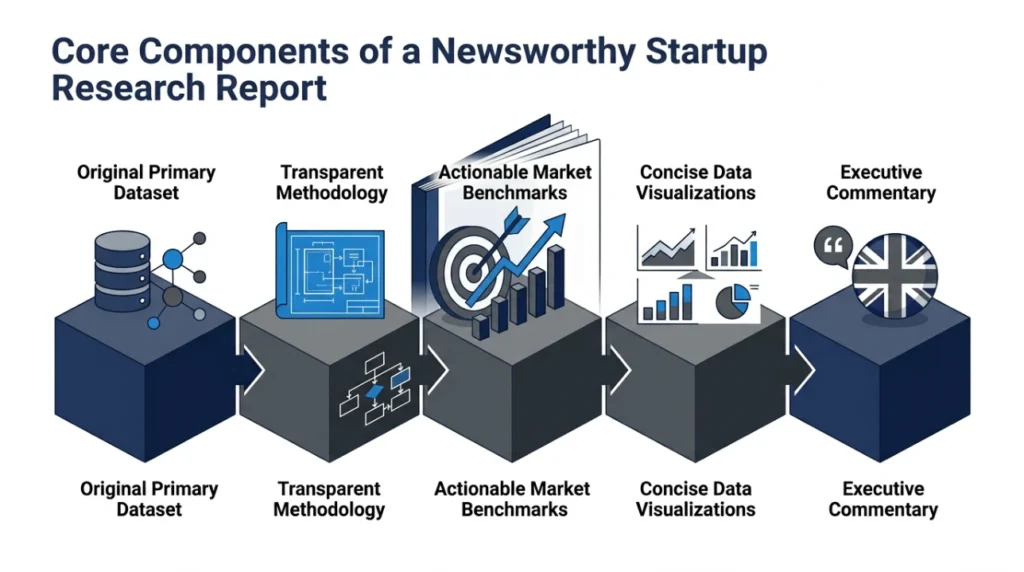
Primary Empirical Datasets
Investors and business editors reject rehashed secondary information. A report must contain unique primary data points that do not exist elsewhere in the public domain.
Examples of primary datasets include proprietary platform transaction volumes, specialized software user retention metrics, or localized regional hiring figures across specific technology corridors like the Silicon Fen in Cambridge.
Methodological Transparency
Financial journalists evaluate the rigor of data collection before considering a report for publication. The document must explicitly state:
- The exact sample size analyzed
- The precise dates of data collection
- The demographic or firmographic distributions
- The margin of error and confidence intervals
Reports lacking explicit methodology sections are routinely dismissed by UK business desks to avoid publishing flawed or biased metrics.
Contextual Executive Commentary
Data points require expert interpretation to form a complete news story. The report must include commentary from startup founders or lead research analysts explaining why the data matters to the broader market.
This commentary must remain factual and focused on sector trends rather than self-promotional claims regarding specific software products or services.
Explore More Expert Insights:
How Investment Firms Build Awareness Using Market Insight Ads
How Finance Brands Improve Conversion Intent Using Retargeting Ads
Why Do UK Investors Trust Data-Driven Media Coverage Over Pitch Decks?
UK investors trust data-driven media coverage because independent journalists perform third-party verification, filter out marketing hyperbole, and evaluate market opportunities against broader macroeconomic metrics, providing unbiased validation that investor pitch decks naturally lack.
Pitch decks represent self-reported, promotional perspectives created directly by founders to secure capital. In contrast, media coverage in recognized publications functions as external validation.
When a journalist at an outlet like Private Equity Wire cites a research report, they verify the source data, check references, and confirm that the trends align with market realities.
Third-Party Editorial Filtering
Journalists act as gatekeepers who scrutinize corporate assertions. They cross-reference startup metrics with competing industry statistics and consult independent domain experts.
When a startup’s data successfully passes this editorial review, investors gain confidence in the underlying operational metrics and overall market positioning of the business.
Institutional Risk Reduction
Venture capital firms and angel syndicates operate under strict fiduciary responsibilities. Citing third-party media coverage based on rigorous research helps fund managers justify deal flow decisions to their Limited Partners.
Independent coverage confirms that the sector opportunity has been publicly examined and recognized by industry observers.
How Does Research Coverage Support Each Stage of the Investment Funnel?
Research coverage supports the investment funnel by driving top-of-funnel brand awareness through media pickup, building middle-of-funnel trust through data validation, and accelerating bottom-of-funnel deal closures by confirming market authority during investor due diligence.
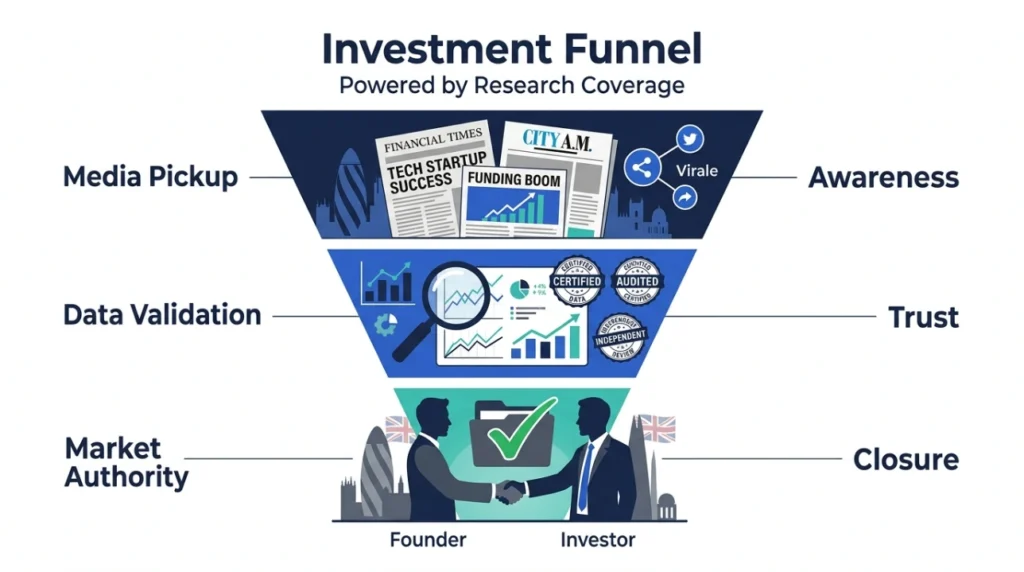
Understanding the educational foundation of this strategy is critical; founders can review the fundamental mechanics of [why UK startups need research reports to raise funding] to grasp top-of-funnel educational positioning before launching outreach programs.
Top-of-Funnel: Sector Visibility and Brand Discovery
At the initial stage of investor engagement, venture firms must recognize the startup’s operational domain. Media coverage generated by research reports introduces the company name alongside critical industry statistics.
- Primary Objective: Establish brand presence across targeted financial outlets.
- Media Types: General financial press, national business news, tech publications.
- Target Metric: Share of voice within specific technology or commercial verticals.
Middle-of-Funnel: Consideration and Educational Engagement
During the middle stage, investors assess the viability of the startup’s market segment. Prospective backers analyze how the company’s research explains structural industry problems and quantifies total addressable market expansion.
- Primary Objective: Educate the target audience on market inefficiencies.
- Media Types: Specialized trade press, institutional investor journals.
- Target Metric: Inbound investor inquiries and report downloads.
To further bridge the gap between initial media interest and formal investor proposals, founders often evaluate specialized partners; studying [startup research reports by Time Intelligence Media Group] provides a clear framework for how dedicated research production drives high-converting investor communications.
Bottom-of-Funnel: Validation and Due Diligence Acceleration
At the final stage of capital raising, investors conduct rigorous due diligence into the startup’s unit economics and growth assumptions. Media coverage citing original research serves as evidence supporting the company’s financial models.
- Primary Objective: Validate growth projections and defend market valuation.
- Media Types: Venture capital newsletters, private equity databases.
- Target Metric: Shortened due diligence timeframes and term sheet execution rates.
What Are Common Pitfalls Startups Experience When Pitching Research to Media?
Common pitfalls include pitching small sample sizes, using overly promotional language, failing to align data with current news cycles, attempting self-distribution without journalist embargoes, and omitting transparent methodology sections required by UK business desks.
Insufficient Sample Sizes
Attempting to generate news coverage using small, statistically insignificant sample groups damages institutional credibility. A survey of 20 consumers or 10 business managers does not provide sufficient statistical power for major UK publications like The Times or The Financial Times.
Data sets must be robust enough to withstand scrutiny from data editors and financial analysts.
Self-Promotional Framing
Business editors discard research reports that read like disguised product pitch papers. If every data point leads directly to a promotional pitch for the startup’s specific commercial offer, journalists classify the material as advertorial content.
The research must focus on broad industry shifts, structural problems, or emerging market opportunities rather than self-serving product feature lists.
Misaligned News Timing
Timing determines whether research coverage succeeds or fails. Distributing a report during major macroeconomic announcements—such as the UK Autumn Statement, Bank of England rate decisions, or general election coverage—results in buried pitches.
Outreach campaigns must be scheduled during quiet news periods or carefully tied directly to ongoing economic discussions.
How Can Startups Measure the Investor ROI of Media-Covered Research?
Startups measure the ROI of media-covered research by tracking qualitative metrics like tier-one press mentions, quantitative indicators like direct inbound investor contacts, and financial outcomes including accelerated due diligence timelines and increased capital conversion rates.
| Measurement Category | Metric Tracked | Business Impact |
| Media Reach | Tier-one press inclusions, trade publication pickups | Increases broad sector authority and brand recognition |
| Investor Engagement | Inbound deal-flow inquiries, pitch deck requests | Expands the top of the venture capital sales funnel |
| Conversion Efficiency | Due diligence duration, term sheet issuance speed | Reduces overall time spent raising investment rounds |
| Capital Yield | Total funds secured, final valuation premium | Maximizes financial returns while minimizing dilution |
Tracking these performance indicators ensures that research generation remains a structured capital-raising strategy rather than an unquantified public relations expense.
By delivering verified data directly to the UK investor media ecosystem, startups validate their market opportunities, attract institutional funding, and establish defensible market leadership.