
An AI Overview citation for research reports occurs when a generative search engine extracts specific data, statistics, or findings from a published document and displays that information directly within a synthetic search summary, linking back to the original source.
Large language models (LLMs) and retrieval-augmented generation (RAG) systems parse online content to build concise answers for complex queries. When a research report contains clear, authoritative data, search engines reference it as a primary source.
Retrieval-Augmented Generation (RAG) Systems
Generative search engines rely on RAG systems to fetch real-time information from the web. Instead of relying solely on pre-trained model weights, the system queries search indexes, retrieves relevant document fragments, and processes them to generate answers. Reports that rank high in retriever algorithms are selected as candidate nodes for the final generated output.
Semantic Parsers and Entity Knowledge
Semantic parsers evaluate documents by mapping entities and relationships. Research reports that explicitly state relationships between variables—such as “UK inflation rates dropped to 2.1 percent in 2025″—help these systems build accurate knowledge triples. This structural clarity allows semantic search engines to verify facts against other indexed sources.
Why do AI Overviews cite specific research reports over others?
AI Overviews cite specific research reports over others because these documents provide unique primary data, maintain high semantic readability, feature structured data markup, and display strong digital authority metrics that lower the language model’s hallucination risk.
Information retrieval algorithms select sources that maximize information gain while minimizing processing friction.
High Information Gain
Search algorithms evaluate content using information gain scores. Research reports containing proprietary surveys, original datasets, and specific experimental results score higher than aggregated content.
Examples of unique primary data include:
- National sample surveys with 1,500 active participants
- Longitudinal datasets tracking quarterly expenditures across 12 months
- Controlled physical measurements taken under standardized conditions
Semantic Density and Low Ambiguity
Generative models favor text with high semantic density. Sentences that contain dense factual statements without unnecessary filler are easier to summarize accurately. Ambiguous phrasing requires extra computing resources to interpret, which increases the likelihood that a model selects a clearer competing document.
Citation Graph Authority
Search engines track how frequently online entities reference specific published materials. A report cited by established universities, government agencies, and industry publications builds a strong position in the global knowledge graph. RAG pipelines prioritize documents with high core-entity authority during the retrieval phase.
How do generative search engines process published research documents?
Generative search engines process published research documents by crawling web pages, converting unstructured text into vector embeddings, breaking content into manageable chunks, and extracting factual entities using natural language processing models.
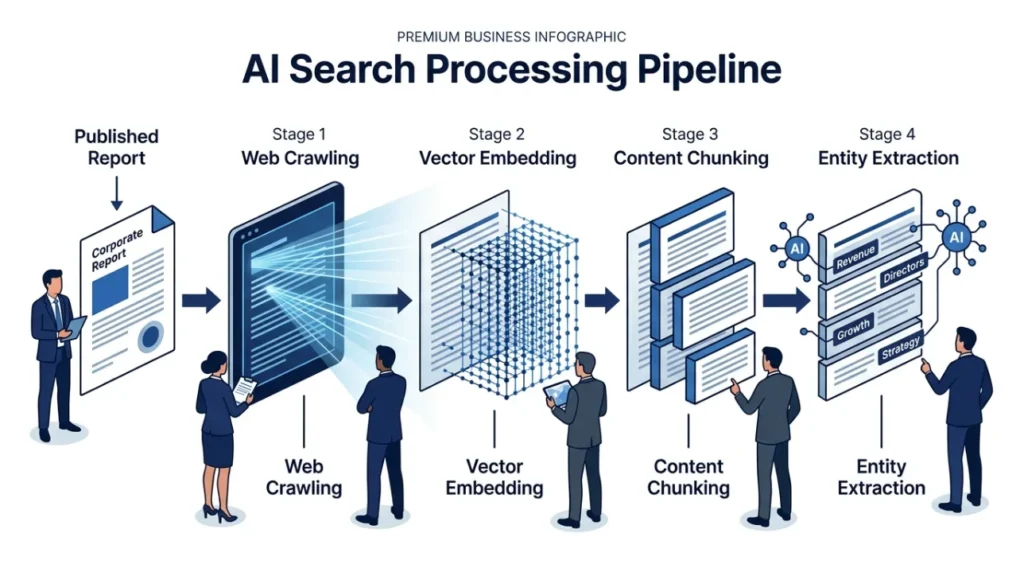
Understanding this technical pipeline helps content publishers format documents for optimal algorithmic processing.
Chunking and Vector Embeddings
When a search crawler indexes a research report, the system divides the text into smaller segments called chunks. Each chunk typically spans between 100 and 500 tokens. The engine converts these chunks into vector embeddings—numerical representations of semantic meaning stored in a vector database.
Vector Distance Matching
When a user submits a complex question, the search engine converts the query into an embedding. The system then calculates the mathematical distance between the query vector and indexed document vectors using cosine similarity. Chunks with the shortest distance are pulled into the language model’s context window.
Fact Extraction and Verification
Once relevant chunks enter the context window, fact-extraction models identify statements containing numerical data, claims, and entity relationships. The model verifies these statements against internal cross-references to confirm factual accuracy before outputting a summary sentence with a link citation.
Explore More Expert Insights:
How Online Retailers Recover Abandoned Carts Using Banner Advertising
How E-commerce Stores Boost Sales Using Retargeting Banner Ads
What structural components increase research report citations in AI search?
Structural components that increase research report citations include clear section headings, structured HTML data tables, bulleted summary blocks, explicit methodology descriptions, and JSON-LD Schema markup embedded within the web page source code.
Structuring content directly reduces the processing work required by RAG parsers.
Summary Key Findings Blocks
Placing an executive summary at the top of a research report allows crawlers to extract core takeaways immediately.
Key structural elements for summary blocks include:
- Short, declarative bullet points
- Immediate inclusion of core metrics
- Explicit definition of terms used throughout the document
- Placement above the fold in the HTML layout
HTML Data Tables vs. Embedded PDF Images
Generative search engine crawlers process standard HTML elements much faster than unstructured images or embedded PDF files. When reports publish data in raw visual graphics or standard image tags, crawlers often miss the underlying values. Publishing data in native HTML <table> elements ensures that search engines index every cell value, header, and unit of measurement.
Structured Schema Markup
Implementing JSON-LD schema markup gives search engines direct metadata about the document. Utilizing schemas such as ScholarlyArticle, Report, or Dataset provides explicit attributes including author credentials, publication dates, publisher entities, and main target subjects.
What formatting techniques maximize data extractions by AI crawlers?
Formatting techniques that maximize data extraction include writing short declarative sentences, using clear data labels, placing quantitative figures near topic keywords, avoiding passive voice, and avoiding complex metaphors or indirect figures of speech.
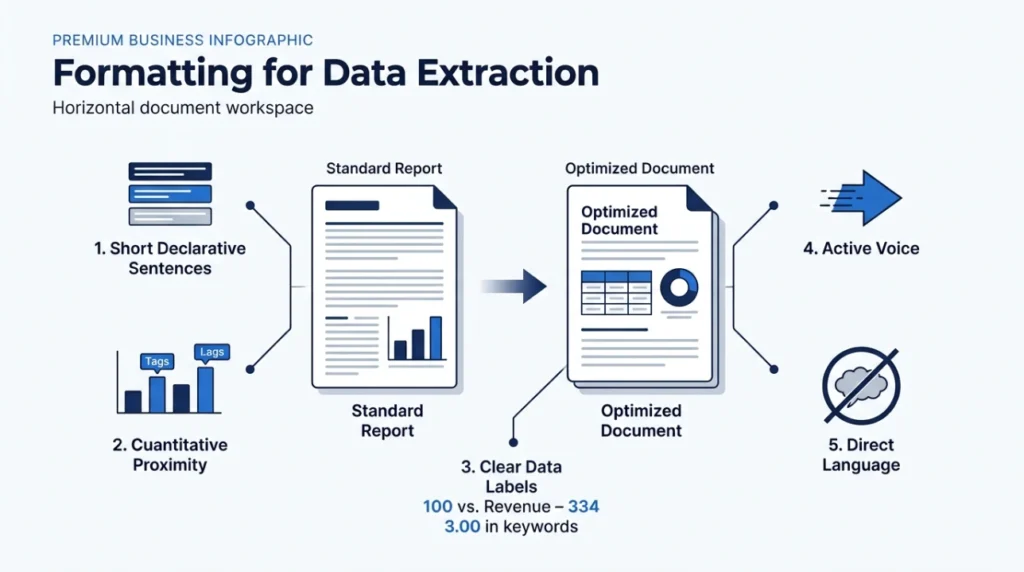
Technical optimization depends heavily on precise text composition.
Direct Declarative Sentence Structures
RAG models parse direct sentences with high precision. Sentence structures that follow a standard Subject-Verb-Object pattern allow natural language processing tools to extract subject relationships accurately.
Examples of direct declarative formatting include:
- “Consumer spending in the UK increased by 3.2 percent in 2025.”
- “Renewable energy provided 45 percent of national grid power during Q2.”
- “The survey recorded responses from 2,000 certified healthcare workers.”
Precise Unit and Label Specification
Data points must retain complete context even when extracted as single sentences. Instead of using relative terms like “last year” or “in this region,” reports should state exact values, years, and geographic boundaries.
| Ambiguous Formatting | AI-Optimized Formatting |
| “Sales grew significantly last quarter across Europe.” | “Retail sales in the United Kingdom grew by 4.1 percent during Q3 2025.” |
| “Most participants preferred the new model.” | “Sixty-eight percent of 500 survey participants preferred the updated software interface.” |
| “Inflation dropped sharply this year.” | “UK annual CPI inflation decreased from 3.4 percent in January 2025 to 2.1 percent in December 2025.” |
How does methodology and sample size affect AI citation rates?
Methodology and sample size affect AI citation rates by providing clear signals of statistical validity, which search engine quality algorithms use to assess the reliability and safety of information before citing it.
Search engines implement automated quality models to filter out unverified claims and low-quality data.
Sample Size Transparency
Search crawlers evaluate research methodologies to ensure data integrity. Reports that explicitly state sample sizes, confidence intervals, and margins of error satisfy automated research verification tests.
Examples of explicit methodological disclosures include:
- “Data collected from a randomized sample of 5,000 UK households”
- “Margin of error: +/- 1.8 percent at a 95 percent confidence level”
- “Study duration: 18 months from January 2024 to June 2025”
Verifiable Data Sources
Information retrieval models trace data origins back to recognized root entities. Reports that clearly document secondary data sources, academic references, and institutional affiliations score higher in automated trust evaluations.
What role does domain authority and digital presence play in AI summaries?
Domain authority and digital presence establish the entity reputation needed for search engine RAG systems to select a research report as a trusted candidate source during real-time retrieval operations.
Technical document optimization must be supported by an established web authority profile.
Entity Association and Knowledge Graphs
Search engines build internal entries for organizations, researchers, and media publications within global knowledge graphs. When an entity is firmly established as an authority within a specific field—such as economics, healthcare, or technology—the platform assigns higher baseline confidence scores to its published documents.
Backlink Profiles and Co-Mentions
Traditional ranking factors remain essential for generative search visibility. Inbound links from established news outlets, educational institutions, and research repositories signal document quality to search engines. Co-mentions across industry websites help search algorithms verify the context and credibility of the published findings.
How can publishers measure AI search visibility for published reports?
Publishers can measure AI search visibility by tracking referral traffic from generative search domains, monitoring brand and document citations in automated queries, tracking share of voice across topic clusters, and auditing vector database indexing status.
Measuring visibility in generative search environments requires tracking non-traditional performance indicators.
Key Performance Metrics for Generative Search
- Citation Frequency: The total number of times an AI Overview displays a link to the document across a target set of search queries.
- Referral Traffic from AI Engine Domains: Direct web visits originating from generative search platforms and chat interfaces.
- Prompt Share of Voice: The proportion of generated answers within an industry sector that cite the publisher compared to market competitors.
- Entity Mentions: The presence of the published document’s name and primary findings within general LLM training sets and retrieved outputs.
Citation Auditing Methods
Publishers use systematic prompt testing across targeted topic areas to verify report visibility. By submitting relevant research queries into various generative search interfaces, teams map which report sections appear in summaries. Monitoring these outputs over time reveals how structural changes, markup updates, and authority improvements influence overall citation counts.
Publishers seeking to improve output performance can optimize report formatting using AI search structure techniques. Organization teams ready to launch fully optimized data campaigns can deploy citation-ready reports to maximize authoritative reach across search platforms.
Generative search engines continue to prioritize clear, structured, and statistically sound research documents. By publishing unique primary data, organizing content with semantic clarity, applying proper schema markup, and maintaining methodological transparency, research institutions maximize their opportunities to secure AI Overview citations.