
AI search visibility for digital research reports represents the measurable rate at which artificial intelligence engines extract, reference, and cite structured document data in generated answers. Higher visibility directly increases organic brand citations, referral traffic, and digital authority scores.
AI search visibility measures how effectively large language models and search engines parse a digital document. Traditional search engine optimisation focuses on keyword density and backlinks. AI search visibility prioritises semantic clarity, entity relationships, and clear data architecture.
When search engines compile generated overviews, they process unstructured text to identify core factual statements. Research reports containing structured data schema, clear entity definitions, and direct answer blocks achieve higher extraction rates. In the United Kingdom media sector, digital reports designed for machine readability outperform traditional static PDF documents in generative search results.
How Do Search Engines Process and Extract Data From Reports?
Search engines process report data through automated web crawlers, natural language processing models, and vector database indexing. The systems segment unstructured text into logical units, parse semantic relationships between entities, and calculate factual confidence scores before generating citations.
The data extraction process follows specific technical stages:
- Ingestion and Segmentation: Automated systems fetch web pages or text rendered from static documents. The software breaks long-form content into smaller logical segments, known as passages or nodes.
- Semantic Parsing: Natural language processing algorithms analyze the grammatical structure of each passage. The system identifies subject-predicate-object triples to establish clear factual claims.
- Entity Extraction: The software identifies unique named entities such as organisation names, geographic locations, published metrics, and specific years.
- Vector Embedding: The engine converts text passages into mathematical vector representations. These vectors store the semantic meaning of the content in a multi-dimensional space.
- Confidence Scoring: The AI engine compares extracted facts across multiple indexed sources. High confidence scores result in inclusion within direct generative search summaries.
Which Structural Components Maximise Report Citation in AI Overviews?
The structural components that maximise report citations include bold direct answer blocks, semantically nested headings, machine-readable JSON-LD schema markup, clear data tables, and explicit entity definitions positioned at the beginning of each major report section.
Direct Answer Blocks
AI engines seek concise factual summaries to serve as answer passages. Placing a 30 to 50-word declarative summary immediately below an H2 element creates an ideal candidate passage for generative retrieval systems.
Machine-Readable Schema Markup
JSON-LD structured data explicitly defines document metadata for web crawlers. Incorporating Report, Article, and Dataset schema types allows search engines to categorize document properties without relying on probabilistic text parsing.
Formatted Data Tables
Tables provide strict rows and columns that isolate precise values. Machine learning models extract quantitative metrics from HTML tables faster and with higher precision than from narrative paragraphs.
| Structural Element | Technical Purpose | AI Search Benefit |
| JSON-LD Schema | Classifies document type and metadata | Guarantees clear entity classification |
| Direct Answer Blocks | Delivers concise, factual passages | Increases direct sentence citation rates |
| HTML Data Tables | Isolates numerical data points | Improves retrieval accuracy for statistical queries |
| Nested HTML Headings | Establishes hierarchical content logic | Ensures accurate passage extraction |
Understanding how content gets indexed requires analyzing the foundational factors explored in what makes research reports get cited in AI overviews. Building on those principles allows organizations to structure technical documents for optimal machine discovery.
What Step-by-Step Process Optimises Reports for AI Search Engine Visibility?
Optimising reports for AI search visibility requires a six-step process: query research, structural heading architecture, schema implementation, entity mapping, direct answer integration, and machine-readability testing. Following these steps ensures complete alignment with generative search extraction standards.
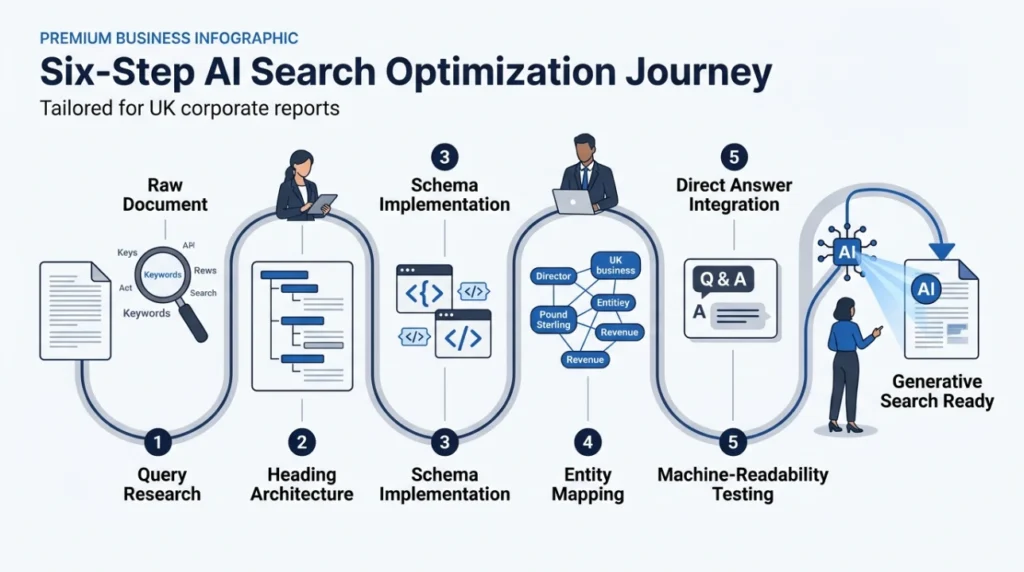
1.Conduct Semantic Intent and Query Research:Identify target AI search queries.
Identify specific target questions, informational queries, and long-tail search terms used by your audience in the United Kingdom market. Map individual questions to explicit document sections.
2.Establish a Strict Heading Hierarchy:Build a logical outline.
Organise the report using a rigid H1 to H3 hierarchy. Ensure every H2 element mirrors a specific user question or clear task requirement.
3.Integrate Direct Answer Blocks:Craft high-confidence summaries.
Write concise, 40-word declarative answer blocks directly beneath each H2 heading. Avoid conversational fluff, hedging words, or introductory statements.
4.Embed Entity Markup and JSON-LD Schema:Add structured data layer.
Implement precise HTML markup and JSON-LD schema scripts. Define author entities, publication dates, target geographical regions, and primary datasets explicitly.
5.Format Technical Metrics and Data:Convert prose to tables.
Convert complex narrative figures, key performance metrics, and comparative data points into clean HTML tables or bulleted lists.
6.Validate Extraction and Retrieval:Test machine parsing.
Test document accessibility using schema validation tools and automated web parsers to verify that text extraction models retrieve clean data blocks.
Explore More Expert Insights:
Headlines for Sponsored Articles: 9 Formulas That Drive UK News Reader Clicks
Sponsored Content Calendar Planning: A 12-Month UK Framework for B2B Brands
How Do Schema Markup and Data Architecture Improve Retrieval Precision?
Schema markup and data architecture improve retrieval precision by providing explicit metadata that removes ambiguity from human language. Structured tags tell search bots exactly what data points represent, eliminating interpretation errors during automated content processing.
Unstructured text leaves room for algorithmic misinterpretation. For example, a reference to a specific number could represent a currency value, a percentage, or a calendar year. Schema markup explicitly assigns meaning to data fields through standardized vocabulary terms defined by Schema.org.
The code sample above demonstrates how Report schema defines key contextual boundaries for search engines. By specifying language as en-GB and location as United Kingdom, the architecture ensures search algorithms deliver the content to regional users with high precision. Combining custom markup strategies with specialized agency solutions like AI-optimised research reports creates a foundation for long-term search performance.
What Are the Key Differences Between Traditional SEO and AI Search Optimisation for Reports?
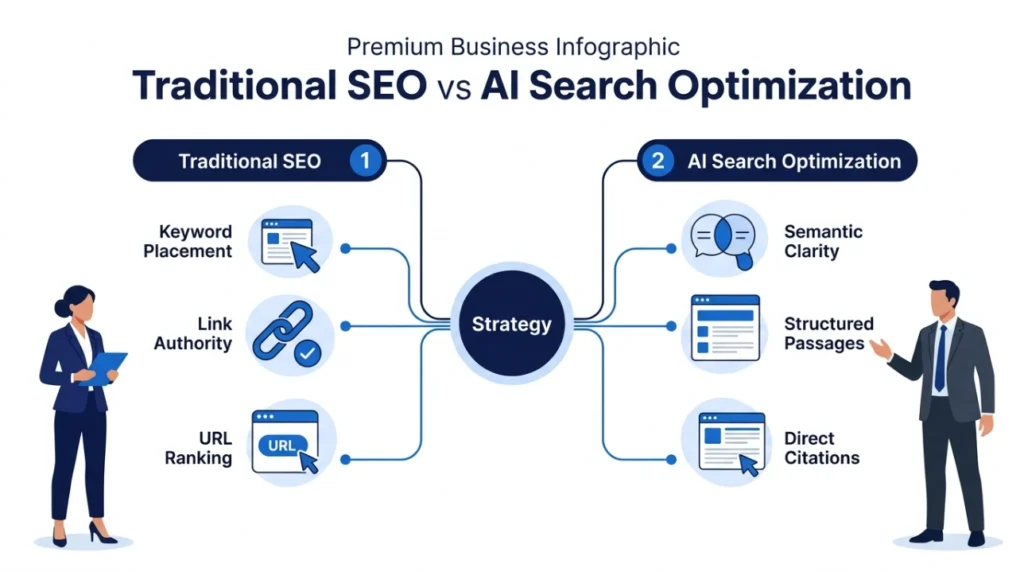
The key differences lie in optimization targets, content formatting, and retrieval metrics. Traditional SEO targets keyword placement and link authority to rank URLs. AI search optimisation targets semantic clarity, structured passages, and entity context to secure direct citations.
1998–2010: Keyword Density Era
Phase 1
Optimization focused heavily on exact-match keyword density, basic metadata tags, and total inbound backlink counts to achieve top blue-link rankings.
2011–2022: Semantic Intent Era
Phase 2
Search engines introduced entity recognition and natural language processing. Optimization shifted toward topical depth, user intent, and site-wide domain authority.
2023–2026: Generative Citation Era
Phase 3
Generative AI search models synthesize direct answers from extracted document passages. Success relies on machine-readable structure, passage relevance, and factual citation generation.
The shift from URL ranking to passage extraction requires fundamental changes in content strategy:
- Primary Objective: Moving from winning page clicks to earning direct citations in AI-generated answers.
- Content Structure: Replacing long narrative text blocks with modular answer passages and data tables.
- Performance Metrics: Tracking direct citation counts and brand inclusion rates alongside traditional organic traffic.
How Do UK Media Organisations Benefit From AI-Optimised Reports?
UK media organisations benefit from AI-optimised reports through increased digital reach, established domain authority, higher brand citation frequency, and faster discovery by professional journalists, analysts, and enterprise B2B customers seeking verified market intelligence.
Brand Authority in Generative Search
When generative engines continuously source data from a specific media publisher, that publisher establishes entity authority within search knowledge graphs. This continuous citation cycle solidifies the brand as a trusted primary source across automated search tools in the United Kingdom.
Direct High-Intent Referral Traffic
AI search summaries link directly to primary reference documents. Users who click these attribution links demonstrate high intent, as they are actively seeking deep-dive validation for specific technical facts or business statistics.
Content Syndication and Distribution Efficiency
Properly structured reports allow external platforms, news aggregation algorithms, and business intelligence databases to ingest and attribute research metrics automatically. This technical efficiency reduces manual syndication efforts while maximizing regional content exposure.
What Are Common Use Cases for AI-Optimised Report Structures?
Common use cases for AI-optimised report structures include annual industry benchmark reports, quarterly economic trend surveys, market research whitepapers, media consumption analyses, and regional regulatory compliance documents published across enterprise sectors.
Sector Benchmark Reports
Annual market benchmarks contain high volumes of statistical data. Structuring these reports with explicit data tables and answer blocks allows AI engines to parse and present specific metrics for user queries regarding industry growth rates.
Policy and Regulatory Whitepapers
Compliance documents often contain complex legal terminology. Applying clear entity mapping and direct summary blocks ensures search crawlers accurately represent regulatory requirements without truncating critical context.
Quarterly Media Consumption Analytics
Media analytics reports provide updated consumer metrics. Using schema markup to highlight temporal attributes—such as specific quarters and publication years—prevents search algorithms from referencing outdated statistical data in user summaries.
Strategic Implementation Checklist for AI Report Visibility
Executing an AI search visibility strategy requires systematic implementation across editorial and technical workflows.
- Mandatory Technical Requirements:
- Implement JSON-LD
ReportorArticleschema markup. - Use clean HTML table markup for all tabular data.
- Define all primary entities explicitly within the first paragraph of every section.
- Restrict H2 headings to explicit user questions or query targets.
- Ensure the document uses accessible, indexable HTML text rather than image-based text rendering.
- Implement JSON-LD
- Editorial Standards:
- Draft a bold, declarative 40-word answer block immediately below every H2 heading.
- Eliminate ambiguous pronoun references (e.g., use “The United Kingdom Media Association” instead of “They”).
- Use specific numeric values instead of vague metrics (e.g., “42 percent increase” instead of “significant growth”).
- Maintain consistent entity naming conventions across all published reports.
Structuring research reports according to machine-readable standards guarantees that digital assets retain maximum search visibility as search engines transition to generative, citation-based response models.