
UK news sites process corporate annual reports by extracting financial metrics, regulatory updates, and strategic announcements to publish structured editorial coverage. Outlets transform raw financial documentation into market news, investor updates, executive analysis, and sector trend articles.
National publications, financial news portals, and regional news sites evaluate annual reports to inform their readerships. Newsrooms analyze these documents to highlight revenue growth, profit margins, executive pay, ESG commitments, and risk management disclosures.
The Role of Financial Data in Media Coverage
Journalists isolate key performance indicators directly from audited balance sheets and profit and loss statements. Outlets focus on figures such as revenue, operating profit, EBITDA, and earnings per share.
Media platforms compare these metrics against consensus estimates and previous fiscal year results. Distinguishing between organic growth and acquisition-driven revenue allows news sites to evaluate a company’s operational trajectory accurately.
The Role of Non-Financial Disclosures
Annual reports contain strategic commentary, risk assessments, and environmental, social, and governance (ESG) reporting. Publications use these sections to construct broader narrative coverage beyond simple balance sheet data.
Editorial teams examine executive statements for forward-looking guidance, market outlooks, and operational restructuring plans. Non-financial disclosures allow news outlets to link corporate performance to broader macroeconomic trends, such as inflation, supply chain disruptions, and labor market shifts.
Which 15 UK News Sites Actively Cover Corporate Annual Reports?
Fifteen prominent UK news sites actively cover corporate annual reports: The Financial Times, Reuters UK, Bloomberg UK, The Times, The Telegraph, The Guardian, The Independent, Evening Standard, City A.M., BBC News, Sky News, Mail Online, Daily Express, Yahoo Finance UK, and Insider Media.
These publications represent a spectrum of media coverage, ranging from national business dailies to regional economic journals and mainstream consumer platforms.
Tier 1 Financial and Wire Outlets
Tier 1 platforms prioritize immediate, high-volume financial data and institutional analysis.
- The Financial Times: Focuses on comprehensive financial accounting, corporate governance, and international strategy for global institutional readers.
- Reuters UK: Delivers immediate earnings data, revenue beats or misses, and concise executive statements for international wire subscribers.
- Bloomberg UK: Translates corporate report metrics into real-time market data, bond yield impacts, and equity valuation shifts.
Tier 2 National Business and Quality Papers
Quality national newspapers connect corporate reporting with broader economic policy and industry dynamics.
- The Times: Analyzes executive leadership performance, long-term corporate strategy, and competitive positioning within the UK market.
- The Telegraph: Examines fiscal performance, regulatory compliance burdens, and corporate tax contributions.
- The Guardian: Emphasizes environmental commitments, executive pay ratios, supply chain ethics, and labor practices detailed in annual disclosures.
- The Independent: Evaluates corporate accountability, consumer impact, and corporate governance compliance.
Tier 3 Commercial, Consumer, and Regional Outlets
Commercial and regional media focus on immediate consumer impact, localized economic factors, and retail market performance.
- Evening Standard: Covers commercial property metrics, London market trading performance, and consumer retail trends.
- City A.M.: Concentrates on daily market updates, financial sector developments, and corporate deal-making in the City of London.
- BBC News: Contextualizes major corporate reports to explain consumer prices, energy costs, and employment figures to the public.
- Sky News: Reports breaking business announcements, major corporate restructuring, and high-profile profit announcements.
- Mail Online: Focuses on high-visibility consumer brands, executive remuneration packages, and workplace dynamics.
- Daily Express: Explores corporate reporting effects on consumer spending power, domestic utility costs, and pension funds.
- Yahoo Finance UK: Summarizes earnings releases, dividend declarations, and share price reactions for retail investors.
- Insider Media: Analyzes regional corporate performance, local job creation, and regional manufacturing output across the UK regions.
What Editorial Criteria Do Journalists Use to Select Annual Reports?
Journalists select annual reports based on financial materiality, regulatory news status, market capitalization, public brand recognition, and unexpected operational developments. Outlets prioritize corporate disclosures that demonstrate substantial revenue shifts, leadership changes, major restructuring, or significant corporate governance failures.
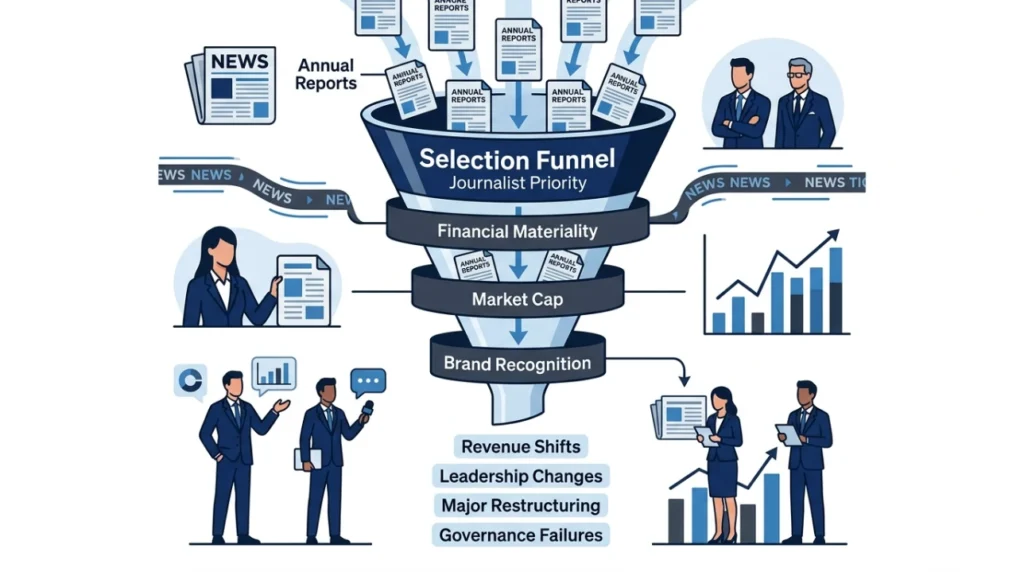
Media platforms screen hundreds of corporate disclosures filed daily through primary regulatory channels such as the London Stock Exchange Regulatory News Service (RNS).
Financial Significance and Market Impact
News organizations prioritize companies with high market capitalizations, such as FTSE 100 constituents. Journalists analyze whether an annual report reveals a profit warning, an unexpected loss, or record-breaking revenue.
Outlets evaluate how report metrics compare to earlier market guidance. A significant divergence between projected performance and actual audited figures triggers immediate press scrutiny.
Public Interest and Topical Relevance
Media coverage increases when an annual report addresses current economic issues. Publications assess disclosures detailing energy costs, supply chain bottlenecks, or artificial intelligence investments.
Journalists select reports that illuminate public debate regarding executive pay ratios, corporate tax strategy, and carbon reduction timelines. Reports from public-facing sectors like retail, aviation, energy, and banking receive consistent editorial attention due to their direct impact on consumers.
Explore More Expert Insights:
How to Brief a UK Publisher for Sponsored Content That Feels Like Real Journalism
Sponsored Content Across 10 Verticals: UK Engagement Benchmarks 2026
How Is an Annual Report Processed into a News Story?
Journalists process an annual report by monitoring regulatory wire services, reviewing executive summaries, cross-referencing past disclosures, and conducting interview follow-ups. Editorial teams synthesize complex 100-plus page financial filings into news articles within minutes to hours of publication.
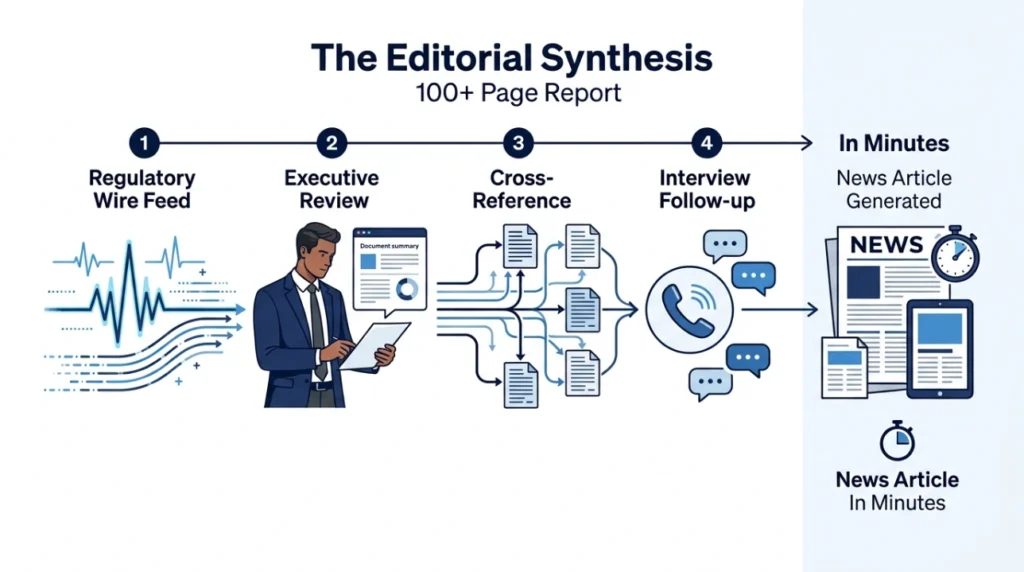
Speed and accuracy govern the editorial process when companies release annual financial documentation to the market.
1.Regulatory Monitoring:Automated RNS tracking.
Newsrooms monitor official news distribution feeds such as the London Stock Exchange RNS. Automated software alerts financial journalists the moment a targeted company publishes its full audited annual results.
2.Data Extraction:Primary metrics review.
Reporters review the primary financial statements, focusing on key line items: revenue, operating profit, pre-tax profit, net debt, and proposed dividend payouts.
3.Contextual Comparison:Historical and estimate analysis.
Journalists compare the extracted figures against consensus forecasts from market analysts and the company’s prior-year financial performance to identify growth or contraction.
4.Qualitative Review:Strategic commentary scan.
Reporters scan the Chairman’s Statement, CEO Review, and Governance sections to identify strategic pivots, operational risks, restructuring plans, and executive pay disclosures.
5.Editorial Drafting and Publishing:Multi-platform distribution.
Journalists write news articles tailored to their audience, highlighting market implications for trade readers or economic impacts for consumer readers, before distributing via online feeds.
Primary Information Extraction
Reporters first read the condensed summary tables, highlighting headline numbers. They check for restated accounts from prior years, exceptional costs, and impairment charges that alter net profit figures.
Journalists isolate dividend announcements to assess shareholder returns. They analyze cash flow statements to evaluate whether operational activities support reported earnings quality.
Contextualization and External Verification
After extracting primary figures, journalists cross-examine company statements with third-party data. They review research notes from investment analysts at financial institutions like HSBC, Barclays, or Peel Hunt.
Reporters check equity market reactions to see if share prices rise or fall following the release. They contact company representatives, industry analysts, and trade union officials to obtain immediate commentary on the reported figures.
To understand how foundational corporate documentation builds initial brand authority before media outreach, review annual report publishing.
What Channels Are Used to Distribute Annual Reports to News Media?
Annual reports are distributed to news media through Regulatory Information Services (RIS), direct press releases, specialized PR wire services, dedicated investor relations portals, and targeted journalist briefings. Companies deploy multiple distribution channels simultaneously to ensure compliance and maximize media reach.
Distribution pathways combine legally mandated regulatory channels with commercial media outreach tools.
Regulatory Information Services (RIS)
UK-listed companies must release their annual financial disclosures through an approved Regulatory Information Service. Platforms like the London Stock Exchange RNS, Business Wire Regulatory Disclosure, and GlobeNewswire transmit financial data directly to financial terminals and major newsrooms.
Publication via an RIS satisfies statutory disclosure laws. It guarantees that all market participants, including news organizations, receive financial information at the same moment.
Direct Media Relations and Briefings
Corporations supplement regulatory filings with targeted media outreach managed by internal communications teams or external financial PR agencies.
- Pre-Market Briefings: Companies host embargoed conference calls or meetings with senior financial journalists prior to the public market opening.
- Media Press Releases: Press teams distribute tailored press releases summarizing key report highlights, executive quotes, and visual assets directly to newsdesk editors.
- Dedicated IR Portals: Organizations host downloadable PDF reports, interactive financial tables, and high-resolution leadership imagery on corporate Investor Relations websites.
- Analyst and Press Conferences: Executives host live webcasts to explain financial performance and answer questions from journalists and industry analysts.
Understanding these distribution strategies helps organizations optimize their outreach. Companies can examine how annual reports position UK brands as industry leaders to improve brand positioning and media engagement.
How Does Coverage Differ Between Financial Wire Services and Consumer Outlets?
Coverage differs between financial wire services and consumer outlets in speed, technical terminology, target audience, and narrative angle. Wire services prioritize raw, immediate financial data for institutional investors, whereas consumer outlets focus on real-world impacts, consumer pricing, job security, and executive conduct.
Different media formats serve distinct reader needs, requiring distinct angles on the same financial report.
Financial Wire Services (e.g., Bloomberg UK, Reuters UK)
Wire services operate on immediate publication schedules during market hours. Articles feature minimal narrative expansion, prioritizing speed, data precision, and exact financial syntax.
Stories use technical terms such as EBITDA, operating margin compression, organic constant-currency growth, and diluted earnings per share. Bulletins highlight immediate stock movement and trading volume variations linked to report releases.
Consumer News Outlets (e.g., BBC News, Mail Online)
Consumer publications translate financial data into accessible news stories for the general public. Articles contextualize corporate profits against public interest factors like energy bills, food price inflation, mortgage rates, or store closures.
Technical accounting terms are simplified into plain language, such as “underlying profit before tax” becoming “total profits.” Coverage emphasizes public accountability, executive compensation changes, environmental impacts, and workforce changes like factory openings or layoffs.
Why Is Annual Report Coverage Important for Corporate Reputation?
Annual report coverage establishes corporate transparency, reinforces investor confidence, shapes public perception, and influences regulatory relationships. Third-party journalistic validation transforms complex corporate reporting into authoritative public records that define an organization’s financial stability and operational ethics.
Press coverage acts as an independent audit of a company’s narrative, directly shaping stakeholder trust.
Investor Confidence and Valuation
Independent news coverage confirms a firm’s financial health to current and prospective investors. Positive media reports on balance sheet strength, debt reduction, or strategic expansion can support equity valuations and lower capital acquisition costs.
Favorable coverage in respected financial outlets like City A.M. or The Financial Times enhances market credibility. Conversely, negative media scrutiny regarding unexpected losses or governance flaws can accelerate share price declines and attract activist investor interest.
Stakeholder Trust and Brand Equity
Coverage in national media extends a company’s reputation beyond financial markets to customers, employees, suppliers, and regulators.
Clear press coverage detailing ESG accomplishments, workforce investments, and ethical supply chains reinforces brand trust. Transparent reporting on operational challenges demonstrates executive integrity and risk management competency during economic downturns.