
An annual report establishes UK market leadership by providing a verified, transparent record of financial performance, strategic progress, and corporate governance. UK brands use these audited documents to prove stability, attract investor capital, and build trust with institutional stakeholders.
Financial Transparency and Market Trust
An annual report serves as a definitive corporate record. In the United Kingdom, statutory regulations require public limited companies and large private enterprises to file yearly financial disclosures with Companies House. Beyond fulfilling legal obligations, these documents provide verified performance metrics that allow investors, analysts, and commercial partners to evaluate an organization’s stability.
Market leadership requires sustained trust. When a brand publishes comprehensive revenue breakdowns, profit margins, and balance sheet calculations, it removes operational opacity. Independent auditing firms verify these figures, giving stakeholders an unvarnished view of corporate health. Unlisted organizations that publish thorough disclosures gain a competitive advantage over secretive peers by demonstrating fiscal discipline and operational maturity.
Strategic Vision and Long-Term Direction
An annual report details past performance and outlines future strategic directions. Corporate leadership teams use the strategic report section to articulate expansion plans, research and development investments, and market acquisition goals. This strategic narrative signals stability to commercial partners, suppliers, and prospective employees.
UK brands establish market authority by setting industry standards through these disclosures. When a company outlines clear benchmarks for operational expansion, environmental standards, or digital transformation, competitors often adjust their strategies to match. The annual document becomes a reference point for sector performance, solidifying the publishing organization’s status as a market driver.
How Does Corporate Reporting Influence Media Coverage and Stakeholder Perception?
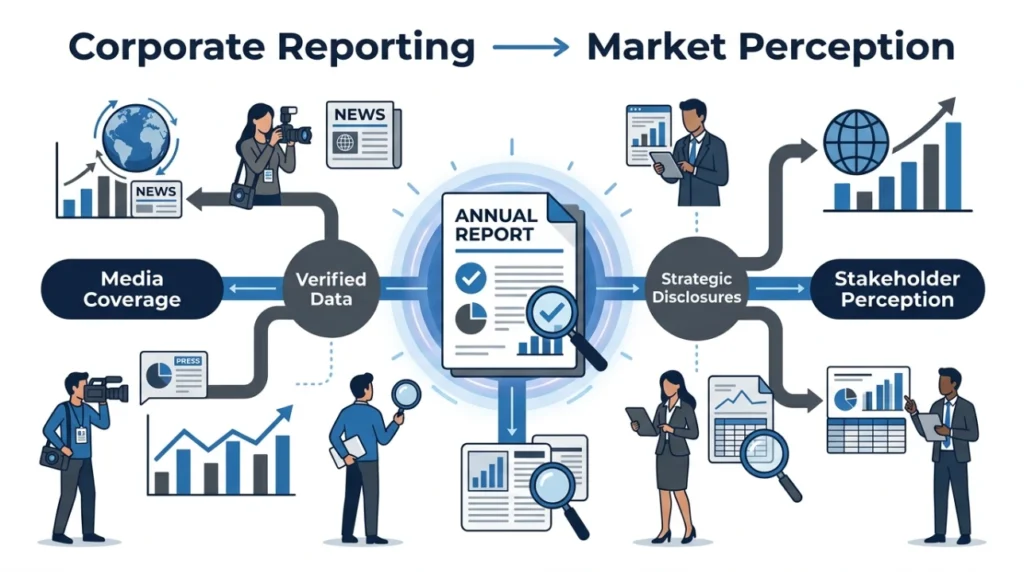
Corporate reporting directly shapes media coverage and stakeholder perception by offering verified data points, executive commentary, and strategic disclosures. Journalists, financial analysts, and market researchers rely on annual reports as primary sources for industry news and comparative analysis.
Providing Primary Data for Business Journalists
Financial journalists and industry trade publications use corporate filings as primary information sources. During peak earnings seasons, newsrooms monitor published disclosures to identify revenue growth, strategic shifts, and market trends. Companies that present clear, accessible, and detailed annual reports increase the likelihood of accurate media coverage.
Primary data reduces journalist speculation. When a brand provides precise metrics regarding market share, employment figures, and capital expenditure, reporters quote those figures directly. This coverage projects the brand’s perspective into national business outlets, financial news networks, and sector-specific publications. Organizations looking to understand how financial disclosures transition into news coverage can analyze news site report coverage.
Building Investor and Institutional Confidence
Institutional investors, pension funds, and wealth managers manage billions of pounds in UK capital. These entities conduct rigorous due diligence before allocating funds. An annual report provides the structural data necessary for equity analysts to build financial models and issue rating recommendations.
Clear reporting lowers perceived risk. When corporate disclosures detail clear risk management frameworks, debt structures, and cash flow stability, institutional investors assign lower risk premiums to the enterprise. This institutional confidence stabilizes share prices, reduces borrowing costs, and enhances the brand’s reputation across global financial markets.
Demonstrating Environmental, Social, and Governance Compliance
UK regulatory frameworks require detailed reporting on Environmental, Social, and Governance (ESG) metrics. The Streamlined Energy and Carbon Reporting (SECR) framework mandates that qualified businesses publish energy consumption, greenhouse gas emissions, and efficiency initiatives within their annual filings.
Proactive ESG disclosures position brands as responsible market leaders. Sustainable investment funds screen potential assets using corporate sustainability metrics. By publishing transparent data regarding workforce diversity, carbon reduction, and ethical supply chain auditing, UK brands attract ESG-focused capital and win consumer loyalty.
Explore More Expert Insights:
How Fintech Companies Acquire Users Using Banner Ads
How Finance Brands Promote Credit Cards Using Display Campaigns
What Are the Essential Components of an Industry-Leading Annual Report?
The essential components of an industry-leading annual report include the strategic report, governance framework, audited financial statements, and director disclosures. Each section must provide transparent, accurate data that complies with UK accounting standards and statutory regulations.
The Strategic Report
The strategic report provides context for the financial statements. Under Section 414C of the Companies Act 2006, UK enterprises must publish a strategic report that presents a balanced analysis of the company’s development, performance, and position during the financial year.
Key elements within the strategic report include:
- Principal Risks and Uncertainties: A detail of operational, market, and financial risks, alongside corporate mitigation strategies.
- Key Performance Indicators: Measurable metrics such as net profit margins, customer acquisition costs, and employee turnover rates.
- Section 172 Statement: A explicit explanation of how directors have considered stakeholder interests, environmental impact, and long-term consequences in their decision-making.
Corporate Governance Frameworks
The governance section outlines how board members manage corporate operations, handle oversight, and protect shareholder value. Organizations adhering to the UK Corporate Governance Code must report on board composition, director independence, audit committee activities, and executive remuneration policies.
Robust governance prevents corporate mismanagement. Clear disclosures regarding internal controls, risk management protocols, and anti-corruption measures demonstrate operational integrity. Industry leaders use this section to prove that financial gains result from sound, sustainable corporate management rather than short-term risk-taking.
Audited Financial Statements
Financial statements form the core quantitative assessment of an annual report. Prepared under International Financial Reporting Standards (IFRS) or UK Generally Accepted Accounting Practice (UK GAAP), these statements consist of three primary tables:
- The Income Statement (Profit and Loss): Details total revenue, cost of goods sold, operating expenses, and net profit over a 12-month period.
- The Balance Sheet (Statement of Financial Position): Itemizes corporate assets, liabilities, and equity at the close of the financial year.
- The Cash Flow Statement: Tracks cash inflows and outflows from operating, investing, and financing activities.
| Statement Type | Core Function | Primary Metrics Tracked |
| Income Statement | Measures operational profitability over 12 months | Revenue, Gross Profit, Operating Margin, Net Income |
| Balance Sheet | Snapshots financial position at year-end | Total Assets, Total Liabilities, Shareholder Equity, Working Capital |
| Cash Flow Statement | Tracks liquidity generation and expenditure | Operating Cash Flow, Capital Expenditures (CapEx), Free Cash Flow |
How Do UK Brands Leverage Reporting for Competitive Advantage?
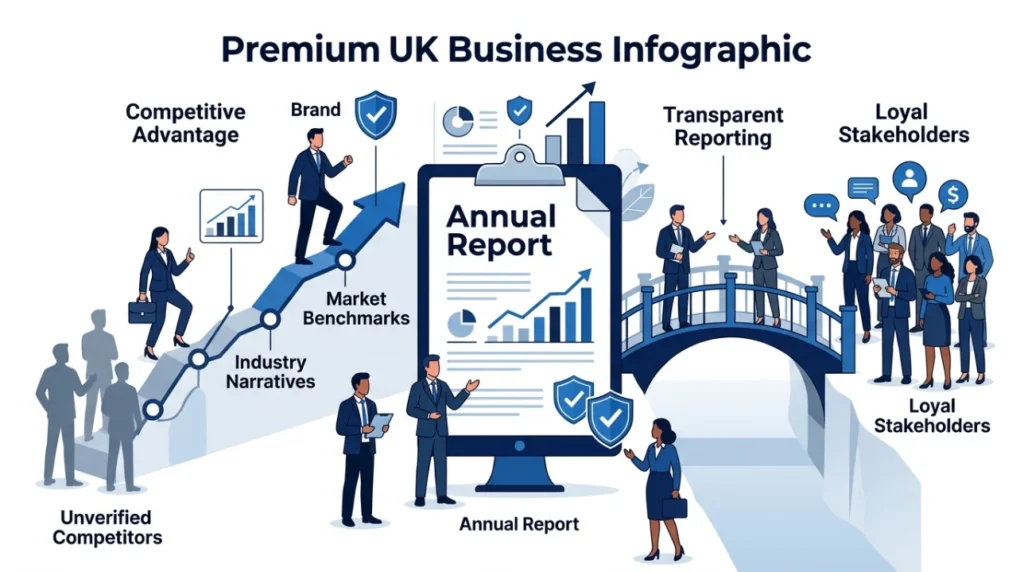
UK brands leverage annual reporting for competitive advantage by establishing market benchmarks, setting industry narratives, and building long-term stakeholder loyalty. Transparent corporate reporting differentiates market leaders from unverified competitors.
Setting Sector Performance Benchmarks
Industry leaders establish performance expectations for their entire sector. When a dominant logistics, technology, or retail firm publishes high profit margins, low customer churn, or high return on capital employed, competitors face pressure to match those metrics.
Publishing detailed operational insights establishes thought leadership. For instance, when a company discloses operational efficiencies gained through automation investments, it defines tech adoption trends within the market. Sector analysts use these pioneer disclosures as the base standard for evaluating competing businesses.
Enhancing Commercial and B2B Relationships
Enterprise clients, buyers, and supply chain partners perform credit risk assessments before entering long-term contracts. A transparent, financially sound annual report simplifies supplier qualification processes and secures favorable commercial terms.
Strong corporate filings reduce transaction friction:
- Vendor Negotiations: Suppliers offer extended payment terms to financially stable buyers with low default risks.
- Commercial Tenders: Public sector and corporate procurement teams award major contracts to vendors with proven balance sheet strength.
- Strategic Partnerships: Joint ventures favor organizations that disclose clear risk management procedures and corporate liquidity.
Companies seeking execution strategies for corporate document generation and sector distribution can review professional options through media intelligence publishing.
Attracting Top Industry Talent
Senior executives, specialized engineers, and high-performing staff seek stable employers. An annual report serves as a recruitment document that demonstrates organizational trajectory, career security, and cultural values.
Candidates evaluate financial health and growth plans before accepting leadership offers. Disclosures highlighting investments in employee training, diversity initiatives, and profit-sharing schemes attract high-caliber professionals. Market leaders use their corporate reporting to demonstrate a commitment to human capital.
What Are the Best Practices for Publishing an Annual Report in the UK?
The best practices for publishing an annual report in the UK include strictly adhering to statutory deadlines, adopting digital-first reporting formats, maintaining concise narrative structures, and ensuring seamless cross-departmental data integration.
Adopting Digital-First and Interactive Formats
Traditional annual reporting relied exclusively on printed bound volumes. Modern UK enterprises prioritize digital-first publishing strategies, releasing interactive PDF documents, dedicated micro-sites, and structured XBRL (eXtensible Business Reporting Language) filings.
Digital reporting offers distinct advantages:
- Searchability: Stakeholders can instantly locate specific financial tables, ESG disclosures, or executive commentary.
- Data Extraction: Analysts can ingest numerical data into financial models without manual entry errors.
- Global Accessibility: Digital distribution delivers report data instantly to global investors, business journalists, and regulatory bodies.
Ensuring Cross-Departmental Accuracy
An annual report requires inputs from financial controllers, legal counsel, investor relations professionals, and operational directors. Maintaining precise data alignment across all sections prevents costly errors or regulatory sanctions.
Organizations must establish rigorous internal sign-off procedures. Audit committees verify financial accuracy, legal teams check regulatory compliance, and communications teams refine narrative tone. This collaborative process ensures the final report is accurate, compliant, and strategic.
Maintaining Regulatory Deadline Compliance
UK regulations set strict statutory filing deadlines based on corporate structure:
- Private Limited Companies (LTD): Must file annual accounts with Companies House within 9 months of the financial year-end.
- Public Limited Companies (PLC): Must file annual accounts within 6 months of the financial year-end.
- Main Market Listed Companies: Must release financial results within 4 months of the year-end under the FCA Financial Conduct Authority Disclosure Guidance and Transparency Rules.
Failing to meet statutory deadlines results in civil financial penalties, director liability, and reputational damage. Adhering to these schedules demonstrates professional operational management and reinforces market confidence.
Annual reporting serves as a strategic asset for UK enterprises. By transforming statutory obligations into transparent, data-rich communications, brands verify their financial strength, influence media narratives, and secure market leadership.