
Research reports earn citations across news sites by providing original, verified, and statistically significant data that supports journalist narratives. Earned media coverage relies on strategic pitch timing, clear methodology, exclusive regional data, and direct alignment with active news agendas.
Mechanics of digital news citations
Digital news publishers require primary sources to validate editorial coverage. When a journalist receives a report containing structured datasets, they extract specific statistics to support an ongoing news story or initiate an original piece.
A citation occurs when the news outlet explicitly names the research entity within the body text or includes a direct hyperlink to the original publication. Hyperlinks serve as structural references for readers and search engine crawlers. News outlets utilize distinct editorial criteria to determine which research reports warrant citations.
The 15-outlet threshold in regional media
Reaching a minimum of 15 unique news sites represents a critical threshold for content distribution. In the United Kingdom, media syndication networks and regional publisher groups share content across multiple domain names.
When a central editorial desk accepts a research report, the story distributes across regional publications. For instance, a single story published by a major media network can syndicate across 15 distinct titles within the same media group, generating separate domain citations.
What makes a research report newsworthy to journalists?
A research report achieves newsworthiness when it reveals unexpected trends, quantifies a known societal problem, or provides localized data for specific regions. Journalists prioritize studies that offer exclusive findings, immediate relevance to current events, and transparent methodology.
The core elements of journalistic relevance
Journalists evaluate pitch emails based on factual density rather than promotional claims. A newsworthy report isolates a single clear narrative supported by numbers.
Reports that highlight national economic changes, shifts in consumer behavior, or industry-specific labor trends generate higher pick-up rates. Newsrooms reject documents that lack clear survey dates, sample sizes, or identifiable author credentials.
Structural requirements for newsroom acceptance
Newsrooms operate on tight deadlines and require immediate access to verifiable facts. To secure media coverage across multiple platforms, a report must present data in an easily digestible layout.
- Sample Size: Minimum of 2,000 respondents for UK-wide consumer surveys to establish statistical validity.
- Data Isolation: Top-line statistics presented within the first two pages of the publication.
- Visual Assets: High-resolution vector charts and infographics formatted for web publication.
- Methodology Section: A clear breakdown of survey logistics, demographic weighting, and margin of error.
How do you structure a research report for maximum media pickup?
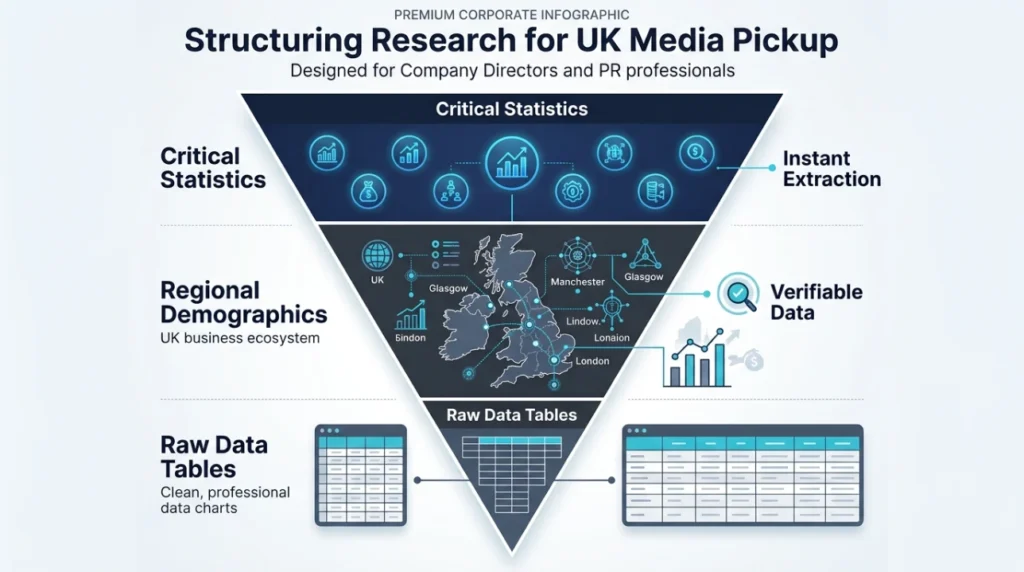
You structure a research report for maximum media pickup by placing key statistics at the top, organizing findings by regional demographics, and providing raw data tables. This inverted pyramid format allows journalists to extract critical figures instantly without reading dense pages.
The executive summary and data layout
The first page of a research report dictates its media adoption rate. Journalists scan the executive summary for bullet points containing percentages, year-over-year growth metrics, and definitive financial figures.
Text blocks must remain short, focusing entirely on hard figures. Avoid broad industry summaries; instead, present direct statistical statements such as “64% of respondents reported increased energy costs in 2025.”
Organizing data for regional multi-site coverage
To earn coverage across 15 different news sites, the report must contain localized datasets. National statistics rarely appeal to regional news editors.
Structuring data into city-by-city or region-by-region breakdowns enables localized media pitching. For example, presenting distinct data points for London, Greater Manchester, the West Midlands, and Yorkshire allows localized press releases to target specific regional editors simultaneously.
What outreach process secures citations across 15 news websites?
Securing citations across 15 news websites requires targeted media list curation, personalized email outreach, strategic timing, and immediate provision of embargoed materials. Reaching out directly to beat reporters ensures that the research lands with journalists covering those specific topics.
Phase 1: Target media identification
A media list must contain journalists who actively write about the subject matter of the report. Utilizing media database tools allows PR strategists to filter reporters by recent publication topics rather than generic job titles. A target list for a 15-site campaign typically contains 100 to 150 vetted contacts across national desks, regional hubs, and trade publications.
Phase 2: Pitch construction and embargo distribution
Pitches must remain under 200 words, opening with the most compelling statistic. The pitch body details the core findings, regional variations, and a link to the full dataset.
Sending pitches under a 48-hour embargo gives journalists adequate time to analyze the dataset, request additional comments, and write their articles prior to the public release date.
Phase 3: Syndication tracking and follow-ups
Media coverage often occurs in waves due to syndicate publishing networks. Once a flagship regional site publishes the story, syndication feeds distribute the article to sister publications within hours.
Strategic follow-up emails sent 24 hours after the initial pitch remind journalists of the embargo lift time, ensuring maximum synchronized coverage across target outlets.
Explore More Expert Insights:
How Online Retailers Recover Abandoned Carts Using Banner Advertising
How E-commerce Stores Boost Sales Using Retargeting Banner Ads
What key components convert news coverage into backlink citations?
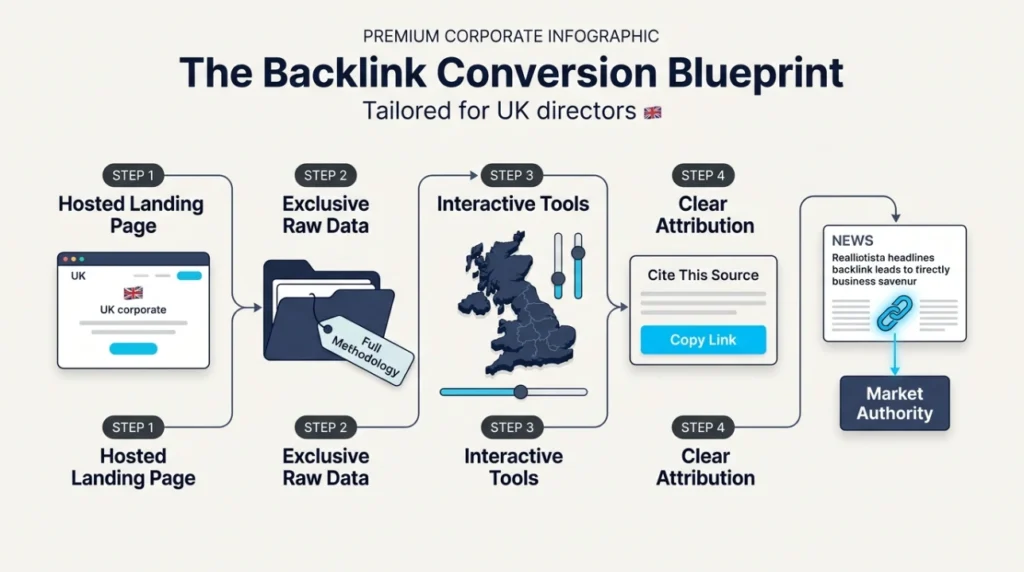
Converting news coverage into backlink citations requires hosted landing pages, exclusive raw data downloads, interactive tools, and clear attribution guidelines. Publishers insert outbound links primarily when their readers require access to the full source methodology or underlying dataset.
The role of the hosted asset landing page
A research report published solely as an unindexed PDF file rarely generates high-volume backlinks. News sites prefer linking to a dedicated HTML landing page on a root domain.
This page should feature the full summary, interactive charts, and an embedded PDF reader. Providing a dedicated URL ensures that journalists have a stable web address to cite as the primary source.
Essential on-page citation drivers
To encourage high-value editorial links, the landing page hosting the research report must provide unique value that cannot be fully replicated inside a news article.
- Raw Data Tables: Downloadable CSV or Excel files containing complete survey outputs.
- Embeddable Graphics: HTML iframe code snippets for interactive data visualizations.
- Quote Repository: Pre-approved commentary from lead researchers and industry analysts.
- Citation Key: A pre-formatted text box showing journalists exact citation formatting guidelines.
When readers want to explore deeper regional breakdowns, they rely on the inline links provided by the journalist. You can explore how report citations on UK news websites can be scaled to build domain authority, or evaluate options to get your report cited through managed distribution channels.
What are the primary SEO benefits of earning citations on 15 news sites?
The primary SEO benefits of earning citations on 15 news sites include increased domain authority, accelerated referral traffic, stronger topical relevance signals, and improved organic keyword rankings. Search engines utilize news site backlinks as primary signals of domain trust and editorial authority.
Domain authority and link equity distribution
News websites maintain high domain authority metrics due to their continuous editorial publishing schedules and massive backlink profiles. When 15 separate news sites publish editorial links targeting a single research landing page, significant link equity transfers to the target domain.
This concentration of high-authority backlinks elevates the overall trust score of the entire website, driving ranking improvements across non-related commercial pages.
Referral traffic and organic keyword expansion
Citations on high-traffic news outlets drive direct referral traffic from engaged readers. Readers clicking a source link arrive directly on the research landing page, lowering bounce rates when the landing page provides deep educational value.
Simultaneously, search engine crawlers index the semantic co-occurrences within the news articles. As search algorithms associate the target domain with specific industry keywords present in the news copy, the website earns higher organic visibility for relevant informational search queries.
What real-world research formats perform best across UK news outlets?
Consumer sentiment surveys, macro-economic impact analyses, industry salary benchmarks, and historical trend comparisons perform best across UK news outlets. These formats consistently deliver the quantitative data required by journalists to construct compelling, fact-based news stories.
Consumer sentiment and behavioral surveys
Consumer surveys analyze public opinion, spending habits, and lifestyle changes across specific demographics. For example, a survey evaluating British remote working trends post-2024 provides immediate editorial value to national business desks and regional workplace publications.
These studies succeed because they reflect real-time cultural shifts that resonate with broad readership bases.
Economic and industry benchmark reports
Economic analyses compile public data or proprietary transaction metrics to highlight financial trends. A report analyzing average commercial property rent increases across 15 UK cities provides regional news sites with localized headlines for their local business sections.
These reports earn sustained media citations because they offer objective benchmarks that external analysts and journalists continuously cite over multi-month periods.
How do news sites credit research sources across different media tiers?
News sites credit research sources through direct hyperlinking, anchor text brand mentions, inline source attributions, and visual graphic credits. The specific format depends on the internal editorial style guide of the media organization.
National versus regional citation practices
Tier-1 national news outlets often enforce strict editorial guidelines regarding outbound links. They may attribute the research via inline text, such as “according to data from independent researchers,” while linking directly to the homepage or the specific report landing page.
Regional news outlets under major publishing networks frequently include direct, keyword-rich hyperlinked attributions within the first two paragraphs of the story to direct readers to the full data source.
Trade publications and syndication networks
Trade publications cater to specialized industry audiences and regularly link to complete methodology pages. They utilize specific anchor text, citing the full report title alongside the publishing entity.
Syndication networks replicate the exact link structures across all regional outlets within their group, ensuring that a single editorial acceptance results in 15 uniform citations across distinct regional domains.